
New Gliding Dinosaur Fossil Reveals Bird-Hunting Predator
A newly identified 120-million-year-old fossil from China belongs to a gliding dinosaur species that hunted ancient birds. The discovery expands the known range and timeline of these feathered creatures.

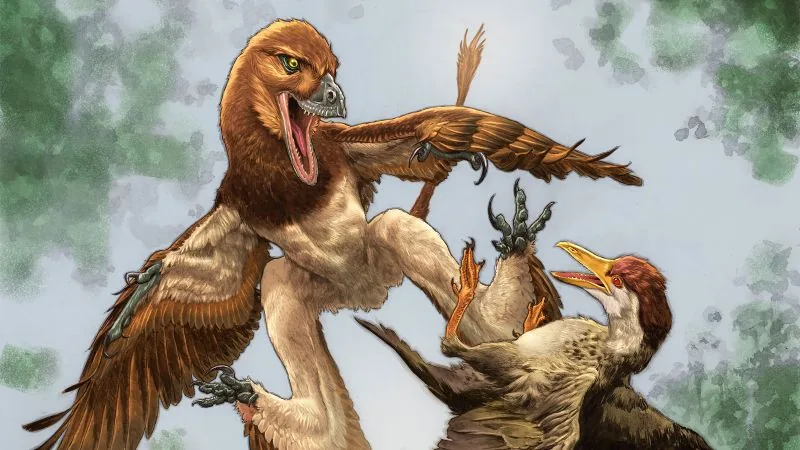
A remarkable 120-million-year-old fossil discovered in China's Changma Basin has provided scientists with new insights into a group of feathered, gliding dinosaurs known as microraptors. The find represents a previously unknown species, named Jian changmaensis, and has expanded both the geographical range and the temporal existence of these unique dinosaur relatives.
The well-preserved fossil includes intact shoulder and forelimb bones, crucial for understanding the creature's mobility. Researchers believe Jian changmaensis was a tree-dwelling predator that likely hunted ancient birds, a significant dietary revelation supported by previous fossil findings and the discovery site's abundance of bird fossils. This new species was roughly the size of a barn owl and possessed feathers on both its arms and hind legs, giving it a four-winged appearance and the ability to glide between trees.
Dr. Matt Lamanna, senior dinosaur researcher at the Carnegie Museum of Natural History and a coauthor of the study published in the Annals of Carnegie Museum, stated, "Jian changmaensis reveals that non-avian dinosaurs lived in what is now the Changma Basin, an area famous for its fossil birds." He added, "Our team has recovered more than one hundred bird fossils at Changma, but only this single non-avian dinosaur specimen. Jian provides critical new information on the biological history of the Changma region and the ecological context of the ancestors of today’s birds."
Diet and Gliding Capabilities
The discovery of Jian changmaensis sheds light on the predatory habits of microraptors. Previous evidence, including a microraptor fossil containing bird bones, suggested these dinosaurs consumed avian prey. The Changma Basin is also known for finding pellet-like bone fragments, similar to those regurgitated by modern owls, further supporting the idea that microraptors were bird predators. This new fossil confirms that microraptors were likely hunting species like Gansus yumenensis, one of China's earliest known bird fossils, found at the same site.
The unique anatomy of Jian changmaensis, particularly its exceptionally long shoulder bones and a distinct hole in the shoulder structure called the supracoracoid fenestra, points to sophisticated gliding capabilities. This feature, common in microraptors but rare in other creatures, is thought to be related to their ability to move efficiently through arboreal environments. "It could have something to do with gliding or something about animals that are on the line to birds changing their shoulder structure to become more suited to flight effectively," explained Dr. Lamanna.
Steve Brusatte, a professor of paleontology and evolution at the University of Edinburgh, who was not involved in the study, commented, "This is neat, a new fossil of those dinosaurs that were basically on the cusp of becoming true birds." He emphasized that while microraptors were not birds, they were closely related to the ancestors of early avian species.
The existence of Jian changmaensis in the Changma Basin, outside the northeastern China region where most microraptor fossils have been found, significantly expands the known distribution of these dinosaurs. T. Alexander Dececchi, an assistant professor at Dakota State University, noted, "It also expands the geographic range and helps show the diversity in anatomy of this group, all of which is important in determining where, when and who among them could use aerial locomotion." He added that the discovery likely indicates a different paleoenvironment and suggests microraptors were a more widespread component of ecosystems than previously understood.
Fossil preservation in the Changma Basin, known for its rich avian fossils, has historically favored flattened specimens, making the study of flight mechanics challenging. However, the three-dimensional preservation of Jian changmaensis's wing offers a rare opportunity for detailed analysis of its flight and gliding adaptations. This exceptional preservation is key to understanding the evolutionary transition between dinosaurs and birds, a period where the lines between the two groups become increasingly blurred with each new discovery.