
Hubble Telescope Aids Roman Space Telescope's Galactic Bulge Mission
NASA's Hubble Space Telescope has completed a large survey of the Milky Way's galactic bulge, providing crucial data to enhance the upcoming Nancy Grace Roman Space Telescope's observations. The Hubble data will help scientists interpret Roman's discoveries of exoplanets and other celestial objects.

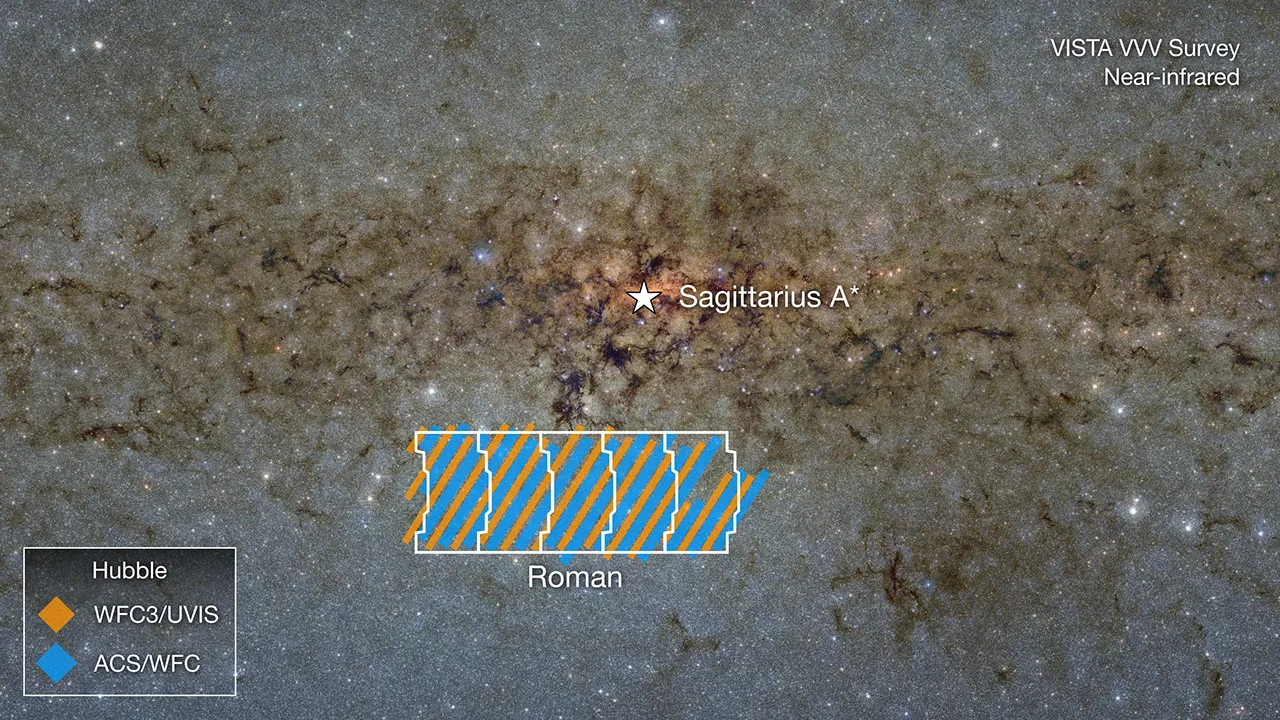
NASA's Hubble Space Telescope has concluded a vast survey of the Milky Way's dense galactic bulge, a region teeming with stars, planets, and celestial remnants. This comprehensive data set is designed to significantly boost the scientific capabilities of the forthcoming Nancy Grace Roman Space Telescope, enabling more precise characterization of exoplanets and other cosmic phenomena when it launches, potentially as early as September 2026. The Hubble survey focused on areas that Roman's core mission will scrutinize, building a vital bridge between past observations and future discoveries.
The galactic bulge, the star-packed central region encircling the Milky Way's core, has long been a subject of intense astronomical study. However, the Roman telescope's ambitious Galactic Bulge Time-Domain Survey aims to revolutionize this field. With a significantly wider field of view and faster observation cadence than its predecessors, Roman is poised to survey millions of stars and identify thousands of new exoplanets. To maximize Roman's potential, astronomers strategically employed Hubble to capture images of many of the same celestial territories. By cross-referencing Hubble's historical data with Roman's upcoming observations, scientists anticipate a clearer interpretation of the new findings, including the detection of rogue planets and isolated neutron stars.
Paving the Way for Discovery
The process of exoplanet formation often mirrors our own solar system's evolution, starting with gas cloud collapse and culminating in star and planet birth. Yet, planetary systems can experience disruptive events, leading to planets being ejected from their birthplaces. Roman's survey is expected to identify numerous such "rogue planets," as well as previously undetected neutron stars and solar-mass black holes. The survey involves six observing seasons, each lasting 72 days, during which Roman will capture images every 12 minutes across a substantial portion of the bulge, approximately 1.7 square degrees.
A primary scientific goal of Roman's mission is to leverage a technique known as microlensing. This method uses the gravitational pull of foreground objects to warp the light from more distant sources, a phenomenon typically observed on the scale of individual stars rather than entire galaxies. Microlensing events are particularly effective for detecting exoplanets located between Earth and the dense stellar population of the galactic bulge. "The great thing about microlensing is that we’ll be able to do a complete census of objects as small as Mars that are moving between us and these fields in the bulge, no matter what it is," said Jay Anderson, a co-author of a recent paper on the work from the Space Telescope Science Institute.
Timing is critical for microlensing studies. When a bright star in the foreground aligns with a star in the galactic bulge, differentiating between the two light sources can be challenging. Pre-observing these potential lensing pairs with Hubble allows astronomers to identify them before a microlensing event occurs. This foresight simplifies the disentanglement process when Roman begins its observations. "The main goal of these observations is to be able to identify objects that participate in lensing events during the Roman survey, catching them before they undergo the lensing event," explained Anderson. "When, in a couple of years, an event happens during Roman's long stare at the field, we can go back and say, ‘This was a red star, this was a blue star, and the event happened when the red star went in front of the blue star.’"
Furthermore, Hubble's data will refine the mass estimations of celestial bodies. Microlensing events initially only provide a ratio of a host star's mass to its planet's mass. However, by analyzing pre- and post-event observations from Hubble, scientists can determine the individual masses of the stars. This capability transforms an ambiguous mass ratio into a more definitive measurement. "Instead of estimating a mass ratio of a planet that's orbiting a star, we can say that we're confident it's a Saturn-mass planet orbiting a star that's 0.8 solar masses, for example," stated Sean Terry, project lead and assistant research scientist at the University of Maryland and NASA’s Goddard Space Flight Center. "So with the help of precursor imaging from Hubble you can hope to get direct measurements of the masses as opposed to indirect mass ratios."
Beyond exoplanet hunting, the extensive Hubble survey is also aiding in the creation of maps that delineate areas obscured by dust and gas, known as extinction zones. This information is vital for understanding the visibility of stars within the galactic bulge. The survey is also establishing a foundational catalog of stars, which will be significantly expanded by Roman. The Hubble survey itself is building a catalog of 20 to 30 million point sources, while Roman is projected to measure between 200 and 300 million, producing some of the deepest sky images ever captured. The data from this recent Hubble effort is now accessible via the Mikulski Archive for Space Telescopes, providing a valuable resource for astronomers worldwide.