
Solar Flare Sparks Aurora Hopes: Northern Lights Possible This Week
A powerful M5.7 solar flare erupted May 10, sending a coronal mass ejection (CME) toward Earth. While not expected to be extreme, it could trigger minor geomagnetic storms and visible auroras at high latitudes.

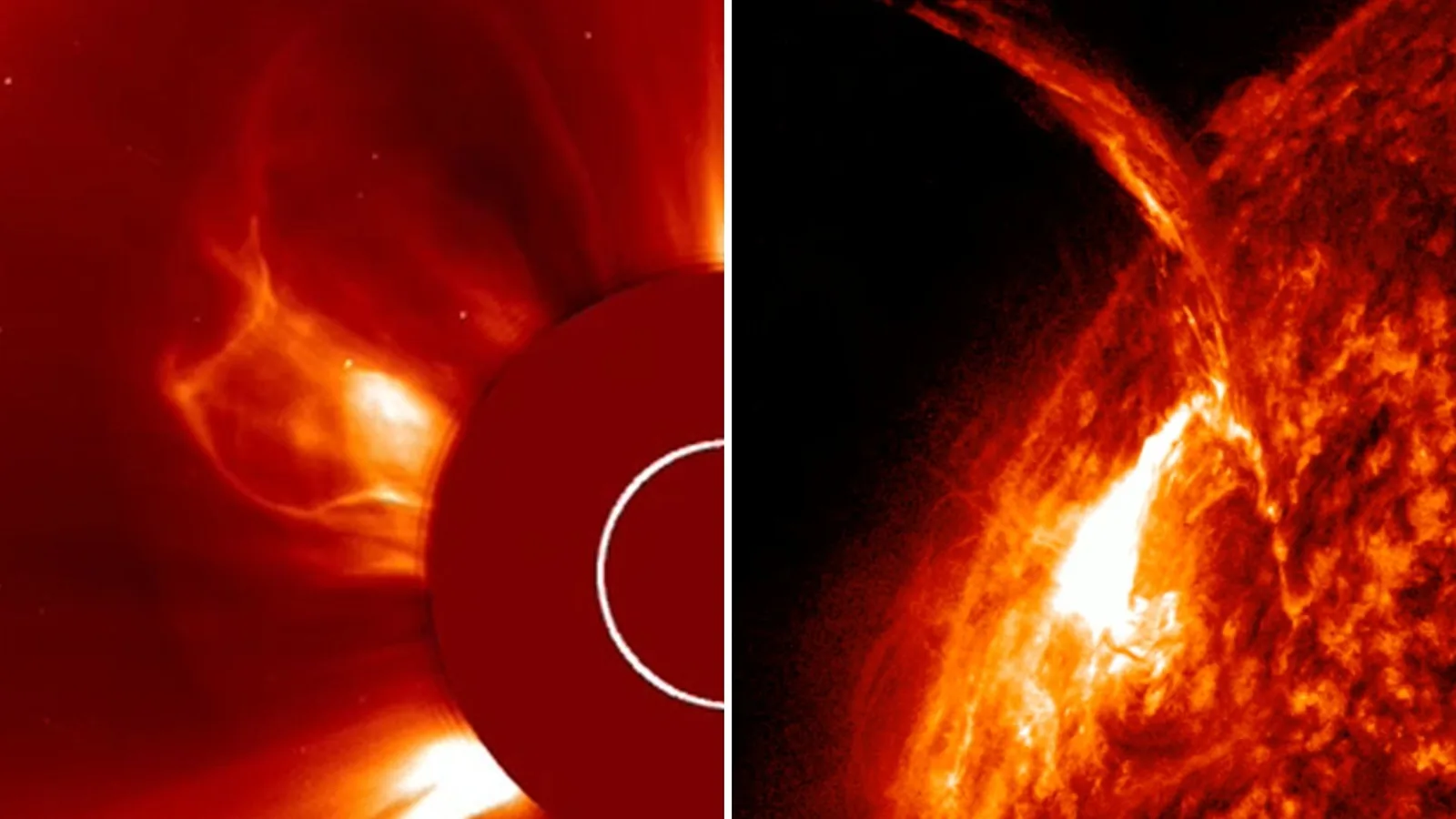
A significant solar flare and associated coronal mass ejection (CME) erupted from the sun on May 10, potentially bringing a chance of auroral displays to higher latitudes this week. The M5.7 class flare, which peaked at 9:39 a.m. EDT, originated from sunspot region AR4436. This active region is currently rotating into a position on the sun where eruptions are more likely to be Earth-directed.
While much of the ejected solar material appears to be veering away from our planet, forecasters at NOAA's Space Weather Prediction Center and the U.K. Met Office indicate that a portion of the CME might graze Earth. This interaction could occur around May 13, potentially leading to minor geomagnetic storm conditions (G1). Such conditions are known to enhance the visibility of the northern lights across parts of the northern U.S. and the U.K.
Solar flares are categorized on a scale from A to X, with X being the most powerful. An M5.7 flare is considered substantial and is capable of causing disruptions to radio communications. Indeed, the flare from May 10 triggered a radio blackout over the Atlantic Ocean, impacting high-frequency radio signals used by aviation and maritime operations, as well as by amateur radio enthusiasts. These blackouts happen when the intense X-ray and ultraviolet radiation from a flare ionize Earth's upper atmosphere.
Aurora Potential and Past Events
The timing of this eruption has particular significance for aurora enthusiasts, recalling a major geomagnetic storm that occurred almost exactly two years prior. On May 10, 2024, Earth experienced an extreme G5 geomagnetic storm, the most powerful recorded in over two decades. That historic event generated spectacular auroras visible much farther south than usual, with sightings reported as far south as Florida and Mexico. However, current forecasts suggest the CME from May 10, 2023, will not approach the intensity of the 2024 storm. Instead, experts anticipate only minor geomagnetic activity if the CME makes contact.
The sun is a dynamic star, constantly emitting charged particles and magnetic fields. These emissions, known as space weather, can have tangible effects on Earth's technology and atmosphere. Understanding solar flares and CMEs is crucial for predicting and mitigating their impact on satellites, power grids, and communication systems. The current active region, AR4436, is nearing Earth's viewing zone, meaning any further significant solar activity could have direct consequences. Scientists continue to monitor the sun's behavior closely, providing forecasts to help prepare for potential disruptions.
While the likelihood of widespread or intense auroral displays is low with this particular event, the possibility remains for enhanced visibility in northern regions. Skywatchers are advised to check local aurora forecasts for the most up-to-date information. Even a glancing blow from a CME can cause enough geomagnetic disturbance to create a more vibrant celestial show than normally observed. This event serves as a reminder of the sun's powerful influence on our planet and the ongoing need for space weather monitoring.