
X-Ray Discovery Unlocks Mystery of Early Universe 'Little Red Dots'
Astronomers have identified an X-ray emitting 'little red dot' (LRD) in the early universe, offering a potential key to understanding these mysterious cosmic objects first observed by the JWST.

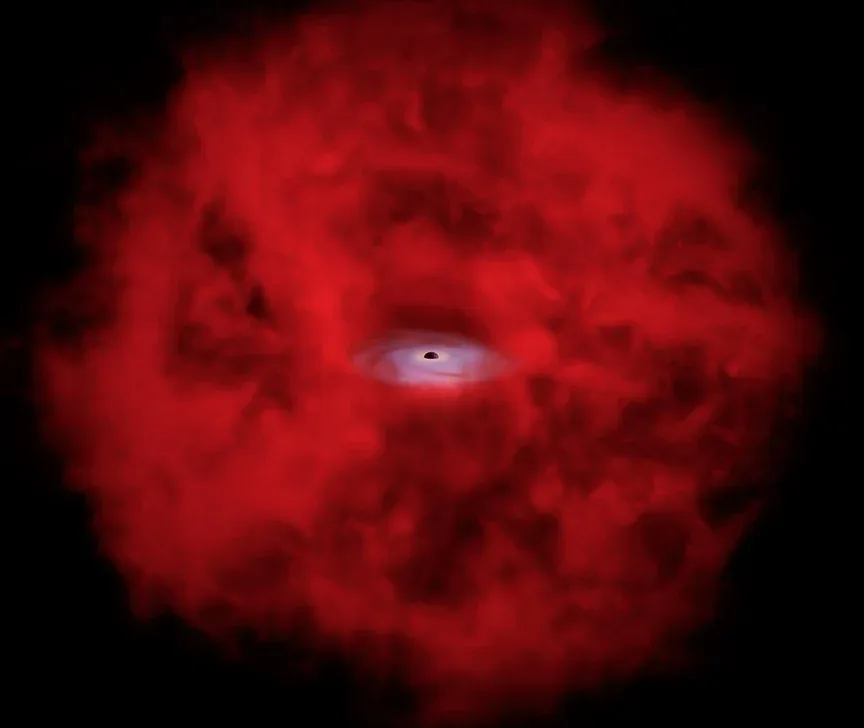
Astronomers have pinpointed a rare X-ray emitting 'little red dot' (LRD) in the early universe, a discovery that could finally solve the mystery surrounding these enigmatic cosmic objects observed by the James Webb Space Telescope (JWST). The object, cataloged as 3DHST-AEGIS-12014 and located about 11.8 billion light-years away, is the first of its kind to emit X-rays, a characteristic typically associated with actively growing black holes rather than the majority of LRDs.
These LRDs, hundreds of which have been detected in JWST's infrared images of the nascent cosmos, are compact blobs that formed roughly 600 million years after the Big Bang. Their unusual appearance, red in optical light and blue in ultraviolet, has fueled intense scientific debate. Theories have ranged from regions around hidden supermassive black holes to early galaxies or even a unique type of short-lived, metal-deficient star dubbed a 'black hole star'.
The detection of X-ray emissions from 3DHST-AEGIS-12014 by the Chandra X-ray Observatory provides a crucial new piece of evidence. "Astronomers have been trying to figure out what little red dots are for several years," said Raphael Hviding of the Max Planck Institute for Astronomy in Germany, lead author of the study. "This single X-ray object may be -- to use a phrase -- what lets us connect all of the dots." The presence of X-rays suggests that this object may be a transitional phase, bridging the gap between nascent black holes and the more developed supermassive black holes known to exist in the early universe.
Unraveling Transitional Phases
The prevailing hypothesis is that 3DHST-AEGIS-12014 represents a crucial evolutionary stage for these early cosmic structures. Unlike other LRDs that do not appear to emit X-rays, this object's X-ray signature strongly indicates the presence of a feeding black hole. Researchers theorize that patchy openings within surrounding gas clouds may be allowing X-rays to escape, explaining the observed variations in its emissions over time.
This finding could fundamentally alter our understanding of early galaxy and black hole formation. "If we confirm the X-ray dot as a little red dot in transition, not only would it be the first of its kind, but we may be seeing into the heart of a little red dot for the first time," stated co-author Hanpu Liu of Princeton University. "We would also have the strongest piece of evidence yet that the growth of supermassive black holes is at the center of some, if not all, of the little red dot population."
The existence of these LRDs in such early epochs of cosmic history poses significant questions. If they are indeed rapidly growing supermassive black holes, why do most not exhibit detectable X-ray emissions like other active black holes? "Finding a little red dot that looks different from the others gives us important new insight into what could power them," explained co-author Anna de Graaff of the Center for Astrophysics | Harvard & Smithsonian.
While the possibility remains that 3DHST-AEGIS-12014 could be a growing black hole shrouded in an unusual type of dust, the X-ray data points strongly towards a transitional phenomenon. Further observational campaigns are planned to gather time-variable data, which will be critical in confirming whether this X-ray dot is indeed a key link between the diverse population of LRDs and the supermassive black hole-powered active galactic nuclei that shaped the early universe.