
Mars Crescent Image Offers New Details From Psyche Spacecraft
NASA's Psyche spacecraft captured a unique crescent image of Mars from 3 million miles away, revealing atmospheric and polar details crucial for its ongoing mission.

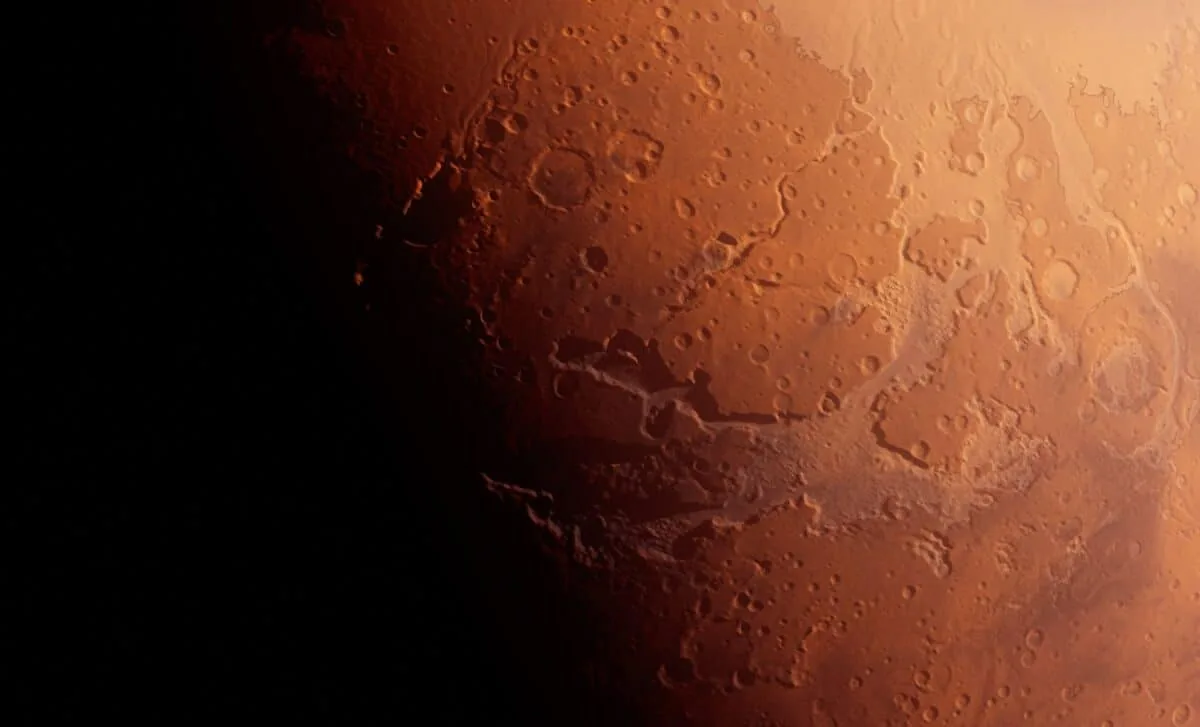
NASA's Psyche mission captured a striking crescent image of Mars on May 3, 2026, from an astonishing 3 million miles away. This celestial photograph was taken in preparation for a critical gravity assist maneuver scheduled for May 15, which will fine-tune the spacecraft's trajectory toward its ultimate destination: the metal-rich asteroid Psyche, due in 2029. The image, though distant, offers unprecedented views of Mars's atmosphere and polar regions, providing valuable data for the ongoing exploration.
The Psyche spacecraft, launched in 2023, is embarking on a complex journey that utilizes several gravitational assists to gain speed and navigate through space. The upcoming flyby of Mars represents a key phase in this multi-year expedition, providing the necessary boost for its long voyage. This particular image showcases Mars as a delicate crescent, an orientation similar to how Earth's Moon appears during its new phase. The photograph was acquired using the spacecraft's multispectral imager, equipped with a panchromatic filter and a very brief 2-millisecond exposure.
Despite the rapid exposure, the vibrant crescent of Mars is clearly discernible, with some areas appearing overexposed. This saturation is attributed to the way sunlight reflects off the Martian surface and scatters through its thin, dusty atmosphere. This atmospheric scattering causes the crescent to appear more elongated than it would on a celestial body lacking an atmosphere. The Martian atmosphere's dust content significantly influences this visual effect, scattering and reflecting sunlight in a manner that wraps the light around the planet, thereby extending the visible crescent. The precise appearance of this phenomenon is sensitive to the density of atmospheric dust.
Seasonal Changes and Atmospheric Mysteries
An intriguing element highlighted in the image is a discernible gap on the right edge of the crescent, marking the location of Mars's north polar cap. Currently experiencing winter, this region is likely undergoing seasonal atmospheric shifts that could impact conditions there. Scientists with NASA speculate that this gap may be caused by the formation of clouds or hazes over the polar region. These formations could potentially impede the sunlight scattering that occurs elsewhere in the planet's atmosphere, altering how light interacts with the Martian surface and offering clues to the planet's dynamic climate. The variation in dust distribution across the planet also contributes to these seasonal changes. The amount of dust in the Martian atmosphere is not static, fluctuating throughout the Martian year and influencing the planet's overall brightness, which is an important consideration for future missions.
The capture and analysis of this Mars image are integral components of the preparation for the Psyche mission. As the spacecraft nears its significant milestones, these imaging exercises serve as crucial calibration and performance characterization opportunities for its sophisticated camera systems. "The Psyche mission’s imager team will be acquiring, processing, and interpreting similar images in the lead-up to the close approach on May 15," NASA stated. "The images are primarily designed to calibrate the cameras and to characterize their performance in flight as a practice run for the approach to asteroid Psyche in 2029." These practice runs ensure the instruments are functioning optimally for the primary scientific objectives, particularly the detailed study of asteroid Psyche's composition and structure, which is believed to be a remnant planetary core.
This indirect route, leveraging planetary flybys, is a cost-effective and efficient method for deep-space exploration. The data gathered during these maneuvers, including the atmospheric observations of Mars, contribute to a broader understanding of planetary science and the challenges of interplanetary travel. The successful execution of these trajectory adjustments demonstrates the engineering prowess behind the Psyche mission and sets the stage for groundbreaking discoveries awaiting the spacecraft upon its arrival at the asteroid.