
Hubble Telescope Reveals Star-Spangled Sea of 500,000 Stars in Globular Cluster M3
NASA's Hubble Space Telescope has captured a breathtaking view of Messier 3, a globular cluster brimming with an estimated 500,000 stars. The image offers insights into the Milky Way's ancient history and unusual stellar phenomena.

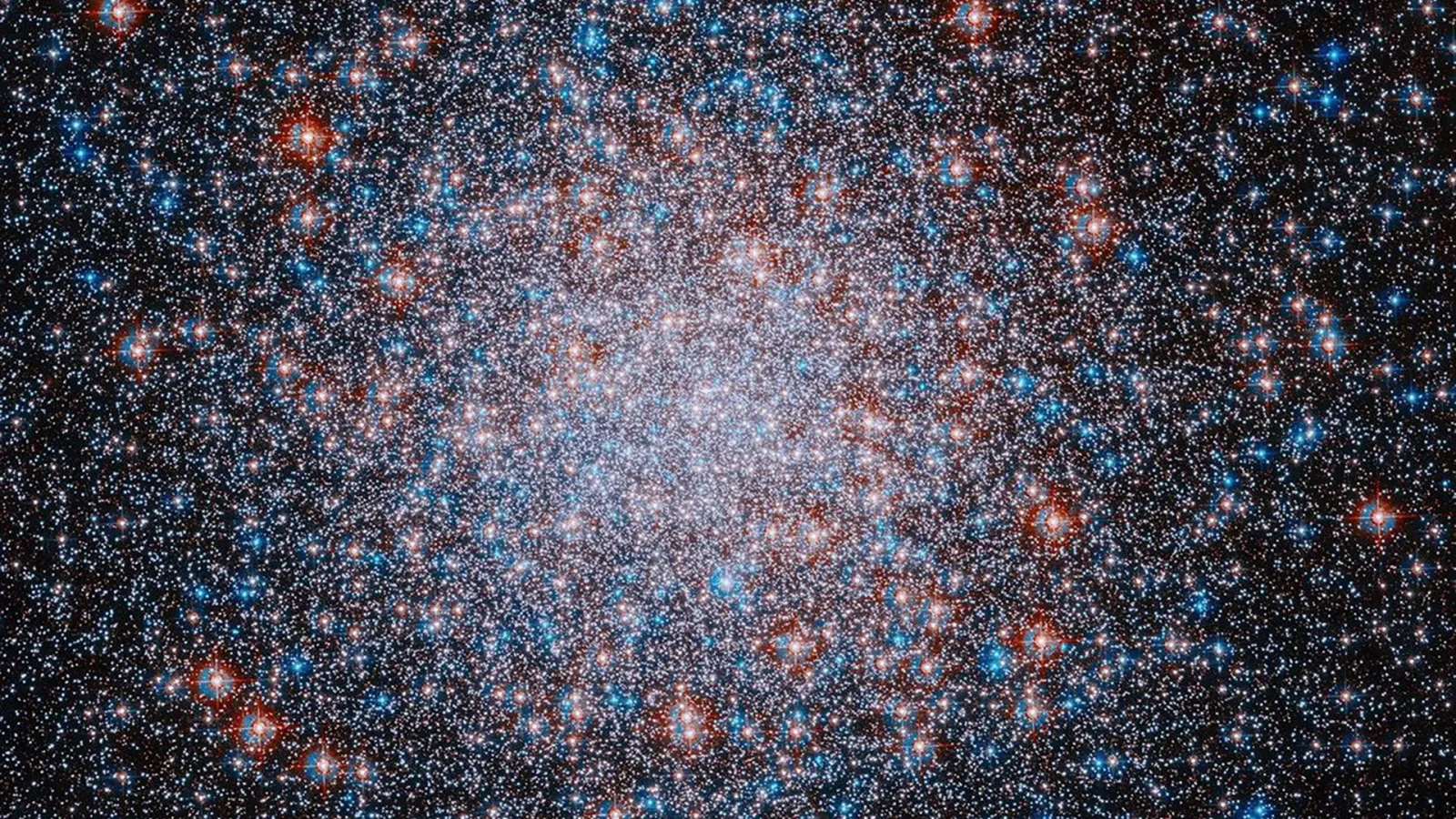
NASA's Hubble Space Telescope has delivered a stunning, high-resolution image of Messier 3 (M3), a dense globular cluster containing an estimated 500,000 stars. Located in the constellation Canes Venatici, M3 is a prominent example of these ancient stellar groupings, offering astronomers a valuable window into the early history of the Milky Way. The new imagery provides unprecedented detail of its structure and the diverse stellar populations within.
Globular clusters are vast, spherical collections of stars, all gravitationally bound and typically formed from the same primordial gas cloud billions of years ago. Unlike younger star clusters, the stars within M3 share a common origin, serving as time capsules that preserve crucial data about the Milky Way's formation and evolution. Around 150 such clusters are known to orbit our galaxy's periphery, but M3 stands out due to its unique characteristics and a remarkably high concentration of RR Lyrae variable stars.
Messier 3 is home to over 240 identified RR Lyrae variables, more than any other known globular cluster. These ancient stars are vital for cosmological distance measurements. They brighten and dim with a predictable periodicity, allowing astronomers to ascertain their intrinsic luminosity. By comparing this with their observed brightness from Earth, scientists can accurately calculate their distances, akin to using the known wattage of a distant light bulb to gauge its range.
Unusual Stellar Populations and Galactic History
Beyond the abundance of RR Lyrae stars, M3 also hosts approximately 70 candidates for an enigmatic stellar type known as blue stragglers. These stars appear significantly younger and bluer than their older, redder neighbors, despite sharing the same ancient origins. The first blue stragglers were actually discovered in M3. The prevailing theory suggests these stars may have gained mass through gravitational interactions with nearby companions, effectively rejuvenating themselves and appearing hotter and brighter.
The cluster's peculiar stellar makeup has led astronomers to suspect a dramatic past event. Evidence indicates two distinct stellar populations within M3, hinting at a possible merger of two original globular clusters. These progenitor clusters are thought to have originated from a dwarf galaxy that was eventually absorbed by the Milky Way, leaving M3 as a potential relic of this ancient galactic collision.
Hubble has observed M3 multiple times since its initial discovery, with the latest observations enhancing scientists' ability to study its complex structure and unusual stellar components. The vibrant colors in the new image are not merely aesthetic; they represent different wavelengths of light captured by Hubble's filters. Blue hues indicate hotter, shorter wavelengths, while red signifies cooler stars and longer, near-infrared wavelengths. This color-temperature relationship is a fundamental tool for understanding stellar characteristics.
This detailed imaging of M3 is part of a broader Hubble Treasury program designed to survey roughly half of the Milky Way's known globular clusters. By analyzing and comparing these ancient stellar systems, researchers aim to construct a precise timeline of galactic formation and development over billions of years. After more than three decades of groundbreaking scientific contributions, the Hubble Space Telescope continues its mission as a premier space observatory. It works in conjunction with newer facilities like the James Webb Space Telescope and the forthcoming Nancy Grace Roman Space Telescope to deepen our understanding of the universe's past and present.