
NYC July Skygazing: Planets, Milky Way & Final Manhattanhenge
July offers New Yorkers a celestial spectacle with visible planets, the Milky Way, and the year's final Manhattanhenge. Don't miss early evening views of Venus and Jupiter.

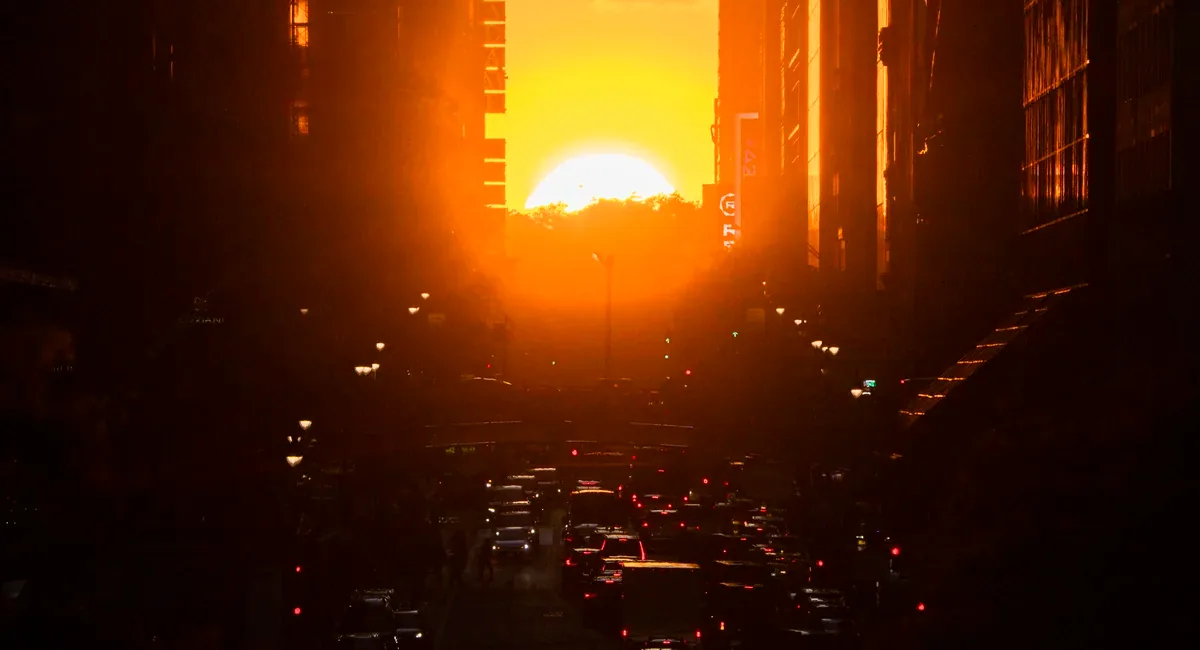
New York City residents have a prime opportunity for celestial observation this July, with warm evenings offering clear views of planets, the Milky Way, and the urban phenomenon known as Manhattanhenge. Several public viewing events and accessible locations across the city provide chances to explore the night sky.
"July is an exciting mix of very prominent naked eye planet alignments, deep sky hunting and good targets for telescope users," said Bart Fried, a member of the American Astronomical Society. Early in the month, observers can spot Venus and Jupiter prominently in the western sky after sunset. Venus, the brighter of the two, is the most luminous object visible after the moon. Jupiter follows closely, appearing lower and to the right of Venus on the horizon. For those who miss these early July sights, Fried advises that Jupiter will set around the same time as the sun by mid-month, diminishing its evening visibility.
Overhead, the bright red giant star Arcturus, located approximately 40 light-years away, is another notable sight. The eastern sky will feature the Summer Triangle, a prominent asterism composed of three bright stars: Vega in Lyra, Deneb in Cygnus, and Altair in Aquila. These stars serve as markers for spotting nearby constellations.
"On the Fourth of July, we're out, it's dark, we're waiting for the fireworks, take a moment to look at what's up in the sky," said Ruth Angus, an astrophysicist at the American Museum of Natural History. "But once the fireworks have gone off, the sky might be obscured by smoke."
Urban Milky Way and Celestial Events
While ideal viewing of the Milky Way often requires escaping city lights, recent reports suggest its luminous band is visible even within New York City. According to Fried, stargazers can find the hazy lanes of the galaxy from the southern tip of Floyd Bennett Field, looking south over the ocean beyond the Rockaways. Deneb, a star within the Summer Triangle, can serve as a guidepost, as it intersects the Milky Way. The darkest skies for viewing the galactic core and its dust lanes occur around the new moon, which falls on July 14 this year.
Adding to the month's attractions, the year's final Manhattanhenge event is scheduled for July 11. At approximately 8:20 p.m., the setting sun will align with the city's east-west grid, appearing to set precisely between buildings. Prime viewing locations include New York City's crosstown streets with unobstructed western views, such as 14th and 42nd streets, Tudor City, and Hunter’s Point South Park in Long Island City. The American Museum of Natural History will also host a block party on West 79th Street, offering clear sightlines to the sunset. The following evening, July 12, the sun's midpoint will align with city streets, creating a half-sunset effect framed by skyscrapers.
The end of July presents a trio of meteor showers: the Alpha Capricornids and Southern Delta Aquariids both reach their peak. However, their visibility will be challenged by the full moon on July 29, which will significantly brighten the night sky. For a better chance to witness shooting stars, the third week of the month, preceding the peak dates, is recommended. The Perseids, highly regarded by astronomers, will also begin their activity around this time, though their peak is expected in August. "If you're looking to get out and do some great shooting star gazing, then it’s probably better to wait for mid-August and then you get the Perseids and the new moon at the same time," Angus noted.