
Jupiter's Mighty Magnetosphere Deflects Solar Winds
Jupiter's immense magnetic field creates a complex shield, deflecting charged particles from the sun. This magnetosphere is a crucial factor in shaping the Jovian environment.

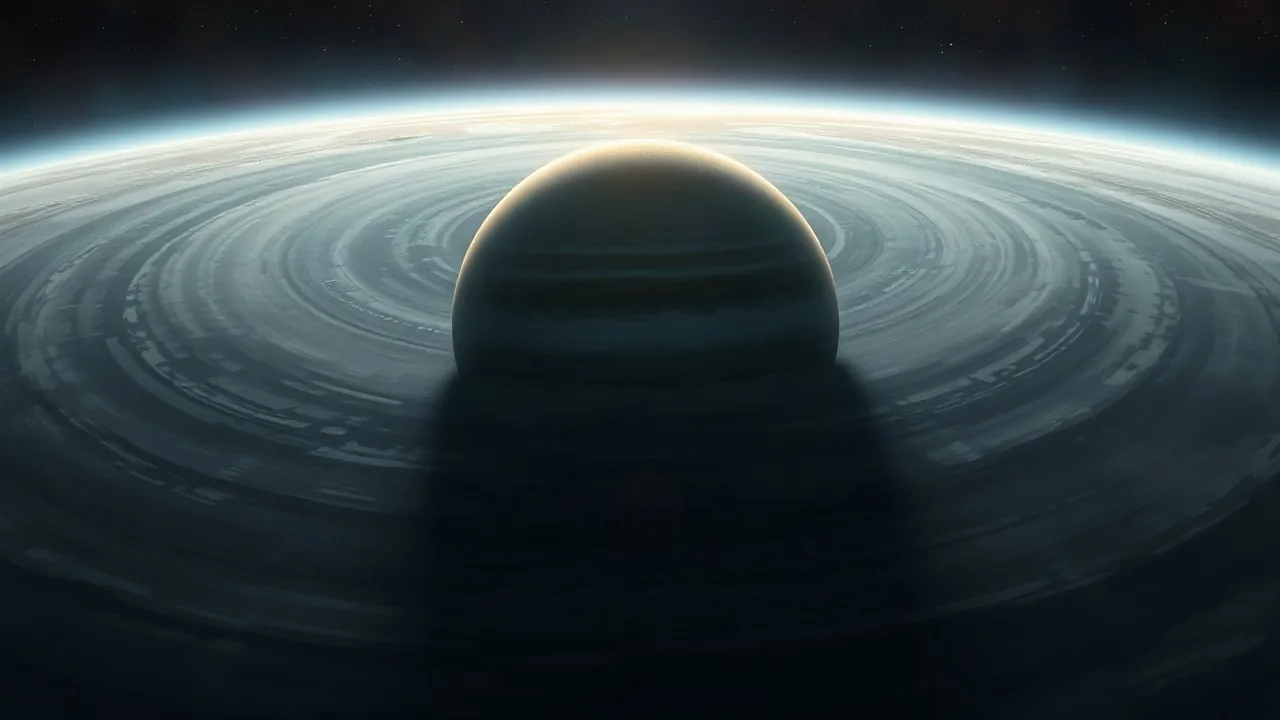
Jupiter, the largest planet in our solar system, possesses a remarkably intricate system for defending itself against the relentless onslaught of charged particles emanating from the sun. This powerful defense mechanism is orchestrated by its colossal magnetosphere, an invisible shield generated by the planet's rapidly spinning, electrically conductive interior. The magnetosphere, extending millions of miles into space, acts as a crucial barrier, protecting the planet and its numerous moons from the harsh solar wind.
Scientists have long studied Jupiter's magnetosphere, recognizing its unique scale and complexity. Unlike Earth's magnetosphere, which is significantly influenced by the sun's magnetic field, Jupiter's is dominated by internal processes. Its magnetic field is about 20,000 times stronger than Earth's, creating a vast cavity in the solar wind and trapping energetic particles. These particles, accelerated to high energies, can create intense radiation belts around the giant planet, posing a significant challenge for any spacecraft venturing nearby.
Complex Interactions and Energetic Particles
The interaction between Jupiter's magnetosphere and the solar wind is a dynamic and complex process. While the magnetosphere largely deflects the solar wind, some particles inevitably penetrate the shield. These captured particles are then accelerated to extremely high energies, forming intense radiation belts. These belts, a byproduct of the magnetosphere's function, are particularly dangerous for electronic equipment and pose radiation hazards for potential future missions.
Dr. Alex Hayes, a planetary scientist at the University of Colorado Boulder, explained the significance of these findings. "Jupiter's magnetosphere is a unique laboratory for understanding plasma physics on a grand scale," Dr. Hayes said. "The processes at play here can inform our understanding of similar phenomena in other astrophysical environments, and even help us better protect our own planet."
The Jovian magnetosphere is not a static entity; it constantly changes in response to variations in the solar wind and the planet's own internal processes. For instance, volcanic activity on Jupiter's moon Io injects vast amounts of sulfur and oxygen into the magnetosphere, fueling its energetic particle population. This constant influx of material, combined with the planet's rapid rotation, creates powerful electrical currents that extend throughout the magnetosphere.
Understanding Jupiter's magnetosphere is vital for several reasons. Firstly, it helps scientists comprehend the diverse range of planetary environments that can arise in different stellar systems. Secondly, it provides insights into the fundamental physics governing magnetic fields and plasmas, which are ubiquitous in the universe. Finally, for future human exploration, understanding these intense radiation environments is paramount for designing protective measures and ensuring the safety of astronauts and equipment.
Recent observations from missions like NASA's Juno spacecraft have provided unprecedented detail about the structure and dynamics of Jupiter's magnetosphere. These observations are helping researchers refine their models and gain a deeper appreciation for the intricate mechanisms Jupiter employs to manage the constant bombardment from the sun.