
Jupiter's Moon Ganymede's Mysterious Heat Source Offers New Origin Clues
New research suggests Jupiter's largest moon, Ganymede, may be heating up from within through a unique process. This "warming-driven dynamo" could reveal secrets about its formation and magnetic field.

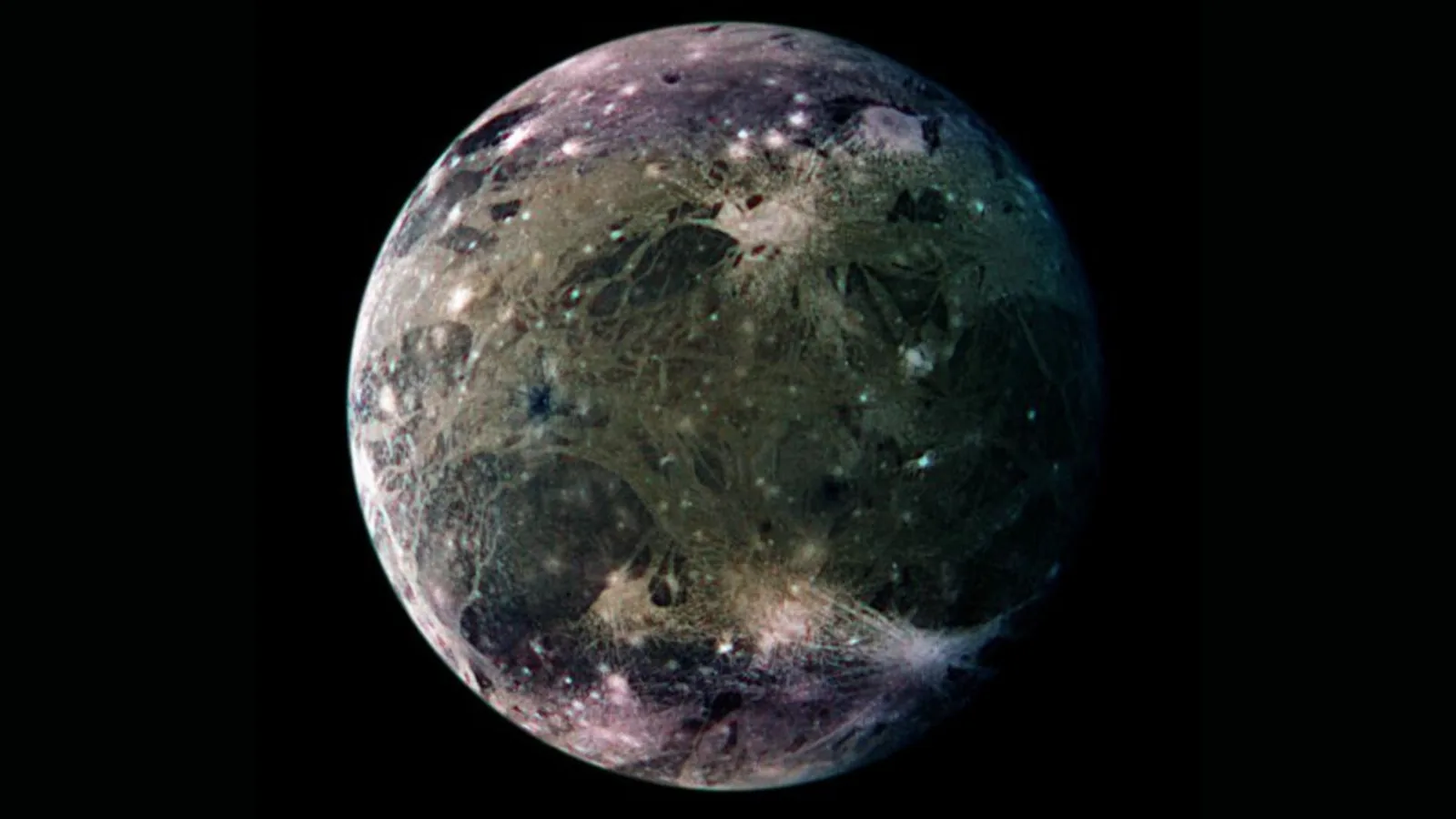
Jupiter's massive moon, Ganymede, the largest satellite in the solar system, is potentially experiencing an internal heating process never before observed, according to new research. This phenomenon could provide crucial insights into the origins of its unique magnetic field, a characteristic only known to exist in this Jovian moon. Ganymede, one of Jupiter's four Galilean satellites, boasts a diameter of nearly 3,300 miles, making it larger than Mercury and significantly wider than Earth's Moon. NASA's Galileo spacecraft first detected its intrinsic magnetic field in 1996, a field generated by a process known as a dynamo, driven by the movement of electrically conductive liquid iron within its core.
However, the exact mechanism behind this dynamo's creation has long been a subject of scientific debate. Traditional formation theories propose that large celestial bodies like Ganymede would need to form with a substantial amount of heat to initiate a metallic core and subsequent dynamo. "Many formation studies suggest that Ganymede formed too cold to start with a metal core," explained Kevin Trinh, a planetary scientist at Caltech and co-author of the study. "Meanwhile, many modeling studies of Ganymede's dynamo assume that Ganymede formed its metal core roughly when the moon itself formed, as Earth did. Both of these things cannot be simultaneously true."
A Novel Formation Hypothesis
Addressing this discrepancy, a study published on May 6 in the journal Science Advances proposes a novel, "topsy-turvy" mechanism. This theory suggests that Ganymede's mysterious metallic core and its dynamo may have formed later rather than earlier in its history. The proposed process involves sinking blobs of molten iron contributing to the moon's core, potentially an ongoing activity. This "warming-driven dynamo" contrasts with conventional ideas, which posit that dynamos form early in planetary bodies and then gradually cool over time. For instance, metallic core formation in planets like Earth is believed to have occurred within 200 million years of the solar system's inception. Moons, due to their smaller size, may struggle to retain enough primordial heat to power such a process.
The researchers' new model offers a potential solution for bodies formed from a "cold start." It integrates Ganymede's known characteristics, such as its composition and estimated core temperature, by assuming its core contains iron and iron sulfide. This combination lowers the melting point of the core material, facilitating dynamo generation. The model suggests that heat generated by radioactive decay of heavier isotopes and tidal heating from Jupiter's immense gravitational pull – which causes Ganymede to be squeezed and stretched as it orbits – could warm the sinking molten metal blobs. This internal friction and radioactive decay provide the energy to power the dynamo responsible for Ganymede's magnetic field. The hypothesis does not rule out an early core formation but offers an alternative pathway.
This revised understanding of lunar magnetic field generation has significant implications, particularly for the search for extraterrestrial life. Magnetic fields are essential for protecting planetary surfaces from harmful solar and cosmic radiation, a crucial factor in habitability. If "cold start" core formation and subsequent dynamos are viable processes elsewhere in the universe, it could expand the range of potentially habitable exoplanets. "There could be young rocky exoplanets or exoplanets with lower radioactive isotope abundances (i.e., slower heating) that would be favorable for a recent warming-driven dynamo," Trinh stated. "The challenge is that no one has detected an exoplanet dynamo so far." The ongoing study of Ganymede offers a unique opportunity to understand these processes on a body within our own solar system, potentially guiding future exoplanet research and the quest to find life beyond Earth. The specific composition and internal dynamics of Jupiter's moon continue to be a focus for planetary scientists seeking to unravel the complexities of planetary formation and magnetic field generation across the cosmos. Understanding Ganymede's magnetic field could unlock broader principles applicable to planetary science.