
JWST Detects Unknown Substance Signature on Pluto and Titan
The James Webb Space Telescope has identified a mysterious absorption line in the light spectra of Pluto and Titan, suggesting the presence of an unknown molecule on both celestial bodies. The finding adds to the intrigue surrounding these distant worlds.

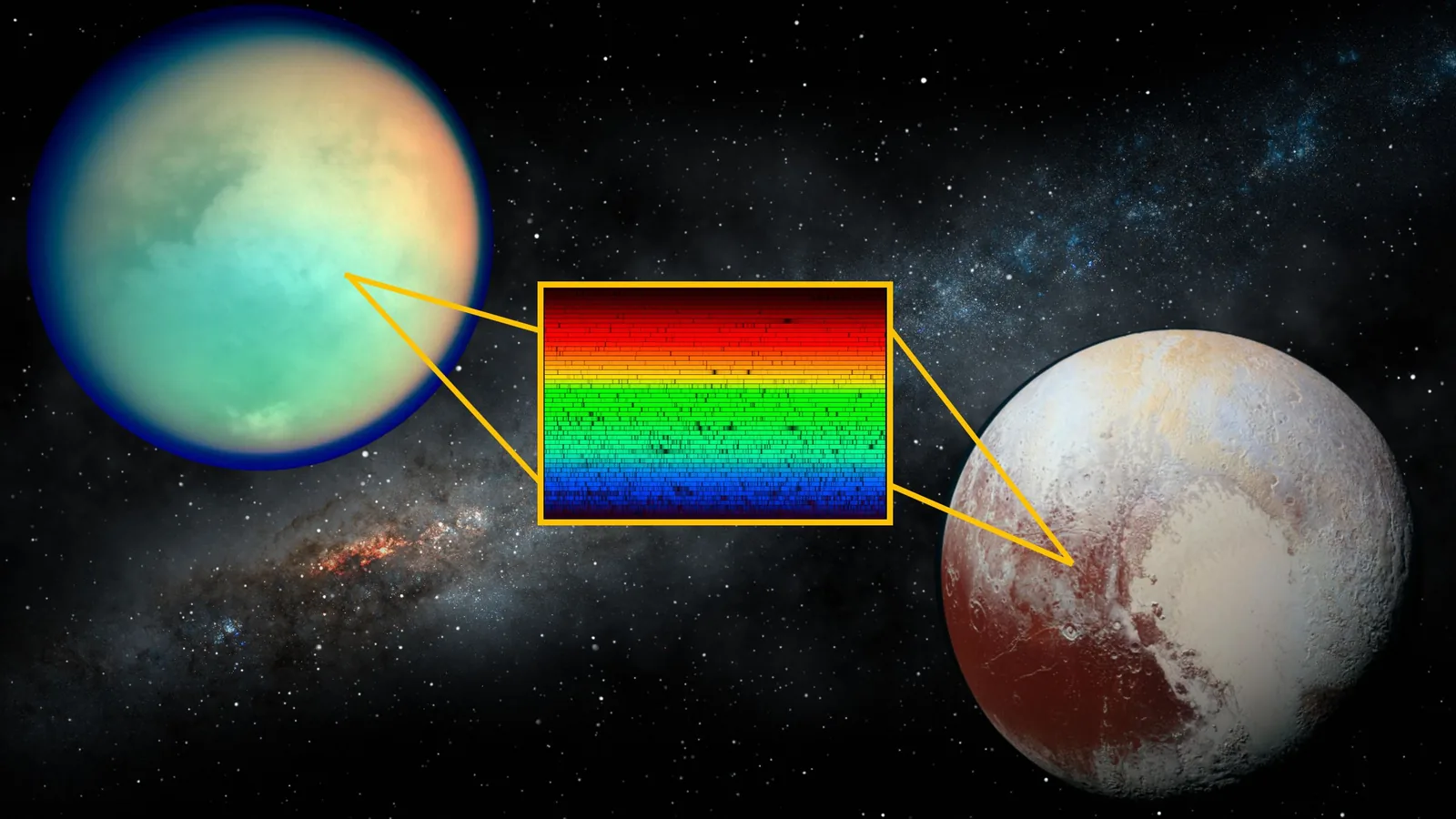
Astronomers using the powerful James Webb Space Telescope (JWST) have detected an unusual absorption signature in the light reflected from the dwarf planet Pluto and Saturn's moon Titan, hinting at the presence of a previously unknown molecule. This discovery, observed at a specific wavelength of 5.11 micrometers, marks a significant, yet puzzling, moment in our exploration of the solar system.
Every chemical compound interacts with light in a unique way, absorbing specific wavelengths that create distinct patterns in a spectrum. Scientists analyze these patterns, known as absorption lines, to identify the composition of celestial objects. The JWST, renowned for its advanced spectroscopic capabilities, has enabled unprecedented detail in these observations. While analyzing data from Pluto and Titan, researchers noted a prominent absorption band at 5.11 micrometers that could not be matched to any known molecule in existing scientific literature or other planetary spectra.
The finding is particularly perplexing because Pluto and Titan share few similarities. Titan, a large moon with a dense atmosphere, boasts liquid methane rivers and lakes, making it one of the most Earth-like bodies in the solar system despite its frigid temperatures. Pluto, conversely, is a much smaller, icy dwarf planet located in the Kuiper Belt, vastly more distant from the sun. Both celestial bodies, however, share atmospheres rich in methane and nitrogen. Crucially, the researchers believe the newly identified molecule is present on the surface of both worlds, rather than in their atmospheres.
A Molecular Enigma Across Vast Distances
The implications of this shared, unidentified substance are profound. While Pluto's absorption signature is roughly three times stronger than Titan's, suggesting a greater abundance on the dwarf planet, the molecule appears unevenly distributed on Titan's surface. Its presence on both worlds, despite their significant differences in size, temperature, and distance from the sun, challenges current understanding of chemical processes in the outer solar system.
Researchers have proposed potential candidates, including a mixture of benzene with an unknown compound, or specific types of acetylene or ketene ice. However, confirming any of these hypotheses will require extensive further investigation. The absorption line's specific location and intensity provide crucial clues, but definitively identifying the molecule remains a complex task.
This cosmic mystery may be partially unraveled by NASA's upcoming Dragonfly mission. Scheduled to launch no earlier than 2028, the rotorcraft lander will explore Titan's surface and atmosphere, equipped with instruments capable of detailed chemical analysis. If the Dragonfly mission can identify the molecule on Titan, it could provide vital insights into its potential presence and behavior on Pluto and other distant bodies.
The ongoing study, which was recently uploaded to the preprint server arXiv, is awaiting peer review. This discovery underscores the JWST's transformative impact on astronomy and highlights how much remains unknown about even our own solar system. The search for this elusive molecule promises to be a fascinating chapter in planetary science, pushing the boundaries of what we know about the chemical diversity of worlds beyond Earth.