
Saturn Shines Brightest Over Kansas City This Weekend
Kansas City stargazers have a prime opportunity to witness Saturn at its most brilliant this weekend, thanks to its annual opposition. The ringed planet will be at its closest approach to Earth and fully illuminated by the Sun.

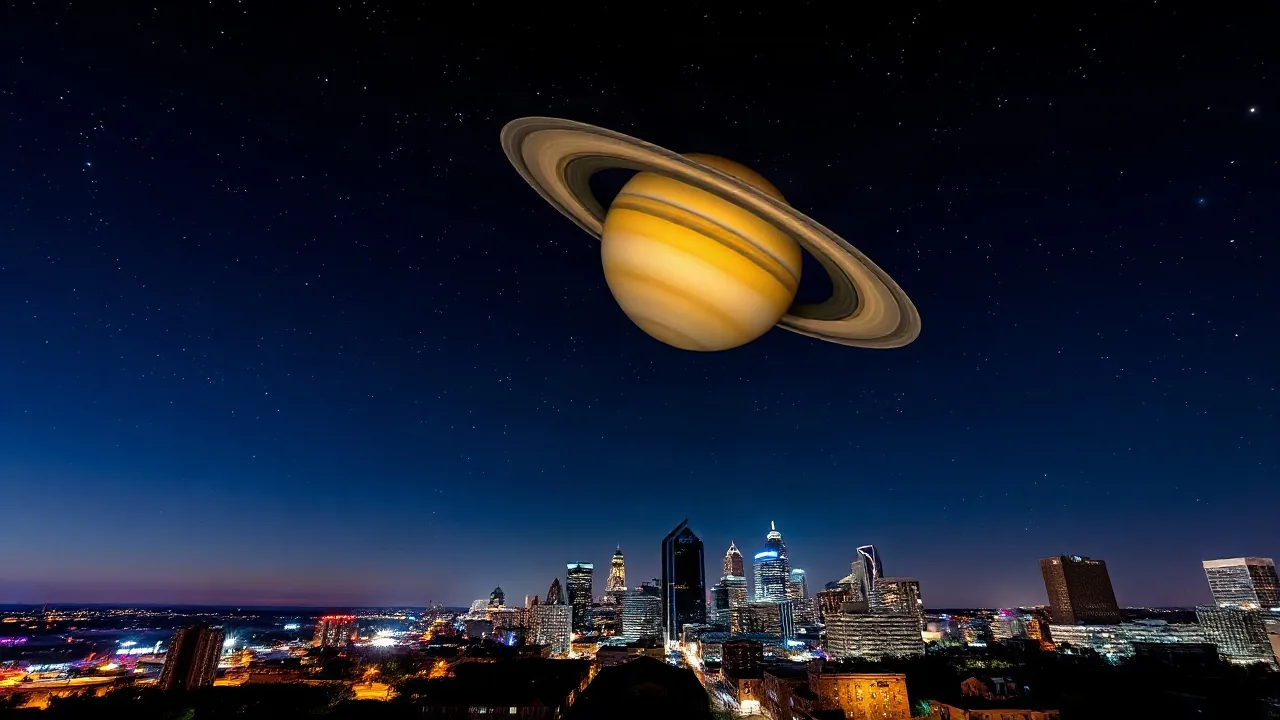
Residents of Kansas City have a celestial treat awaiting them this weekend, as the planet Saturn will be at its brightest and most visible. The ringed planet is set to reach opposition on October 3, 2026, a yearly astronomical event where it appears at its largest and brightest in the night sky as seen from Earth.
This phenomenon occurs when Earth passes directly between the Sun and Saturn, positioning the planet opposite the Sun in our sky. For observers in Kansas City and across the Northern Hemisphere, this means Saturn will rise around sunset and remain visible throughout the night, offering an exceptional viewing window. While binoculars can enhance the view, a small telescope is typically needed to clearly discern Saturn's iconic rings.
An Opportunity for Clearer Views
Astronomers explain that during opposition, Saturn is at its closest point to Earth in its orbit, making its disk appear larger and its reflected sunlight more intense. This year's opposition is particularly favorable, with clear skies anticipated in many regions. Sky & Telescope magazine noted that the period around opposition provides the best opportunities for amateur astronomers to observe planetary details.
The apparent brightness of Saturn is a result of its proximity and the full illumination it receives from the Sun. While the planet is always a significant celestial body, its appearance during opposition is markedly different from its typical visibility. This event is part of a broader spectacle in the October sky, which also includes the Hunter's Moon and potential meteor showers, offering multiple reasons for the public to engage with astronomy.
Historically, Saturn has captivated human imagination for millennia, recognized as a distant world long before its rings were discovered. Galileo Galilei first observed its unusual shape in 1610, though his early telescope lacked the power to resolve them as rings. It wasn't until Christiaan Huygens in 1655, using a more advanced telescope, that Saturn's majestic rings were correctly identified. The current ability to view these rings with even modest equipment highlights the progress in optical technology and our continued fascination with the cosmos.
To best observe Saturn this weekend, experts recommend finding a location away from city lights, which can obscure fainter celestial objects. Patience is also key, allowing your eyes to adjust to the darkness. While the planet will be easily visible to the naked eye as a bright, yellowish star, the true reward comes with magnification, revealing the subtle grandeur of its rings and possibly its larger moons, such as Titan.