
Large Hadron Collider Seeks Quantum Black Holes, Theory of Everything
Scientists at the Large Hadron Collider continue their search for elusive quantum black holes and a unified theory of everything. New data refines the possibilities for these exotic phenomena.

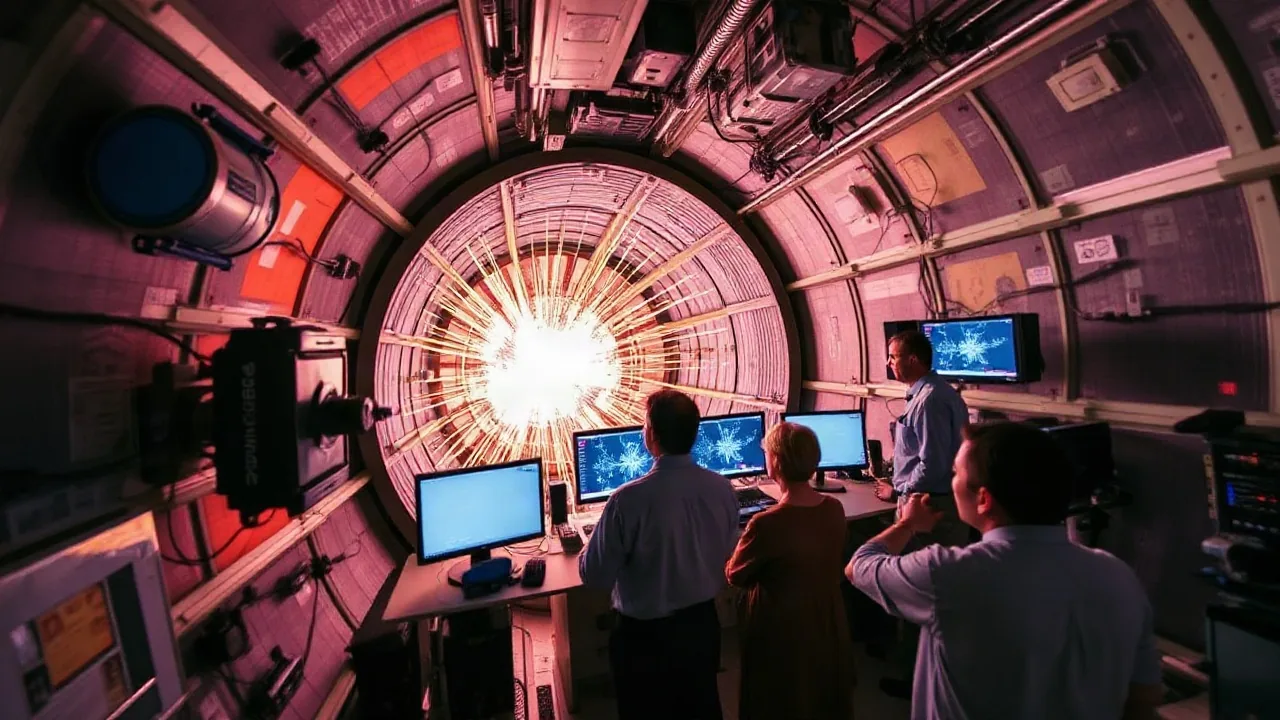
The Large Hadron Collider (LHC), the world's most powerful particle accelerator, is continuing its ambitious quest to detect exotic phenomena such as quantum black holes and to shed light on a potential theory of everything. Physicists operating the collider at CERN, near Geneva, Switzerland, are analyzing vast datasets for signs of these fleeting, subatomic structures that could challenge our understanding of fundamental physics.
Quantum black holes, unlike their astronomical counterparts, are predicted to be incredibly small and short-lived, evaporating almost instantaneously through Hawking radiation. Their detection at the LHC would provide direct evidence for theories that attempt to reconcile general relativity and quantum mechanics, a major goal known as a theory of everything. The ongoing experiments aim to either discover these predicted particles or, by ruling out certain parameters, to further refine the search for them.
Refining the Search Parameters
Recent analyses have helped to constrain the specific properties that such quantum black holes might possess. By meticulously examining collision data produced by the LHC's powerful beams of protons, researchers are placing limits on the energy scales and interaction strengths where these objects might manifest. While no definitive evidence has yet emerged, each round of data collection and analysis narrows the theoretical landscape, guiding future experimental strategies. The ongoing upgrades to the LHC and its detectors are designed to increase the collision energy and luminosity, thereby enhancing the chances of observing rare events.
Dr. Emily Carter, a theoretical physicist not directly involved with the current data analysis but an expert in quantum gravity, commented on the significance of the ongoing work. "The hunt for quantum black holes at the LHC is not just about finding a new particle; it's about testing the very fabric of spacetime at its most fundamental level," she stated. "If detected, they would be a direct window into quantum gravity, a field that has eluded experimental verification for decades. Even null results, properly interpreted, push the boundaries of our knowledge and constrain theoretical models."
The quest for a theory of everything is one of the grand challenges in modern physics. Such a theory would unify all the fundamental forces of nature—gravity, electromagnetism, and the strong and weak nuclear forces—under a single, coherent framework. Particle accelerators like the LHC are crucial tools in this endeavor, as they can recreate the extreme conditions of energy and density that existed in the very early universe, conditions under which these fundamental forces may have been unified.
The data being analyzed comes from high-energy proton-proton collisions, which simulate the conditions shortly after the Big Bang. When protons collide at near the speed of light, their constituent quarks and gluons can interact, potentially forming new particles, including the hypothetical quantum black holes. Sophisticated detectors surrounding the collision points capture the debris from these events, allowing scientists to reconstruct the particle trajectories, energies, and types.
While the primary focus remains on quantum black holes, the LHC experiments also probe other areas of fundamental physics, such as supersymmetry and extra spatial dimensions. The precise measurements of particle properties and interactions contribute to a broader understanding of the Standard Model of particle physics and search for deviations that could indicate new physics. The scientific community eagerly awaits further results from the LHC, as each new discovery or constraint brings us closer to unraveling the universe's deepest mysteries.