
Mars Rover Photo Mystery: Jellyfish or Camera Glitch?
A peculiar image from the Mars Curiosity Rover has sparked debate, with some seeing a "jellyfish" and experts suggesting a camera artifact or cosmic ray strike.

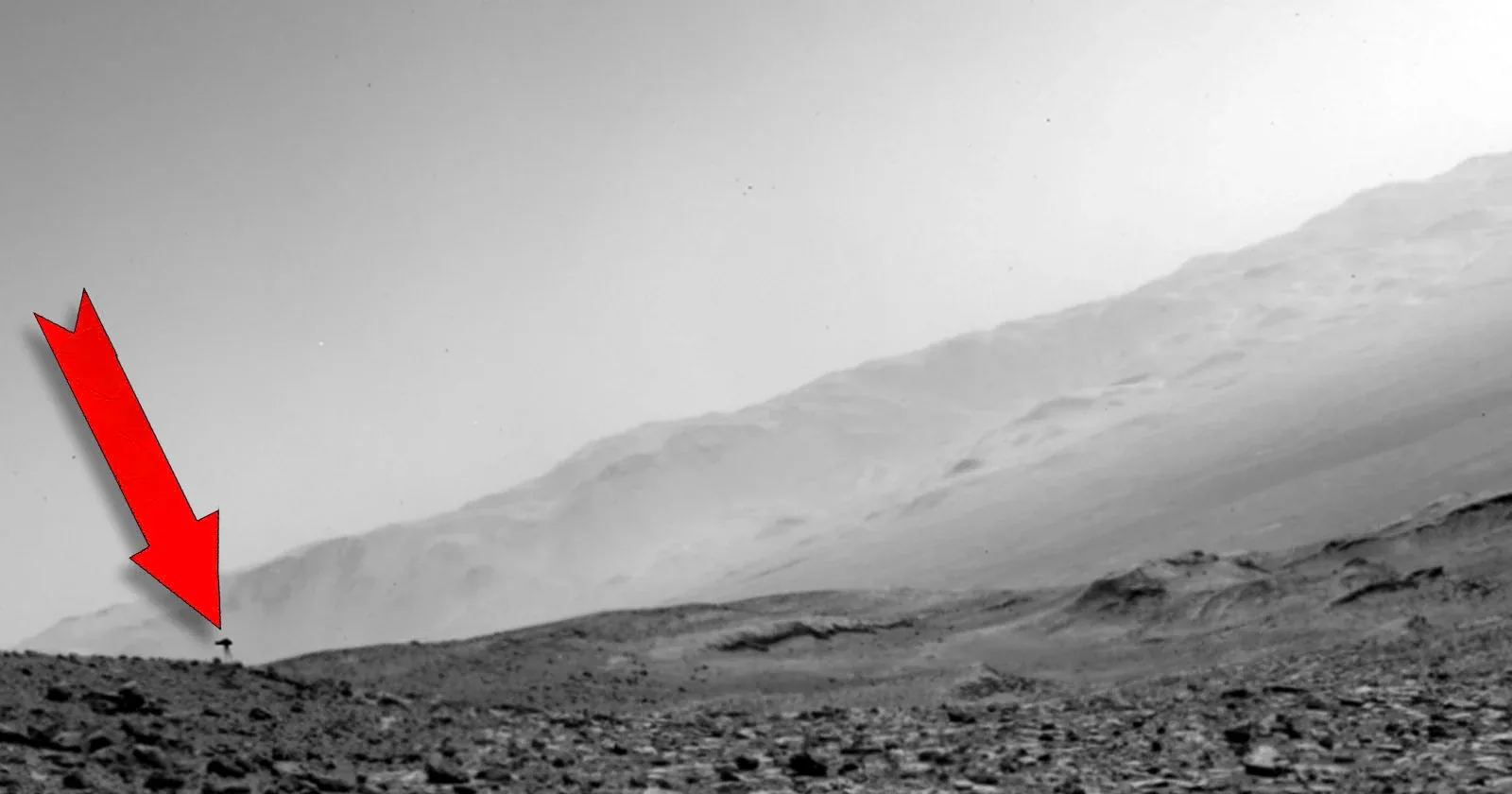
An unusual anomaly captured by NASA's Mars Curiosity Rover on August 20, 2023, has resurfaced online, prompting speculation about what it might be. The image, taken by the rover's Right Navigation Camera, shows a distinct shape hovering on the Martian horizon that, to the human eye, resembles a domed head with tentacles, reminiscent of science fiction invaders.
The appearance of this object has led to sensational headlines suggesting the discovery of alien life on the Red Planet. However, a closer examination of the rover's photographic record reveals a more technical explanation. NASA's own website confirms the object is present in the photograph, but a crucial detail emerged from the rover's data: a nearly identical photograph taken just 13 seconds prior does not feature the anomaly.
This temporal discrepancy has fueled theories, including one suggesting a large invertebrate rapidly moving across the Martian surface. While the allure of alien life is potent, astrophysicists and imaging experts lean towards a more grounded explanation. Dr. Joseph Farah, an astrophysicist, posits that the image is likely an artifact caused by a cosmic ray striking the camera's sensor at the precise moment the photo was taken. He points to a distinctive, perfectly straight row of black pixels within the anomaly when zoomed in as evidence. "What I think happened is a cosmic ray struck the camera at the exact right moment and left this big old artifact in the image," Dr. Farah explained. "It explains why the shape is so weird; just a perfect row of pixels with no anti-aliasing effect. And why it wasn't present just 13 seconds earlier."
Interpreting Martian Images
The debate highlights the challenges of interpreting images from other worlds, where environmental conditions and technical processes can create illusions. Another hypothesis, noted by EarthSky, suggests the anomaly could stem from an electronic or transmission glitch occurring at various stages. "A pixel value can change at multiple points between the camera sensor and the final image file on Earth," the publication reported. "Within the readout electronics, inside the flight computer’s storage, during onboard compression, throughout the downlink transmission or during ground processing." This means that the 'jellyfish' could be a digital ghost, a product of data corruption rather than a biological entity.
For photographers on Earth, the incident serves as a curious reminder of how unexpected elements can appear in images. While the possibility of discovering extraterrestrial life on Mars remains a driving force behind planetary exploration, most scientific explanations for peculiar sights tend to be rooted in physics and technology. NASA's ongoing missions continue to send back data and imagery, constantly refining our understanding of the Martian landscape and its potential secrets. Earlier in 2026, the Curiosity rover also captured images of rocks resembling dragon scales and vast fields of geometric polygons, further showcasing the strange geological formations on the planet.