
Milky Way Absorbed Dwarf Galaxy 11.8 Billion Years Ago
New research suggests the Milky Way galaxy merged with a smaller galaxy approximately 11.8 billion years ago. This event, observed using data from the Hubble and Gaia telescopes, marks the earliest known galactic merger for our galaxy.

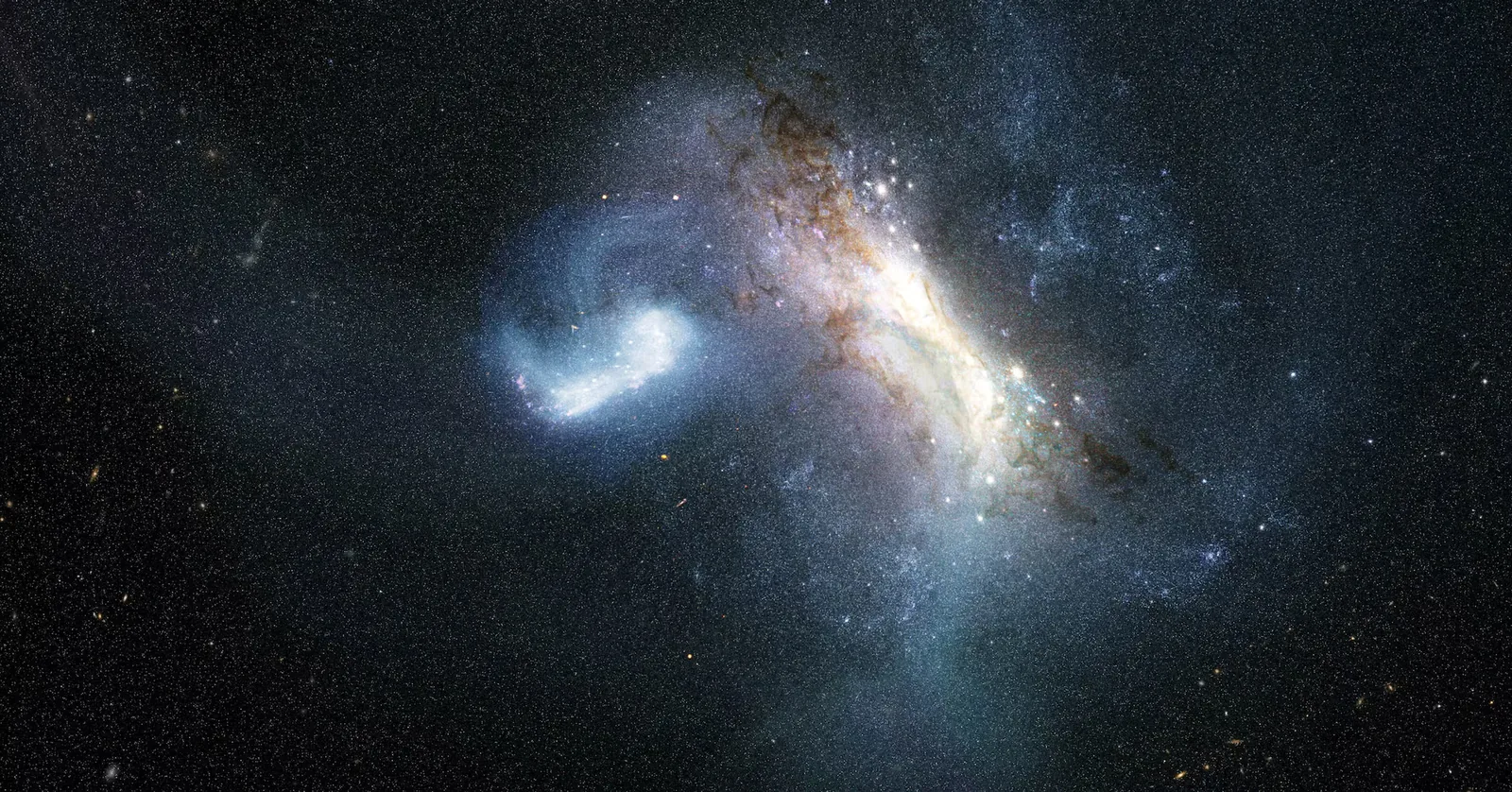
Our home galaxy, the Milky Way, grew to its current massive size by consuming smaller galaxies, with new research identifying a significant merger event that occurred around 11.8 billion years ago. This discovery, detailed in a study using data from the Hubble and Gaia space telescopes, provides evidence that our galaxy absorbed a dwarf galaxy when the universe was just a fraction of its current age.
Scientists analyzing star clusters in the Milky Way's central regions have found that many of these stars originated from a smaller galaxy, now designated LKH (Low-energy-Kraken-Heracles). This dwarf galaxy, estimated to have had a stellar mass equivalent to 500 million suns at the time of the merger, was roughly a quarter the size of the Milky Way itself. The merger occurred approximately 2 billion years after the Big Bang, the event that initiated the universe.
For decades, astronomers have debated whether the Milky Way's growth was primarily driven by internal star formation or by external galactic mergers. This latest study strongly suggests that galactic mergers played a crucial role in its early development, infusing it with not only stars but also interstellar gas necessary for further star formation, and even dark matter.
Galactic Evolution and Early Star Formation
The research team utilized data from the orbiting Hubble and Gaia telescopes to examine stellar clusters, each containing hundreds of thousands of stars, located within the Milky Way's innermost 20,000 light-years. By measuring the age, chemical composition, and trajectories of these stars, they were able to trace their origins. A light-year, the distance light travels in one year, is equivalent to approximately 5.9 trillion miles (9.5 trillion kilometers).
"I would say that from the point of view of stars, the merger was rather peaceful, with no star-to-star crashes," said Dr. Luca Massari, a lead researcher on the study. "But from the point of view of the gas, the merger was more 'explosive' — likely, the collision between the gas from LKH and that from the Milky Way triggered the formation of many stars."
It is believed that many stars born in the dwarf galaxy LKH are still present within the Milky Way's inner regions, potentially hidden within stellar clusters. However, the dense interstellar dust in this area makes identifying individual stars a significant challenge.
The Milky Way is known to have a history of absorbing other galaxies. Besides the LKH merger, it assimilated the Gaia-Sausage-Enceladus dwarf galaxy about 1.8 billion years after the LKH event. More recently, over the past roughly 6 billion years, it has been merging with the Sagittarius dwarf galaxy.
"Every single one of these mergers had an influence on the events that have led to the formation of our own solar system, and ultimately of Earth," Massari added. "This is why I think that reconstructing the pieces of the Milky Way's past effectively contributes to answering the big question about, 'Where do we come from?'" Understanding these ancient galactic interactions is key to understanding our own cosmic origins.