
Moon and Venus Align for Closest 2026 Conjunction
Skygazers can witness a rare celestial event as the Moon and Venus achieve their closest alignment of 2026. The spectacle will be visible in the pre-dawn sky.

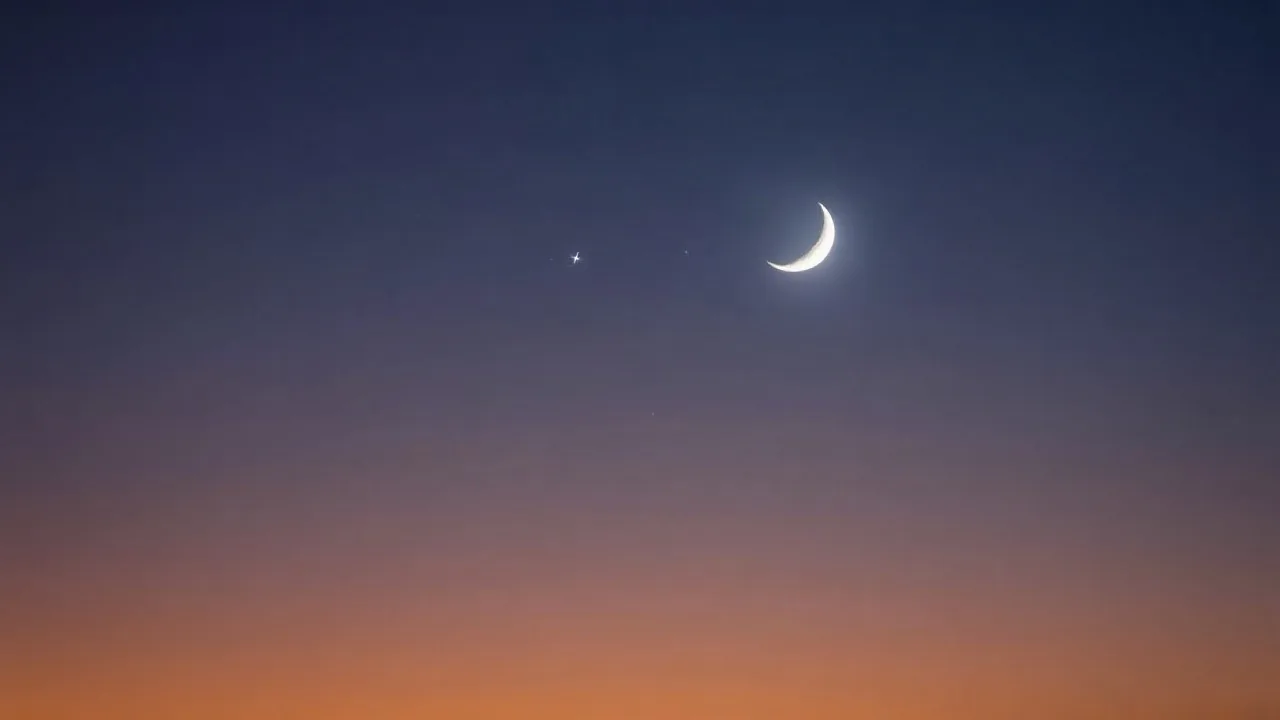
In a captivating astronomical display, the Moon and Venus are set to achieve their closest conjunction of 2026, offering a spectacular view for early risers. This celestial meetup, occurring in the pre-dawn hours, will see the two brightest objects in the night sky appear exceptionally near each other. Skywatchers across the Northern Hemisphere can anticipate this event in the coming days, marking a highlight for amateur astronomers and casual observers alike.
The precise timing of the closest approach is expected between November 4th and November 7th, 2026. During this period, the crescent Moon will be in close proximity to the planet Venus, creating a striking visual. Adding to the celestial tableau, the bright star Spica, the 15th brightest star in the night sky and the brightest star in the constellation Virgo, will also be visible nearby. This trio promises a memorable observation opportunity.
Dawn's Brightest Trio
The conjunction is particularly noteworthy because it involves not just the Moon and Venus but also Spica. Venus, often referred to as the "morning star" or "evening star" due to its brilliance, will be easily identifiable. The Moon, in its waxing crescent phase, will add its own luminous presence to the scene. Spica, a blue-white supergiant star, will complete this visually stunning arrangement. For the best views, observers should look towards the eastern horizon shortly before sunrise.
Astronomers advise that while the conjunction occurs over several days, the peak closeness will be within a specific two-day window. Early morning hours, from approximately 5:30 AM local time onwards, will offer the optimal viewing conditions. The exact visibility may depend on local weather patterns and the observer's specific location, but the general eastern horizon will be the focal point. This event serves as a beautiful reminder of the dynamic nature of our solar system and the predictable, yet awe-inspiring, movements of celestial bodies.
This alignment is more than just a pretty sight; it's a predictable dance governed by orbital mechanics. The Moon orbits Earth approximately every 27.3 days, while Venus orbits the Sun roughly every 225 Earth days. Their apparent closeness from our perspective on Earth is a result of their respective orbital paths intersecting in a way that makes them appear side-by-side in the sky. These celestial alignments happen regularly, but the degree of closeness and the presence of other bright objects like Spica make specific events like this one stand out for astronomy enthusiasts.
The coming days present a prime opportunity for people to engage with the cosmos. Events like the moon and Venus conjunction encourage an appreciation for the vastness of space and the science that helps us understand it. Sharing these viewing experiences can foster a sense of wonder and community, connecting individuals to the natural world beyond Earth. It also provides a chance to test out new cameras or telescopes, or simply to step outside and observe the universe.