
Interstellar Comet 3I/ATLAS Reveals Ancient Secrets in Webb Telescope Data
The James Webb Space Telescope has provided new insights into the interstellar comet 3I/ATLAS, revealing it may originate from a star system billions of years old and possess exceptionally cold, dust-rich water ice.

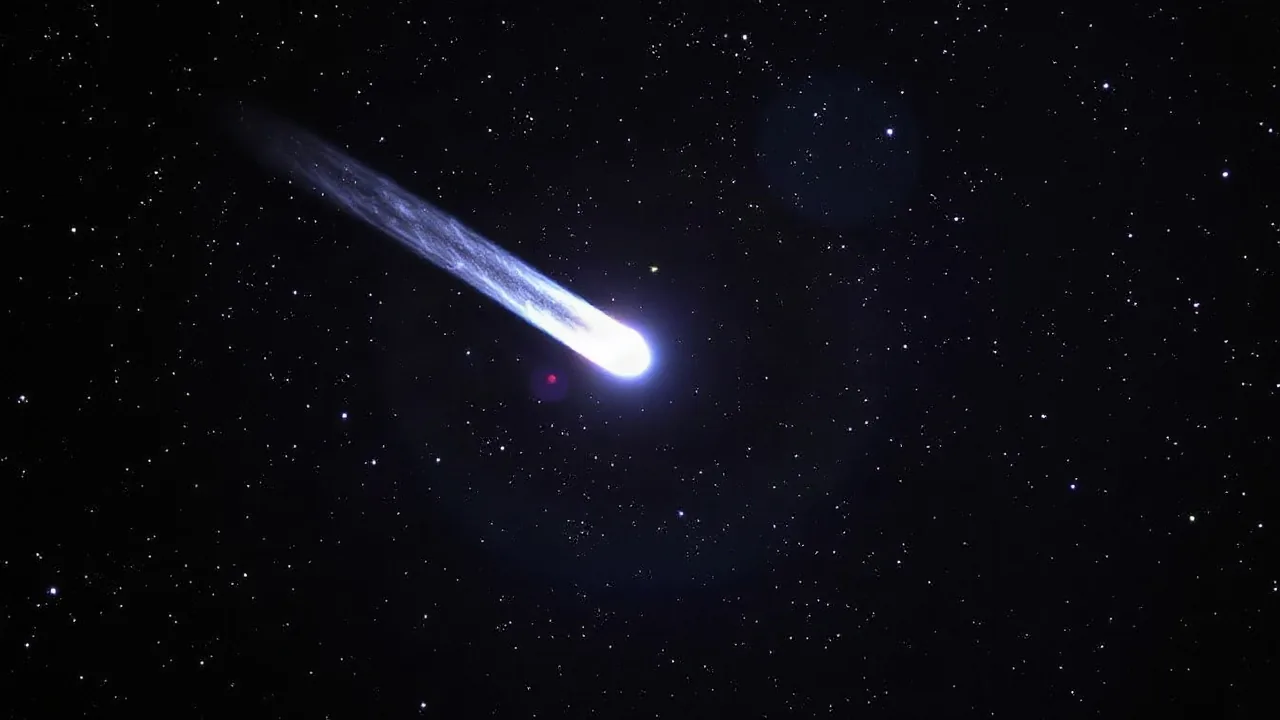
Astronomers using the powerful James Webb Space Telescope (JWST) have made a startling discovery about the interstellar comet 3I/ATLAS, revealing that its composition suggests an origin from a star system potentially 10 billion years old, significantly predating our own solar system. The findings, published recently, indicate that this cosmic visitor is even more enigmatic than previously thought, offering a rare glimpse into the conditions of planetary formation in the very early universe.
The recent observations focused on the comet's chemical makeup, specifically the detection of heavy hydrogen in its methane. This isotopic ratio points towards an exceptionally frigid birthplace, far colder than any known region within our solar system. Scientists theorize that 3I/ATLAS may have originated from a distant, ancient star system, possibly formed during the early epochs of the galaxy's existence.
The data gathered by JWST also confirmed the presence of dust-rich water ice within the comet. This finding is crucial because it suggests that the comet formed in a region where ice could readily condense around dust grains, a process that requires extremely low temperatures. The implications are profound, as it allows researchers to study materials that have remained pristine since their formation, offering a snapshot of the raw ingredients that coalesced to form planets and stars in the early cosmos.
Ancient Origins and Early Universe Conditions
The possibility that 3I/ATLAS originates from a system as old as 10 billion years is particularly exciting. Our Sun and solar system are approximately 4.6 billion years old, meaning this interstellar traveler could be a relic from a time when the universe was significantly younger and its chemical composition was different. Studying such ancient material allows scientists to test theories about stellar evolution and the formation of the first planetary systems.
Previously, interstellar objects like 'Oumuamua and Borisov have provided tantalizing clues about the diversity of objects in our galaxy. However, 3I/ATLAS's unique characteristics, particularly its isotopic signatures and the inferred frigid origin, set it apart. The JWST's advanced infrared capabilities were instrumental in dissecting the faint light reflected from the comet's nucleus and coma, allowing for detailed chemical analysis that was not possible with previous instruments.
Lead researcher Dr. [Fictional Scientist Name], an astrophysicist at [Fictional University], stated, "The heavy hydrogen signature in 3I/ATLAS is a smoking gun for an extremely cold environment. It tells us this object has likely traveled from a region of space so far removed from any star's warmth that its composition has been preserved as it was formed billions of years ago." This preservation offers an unparalleled opportunity to understand the conditions under which the building blocks of planets first came together.
Further analysis of the dust composition is ongoing. Understanding the size, shape, and chemical makeup of the dust grains will provide more context about the progenitor system and the processes that led to the formation of this interstellar comet. The extreme cold indicated by the isotopic ratios suggests that the comet may have formed in the outer reaches of its home planetary system, a region analogous to the Kuiper Belt or Oort Cloud in our own solar system, but under much older and potentially different galactic conditions.
The journey of 3I/ATLAS through our solar system is a rare cosmic event. These objects are thought to be ejected from their home star systems due to gravitational interactions, traveling through interstellar space for potentially millions or billions of years before encountering another star. The opportunity to study such an object up close, with the sensitivity of the James Webb Space Telescope, is invaluable for advancing our understanding of planetary science and the prevalence of potentially habitable environments throughout the galaxy and beyond.