
4.1 Billion-Year-Old Mars Meteorite Discovered in Sahara
A rare meteorite unearthed in the Sahara Desert has been identified as a 4.1-billion-year-old fragment of Mars, offering scientists a glimpse into the Red Planet's earliest history.

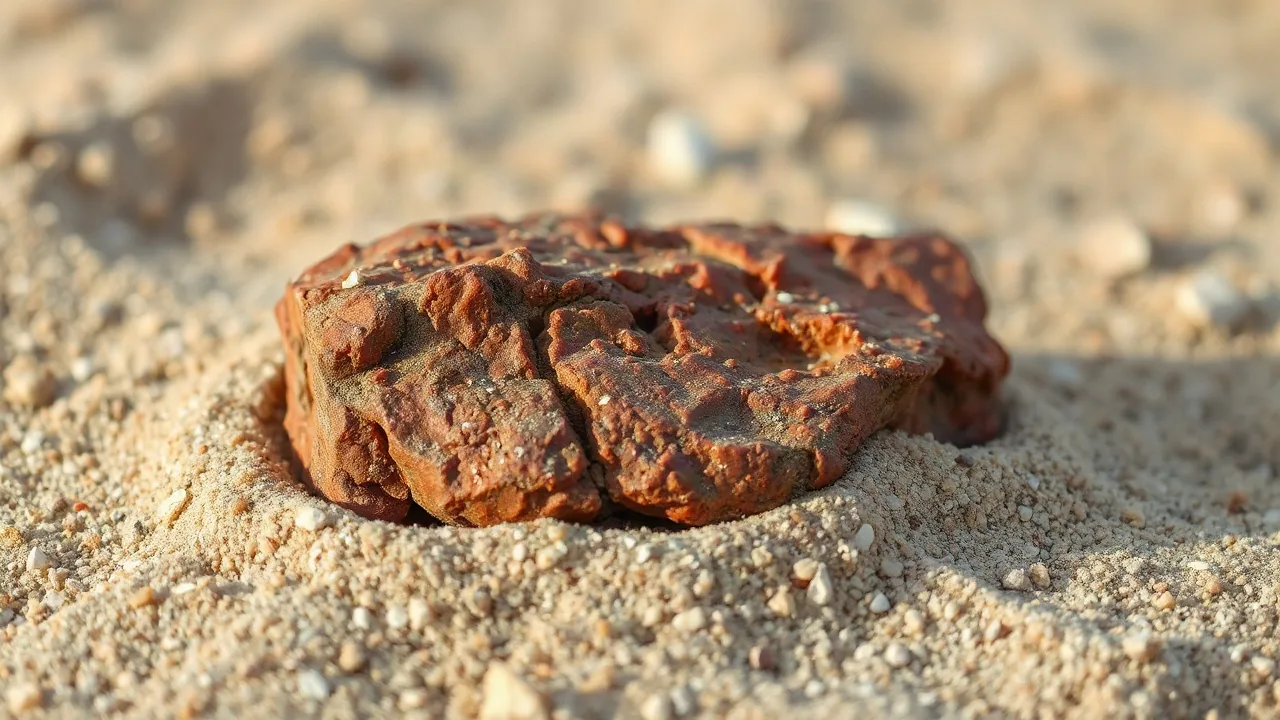
Scientists have announced the discovery of what they believe to be one of the oldest Martian meteorites ever found, a 4.1-billion-year-old rock unearthed in the Sahara Desert. Dubbed Teghaza 001, this ancient piece of Mars provides an unprecedented window into the early geological evolution of the Red Planet, dating back to a period shortly after Mars's formation.
The meteorite's remarkable age was determined through rigorous scientific analysis, including radiometric dating techniques that measure the decay of radioactive isotopes. These methods allow researchers to pinpoint the time when the rock solidified. The findings, published in a recent scientific journal, suggest Teghaza 001 is a remnant from Mars's Hadean or early Noachian period, an era for which terrestrial rock samples are scarce.
A Glimpse Into Early Mars
Understanding the early history of Mars is crucial for piecing together the story of planetary formation and the potential for life beyond Earth. Meteorites like Teghaza 001, which originated from impacts on Mars that ejected rock into space, offer pristine samples of the planet's crust and mantle. Unlike rocks on Earth, which have been significantly altered by plate tectonics, erosion, and water, Martian meteorites provide a more direct record of the planet's composition and conditions billions of years ago.
Dr. Anya Sharma, a planetary geologist involved in the analysis, stated, "This meteorite is a treasure trove. Its age pushes back our understanding of Martian geology significantly. We're looking at material that formed when Mars was a very different world, potentially before the development of its extensive northern ocean or the formation of its oldest volcanic features." The research team utilized advanced mass spectrometry to analyze the isotopic composition of the meteorite, comparing it to known Martian atmospheric and surface signatures.
The discovery highlights the ongoing importance of meteoritic research in planetary science. Each new find, especially one of such antiquity, adds crucial data points to models of planetary evolution. The Teghaza 001 meteorite is believed to have been ejected from Mars by a massive impact event billions of years ago, traveling through space before eventually landing on Earth, where it lay preserved in the arid desert environment for potentially millions of years before its discovery.
Previous discoveries of ancient Martian meteorites have provided invaluable insights, but Teghaza 001's age places it among the very earliest samples available for study. Its composition may reveal clues about the planet's initial atmosphere, magnetic field, and the presence of liquid water, all key ingredients for habitability. Further studies are planned to investigate potential organic compounds within the meteorite, though scientists caution against premature speculation about signs of ancient life.
The Sahara Desert, with its dry and stable climate, has long been a productive region for meteorite hunting, preserving these extraterrestrial visitors from atmospheric and geological alteration. Organizations like NASA's Jet Propulsion Laboratory often collaborate with international research teams to analyze such finds, contributing to our collective knowledge of the solar system and the unique history of the Red Planet.