
NASA Astronaut, Two Cosmonauts Land Safely After 241 Days on ISS
A NASA astronaut and two Russian cosmonauts have safely returned to Earth after a 241-day mission aboard the International Space Station. Their Soyuz spacecraft landed in Kazakhstan on Sunday morning.

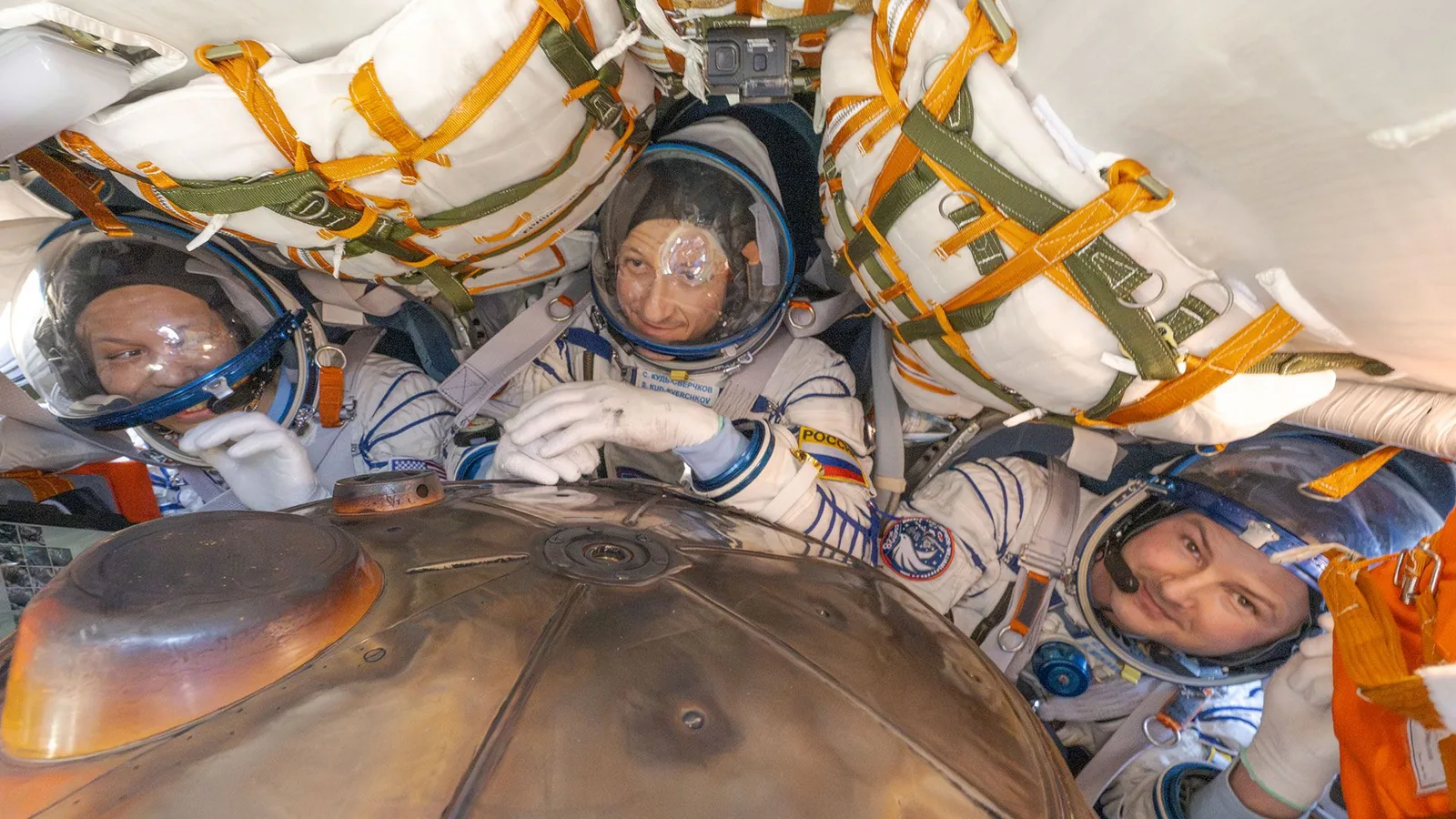
A NASA astronaut and two Russian cosmonauts successfully returned to Earth on Sunday, July 26, concluding a 241-day mission aboard the International Space Station (ISS). The Soyuz MS-28 spacecraft, carrying NASA astronaut Chris Williams and Roscosmos cosmonauts Sergey Kud-Sverchkov and Sergei Mikaev, separated from the orbiting laboratory at 3:03 a.m. EDT (0703 GMT). The trio's journey concluded with a landing on the Kazakh steppe approximately three and a half hours later, at 6:27 a.m. EDT (1027 GMT).
The crew's departure from the ISS followed a change-of-command ceremony held the previous day. During the event, Expedition 74 commander Sergey Kud-Sverchkov handed over leadership of the station to NASA astronaut Jessica Meir, marking the official transition to ISS Expedition 75. Following the ceremony, the departing crew shared their farewells and secured the hatches of the Soyuz MS-28 spacecraft on Saturday night.
The Soyuz MS-28 mission commenced on November 27, 2025, launching on Thanksgiving Day. This mission marked the first spaceflight for both Chris Williams and Sergei Mikaev. For Sergey Kud-Sverchkov, it represented his second voyage to space, adding to his extensive experience and bringing his total time in orbit to over 426 days. During their extensive stay, the crew of Soyuz MS-28 completed 3,856 orbits of Earth, accumulating a total travel distance exceeding 102 million miles (164 million kilometers).
Mission Highlights and Scientific Contributions
Throughout their nearly eight-month stay on the International Space Station, the crew was deeply involved in a wide array of scientific research and technological development. Their work spanned multiple disciplines, including human physiology in microgravity, materials science, and Earth observation. Experiments conducted by the NASA team and their international partners are crucial for understanding the long-term effects of spaceflight on the human body, informing future missions to the Moon and Mars. For instance, studies on bone density loss and muscle atrophy provide vital data for developing countermeasures to keep astronauts healthy on extended voyages.
The ISS serves as a unique platform for international collaboration, fostering diplomatic ties and advancing scientific knowledge beyond national borders. This mission underscored the continued partnership between the United States and Russia in space exploration, even amidst broader geopolitical tensions. Such cooperation is essential for tackling the complex challenges of space travel and for pushing the boundaries of human endeavor into the cosmos. The data gathered from experiments aboard the ISS contributes significantly to advancements not only in space science but also in terrestrial applications, from medical imaging to climate monitoring.
The return of Williams, Kud-Sverchkov, and Mikaev marks a successful completion of their orbital objectives. As they undergo readaptation to Earth's gravity, scientists will continue to analyze the vast amount of data collected during their expedition. Their contributions are a testament to the ongoing dedication and innovation within the space exploration community, paving the way for future discoveries and human journeys beyond our planet.