
NASA Extends Voyager 2's Deep Space Mission with Power-Saving "Big Bang"
NASA engineers have implemented a power-saving strategy dubbed the "Big Bang" to extend the operational life of the Voyager 2 spacecraft, ensuring its science instruments continue functioning for at least another year.

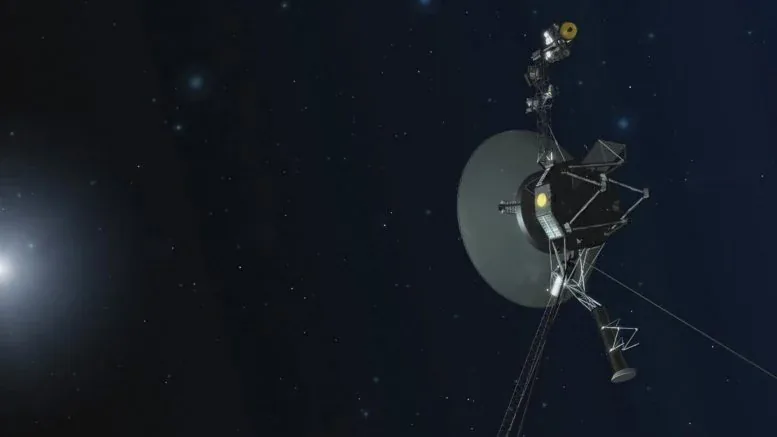
NASA engineers at the Jet Propulsion Laboratory have successfully devised a novel strategy to prolong the scientific mission of the Voyager 2 spacecraft, which launched nearly 50 years ago. This initiative, nicknamed the "Big Bang," aims to conserve the probe's dwindling power supply, potentially extending its data collection capabilities by at least another year. The operation involved simultaneously deactivating certain power-hungry instruments and activating alternative, more energy-efficient systems.
The challenge extended beyond simply switching off components; engineers also had to ensure that the spacecraft would maintain a sufficiently warm internal temperature for its delicate systems to continue operating. Voyager 2, like its twin Voyager 1, relies on radioisotope thermoelectric generators (RTGs) for its electricity. These generators convert the heat from decaying plutonium into electrical power. Over nearly five decades, this decay process has led to a consistent reduction in the available power, with each spacecraft losing approximately 4 watts annually. This steady decline has left the probes with critically low reserves of electricity.
To manage these constraints, the mission team has progressively turned off non-essential devices and systems. By 2024, power limitations had already necessitated the deactivation of two scientific instruments on each Voyager spacecraft. Without the recent "Big Bang" intervention, NASA anticipated needing to power down another instrument on Voyager 2 before the close of 2026. The newly achieved power conservation is expected to keep the spacecraft's three remaining instruments operational for at least one additional year.
Conserving Power for Continued Exploration
The successful implementation of the "Big Bang" technique on Voyager 2 is a testament to the ingenuity of NASA's engineering teams. The careful orchestration of shutting down and replacing systems required meticulous planning and execution, especially given the vast distance separating the spacecraft from Earth and the communication delays involved. The primary objective was to buy more time for the valuable scientific instruments to gather data from the outer reaches of the solar system and beyond.
The conserved power is anticipated to facilitate continued operation of Voyager 2's three active science instruments. These instruments are crucial for understanding the heliosphere, the magnetic bubble surrounding our solar system, and the interstellar medium beyond it. This extension of the mission allows scientists to collect more data on phenomena that are difficult or impossible to study from Earth, offering unique insights into the boundary between our solar system and the vastness of interstellar space.
Following the success with Voyager 2, NASA plans to implement the same power-saving modifications on Voyager 1. The mission team aims to complete this process in the coming months. Voyager 1, currently the most distant human-made object, is also experiencing power constraints, though its operational status may differ slightly due to its unique trajectory and instrument configuration. The parallel effort underscores the ongoing commitment to maximizing the scientific return from these historic spacecraft, which have been at the forefront of solar system exploration for decades.
The original launch of Voyager 2 occurred on August 20, 1977, just weeks after its twin, Voyager 1. Both probes have far exceeded their original mission objectives, which were primarily focused on flybys of Jupiter and Saturn. Voyager 2 went on to visit Uranus and Neptune, providing humanity's only close-up views of these ice giants. Now, operating in interstellar space, these enduring NASA explorers continue to push the boundaries of human knowledge, demonstrating remarkable longevity and adaptability in the harsh environment of deep space.