
NASA Concludes MAVEN Mars Mission After Decade of Atmospheric Study
NASA has officially retired its MAVEN Mars probe after losing contact in late 2025. The mission exceeded its planned lifespan by over a decade, providing crucial data on the Martian atmosphere and its loss.

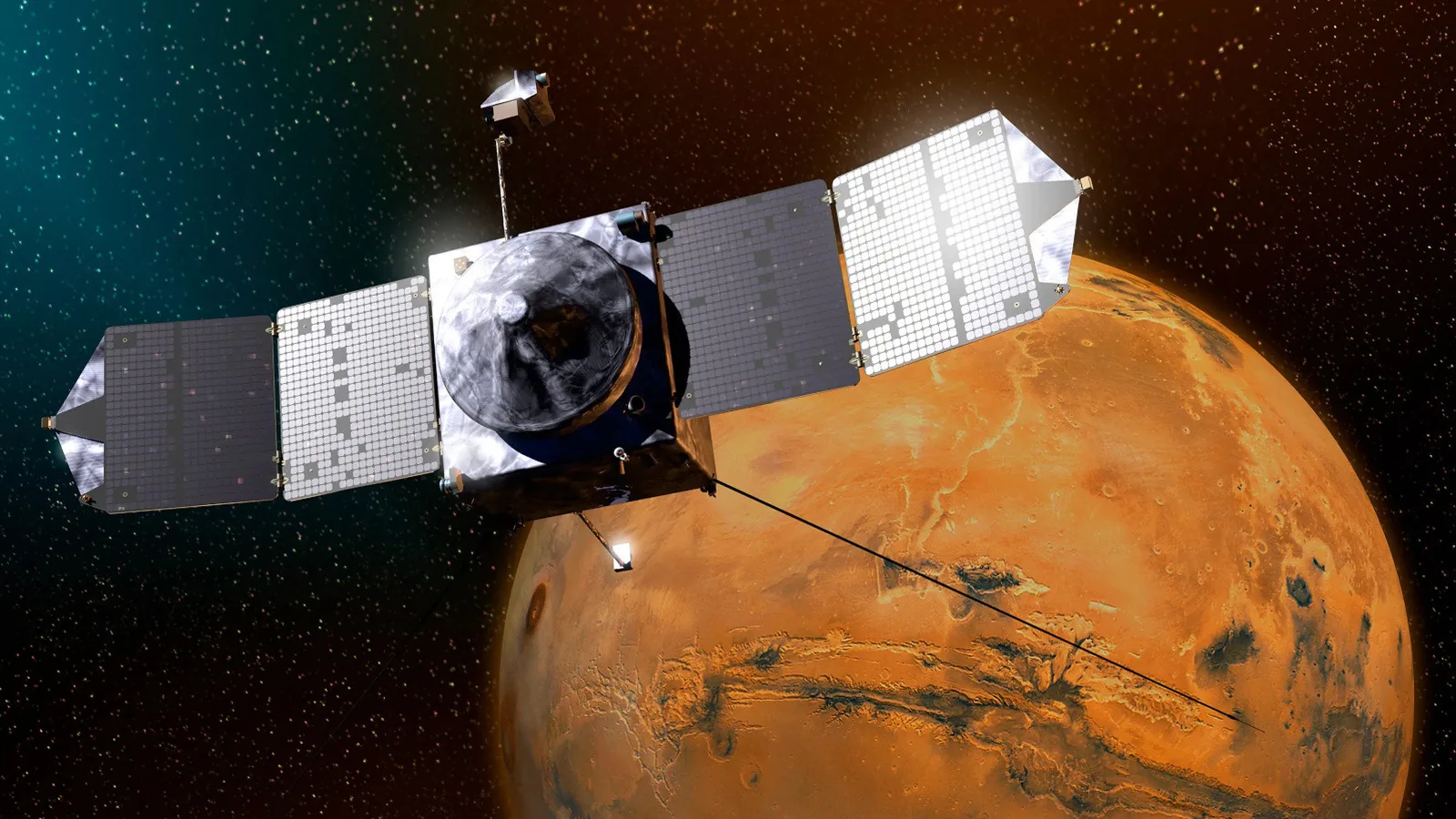
NASA has officially concluded its Mars Atmosphere and Volatile Evolution (MAVEN) mission, more than six months after losing contact with the spacecraft. The probe, which was dedicated to studying the Martian atmosphere and its historical evolution, spent over 11 years in orbit, significantly surpassing its initial one-year science mission. MAVEN was launched from Cape Canaveral in November 2013, successfully entering Martian orbit in September 2014. Beyond its primary science objectives, the probe also served a vital role as a communications antenna for the Mars 2020 mission, which delivered the Perseverance rover to the Red Planet.
The last confirmed contact with MAVEN occurred on December 6, 2025, when the probe experienced a sudden loss of signal after passing behind Mars. Mission controllers initially explored recovery options, forming an anomaly review board in February 2026 to assess the probe's status and potential for salvage. However, the board ultimately determined that the spacecraft was no longer capable of conducting science operations or transmitting data back to Earth. Data from the Deep Space Network indicated that MAVEN entered a safe mode and began rotating at an unexpectedly high rate after re-emerging from behind the planet. This rapid rotation is believed to have depleted its batteries and caused its communication system to fail.
Decade of Discovery on the Red Planet
MAVEN's extensive observations have been instrumental in shaping our understanding of Mars' atmospheric history. The mission provided definitive evidence that solar winds and solar storms have continuously stripped away the Martian atmosphere. Scientists now understand these processes to be the primary drivers behind Mars' dramatic climate shift from a potentially habitable environment to the cold, arid world it is today. The probe's findings also revealed that protons could generate novel types of auroras on Mars, occurring anywhere across the planet, a stark contrast to Earth where auroras are typically confined to polar regions. Furthermore, MAVEN helped researchers unravel the impact of planet-wide dust storms, demonstrating how they contributed to the loss of water molecules into space.
The extended operational life of the MAVEN probe allowed for an unprecedented accumulation of data, far exceeding initial expectations. This wealth of information continues to inform ongoing research into planetary habitability and atmospheric escape mechanisms. While the exact root cause of the final anomaly is still under review, NASA expects to publish a detailed report later in 2026. The mission's legacy lies not only in its scientific discoveries but also in its technological resilience, serving as a crucial asset for subsequent missions like the Mars 2020 rover.
The loss of MAVEN marks the end of an era for Martian atmospheric research but leaves behind a rich dataset that will be analyzed for years to come. Its contribution to understanding how planets lose their atmospheres provides invaluable context for the search for life beyond Earth and the study of exoplanet atmospheres. The mission's success underscores the importance of dedicated atmospheric probes in deciphering the evolution of planetary climates.