
Aurora Forecast: Northern Lights May Appear in 9 US States Tonight
The Northern Lights could be visible across parts of nine U.S. states tonight due to potential geomagnetic storms. NOAA's forecast suggests sightings in northern regions and even some border states.

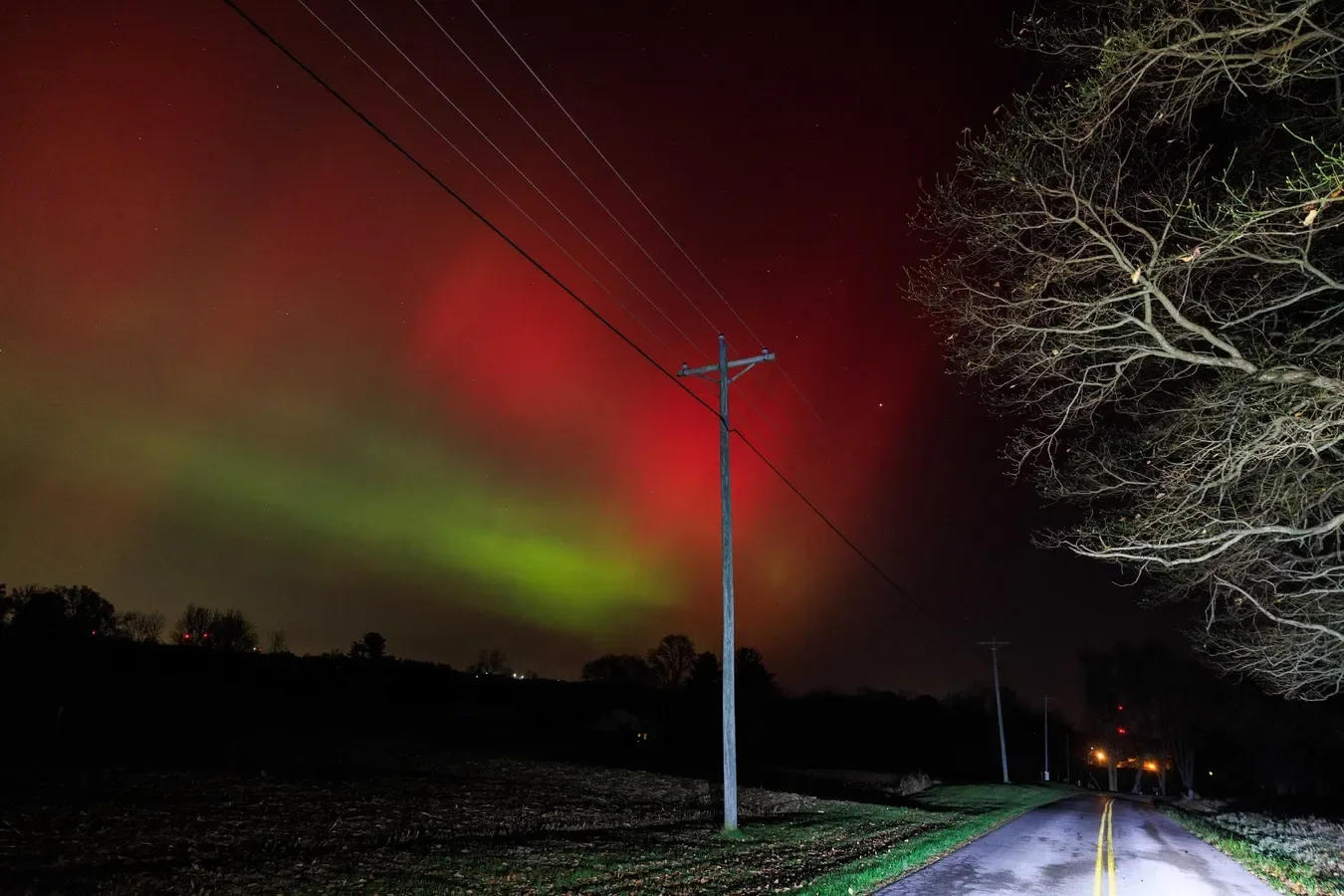
Residents in several northern U.S. states might have a chance to witness the aurora borealis on Tuesday night, according to a forecast from the National Oceanic and Atmospheric Administration (NOAA). The phenomenon, commonly known as the Northern Lights, could appear further south than usual due to anticipated geomagnetic storms driven by evolving space weather conditions.
The possibility of seeing the aurora stems from two distinct solar events. Forecasters at NOAA are tracking high-speed solar winds originating from a coronal hole – an area on the sun with cooler, less dense plasma that appears dark in certain solar imagery. These fast-moving solar winds can travel across space and interact with Earth's magnetosphere, potentially triggering geomagnetic storms.
In addition to the solar winds, NOAA also recorded coronal mass ejections (CMEs) on Friday and Saturday. These are massive bursts of magnetized plasma and energetic particles ejected from the sun's outer atmosphere, the corona. If these CMEs are directed towards Earth, they could arrive as early as Tuesday, further contributing to geomagnetic activity.
While the expected storms are forecast to be mild, even lesser geomagnetic disturbances can cause the aurora’s typical visibility range to expand. NOAA's forecast map indicates a low likelihood of aurora visibility in states bordering Canada. These include Washington, Idaho, Montana, North Dakota, South Dakota, Minnesota, Wisconsin, and Michigan. For residents of Alaska, the aurora is predicted to be highly visible, though summer's late sunsets might obscure the view.
Tips for Aurora Viewing
To maximize chances of observing the aurora, experts advise heading north towards Earth's magnetic pole. Finding a location with an unobstructed view of the night sky, ideally far from urban light pollution, is crucial. NOAA data suggests the aurora is most active in the hours surrounding midnight, recommending viewing times between 10 p.m. and 2 a.m. local time on Tuesday night and into early Wednesday morning.
The science behind the aurora borealis involves charged particles from the sun colliding with gases in Earth's upper atmosphere. These collisions excite the atmospheric gases, causing them to emit light. The colors observed, such as green, pink, and purple, depend on the type of gas molecule and the altitude at which the collision occurs. Typically, the aurora is primarily seen at high latitudes, closer to the Arctic and Antarctic circles, due to the Earth's magnetic field lines channeling these solar particles towards the magnetic poles.
This particular forecast highlights how space weather events, though sometimes minor, can have tangible effects observable even in mid-latitude regions. Understanding these phenomena is increasingly important as society relies more on technologies susceptible to space weather, such as satellite communications and GPS systems. NOAA's Space Weather Prediction Center continuously monitors solar activity to provide timely forecasts for both scientific understanding and public interest.