
Northern Lights Visible Across US Due to Solar Storm Ahead of July 4
A potent solar storm triggered by a powerful solar flare could make the Northern Lights visible in many U.S. states this week. The geomagnetic event is expected to peak around July 3, offering a dazzling celestial display.

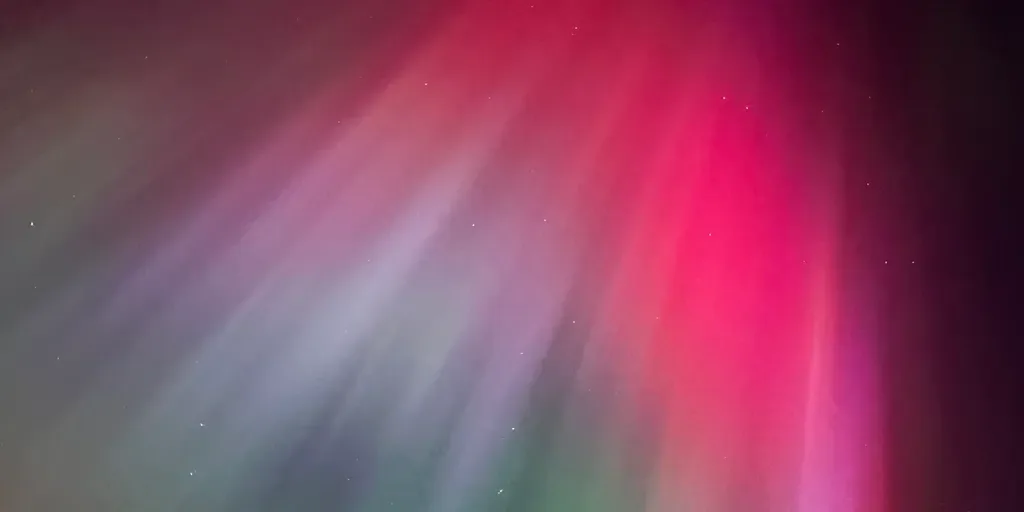
Residents across a significant portion of the United States may have the chance to witness the aurora borealis, commonly known as the Northern Lights, as a powerful solar storm approaches. The geomagnetic event, expected to peak on July 3, is a result of a significant solar flare that erupted on Tuesday, according to officials. This celestial phenomenon could provide a spectacular light show across the northern U.S. and Upper Midwest, potentially overshadowing the anticipated Fourth of July fireworks.
The solar flare, which peaked around 4:50 p.m. EDT on Tuesday, unleashed a burst of X-rays that reached Earth in just over eight minutes. This immediate impact triggered strong radio blackouts, classified as R3 events, across the sunlit side of the planet. The disruption affected high-frequency radio communications in parts of North America, leading to brief outages for many residents. National Oceanic and Atmospheric Administration (NOAA) scientists confirmed the solar flare's intensity and its immediate effects on Earth's atmosphere.
Geomagnetic Storm Expected to Enhance Aurora Visibility
Following the initial X-ray burst, the event also produced a coronal mass ejection (CME). A CME is a massive cloud of magnetized solar plasma and magnetic fields ejected into space by the sun. When such a cloud interacts with Earth's magnetic field, it can generate a geomagnetic storm, which is the primary driver behind the vivid auroras. NOAA is forecasting a Kp index of 5 for Thursday and Friday. A Kp index of 5 signifies a strong geomagnetic storm, which could push the visibility of the aurora farther south than is typically observed.
States with the highest probability of viewing the Northern Lights include Washington, Idaho, Montana, North Dakota, South Dakota, northern Minnesota, northern Wisconsin, northern Michigan, and Alaska. Experts recommend seeking out dark locations, far from the light pollution of urban areas, and finding a spot with an unobstructed view of the northern horizon. The optimal viewing window is generally considered to be between 10 p.m. and 2 a.m. local time, though the specific timing can vary with the storm's intensity and local conditions.
Solar storms are natural phenomena that occur when the sun releases significant amounts of energy and particles into space. These events are typically caused by complex magnetic field interactions on the sun's surface. When these magnetic fields become twisted and then suddenly snap, they release immense energy, leading to flares and CMEs. While these events can cause temporary disruptions to technology, such as radio communications and satellite operations, they also create breathtaking natural displays like the aurora borealis. The current event is being closely monitored by space weather agencies, including NASA and NOAA, to assess its full impact and duration.