
Northern Lights Visible Sunday: Aurora Forecast for US States
The Northern Lights may be visible Sunday in northern US states due to minor geomagnetic storms. Areas from Washington to Michigan, plus Alaska, have a low to high likelihood of aurora sightings.

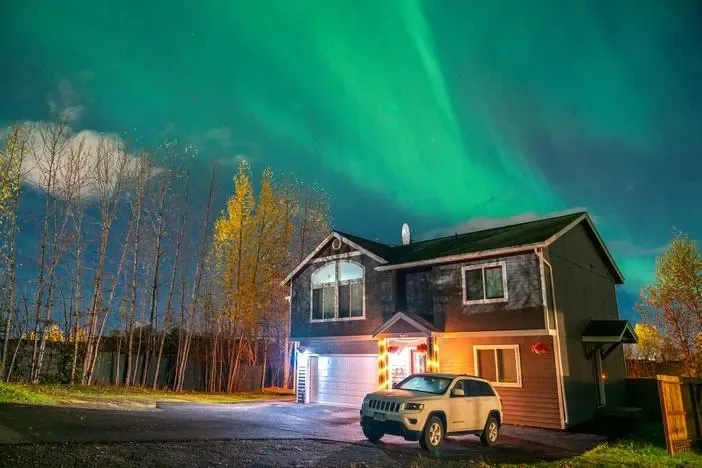
Residents in several northern U.S. states and Alaska have a chance to witness the aurora borealis this Sunday, July 7, 2026, as minor geomagnetic storms are expected. NOAA forecasts indicate that the aurora borealis could be visible in regions near the U.S.-Canadian border, with higher chances in Alaska.
The potential for aurora sightings stems from the interaction of solar winds with Earth's magnetic field. These solar winds originate from specific regions on the Sun known as coronal holes. Coronal holes are cooler, less dense areas on the Sun's surface where magnetic fields allow high-speed solar wind streams to escape into space. While the storms predicted for Sunday are classified as minor, they are sufficient to cause the aurora to appear in latitudes further south than typically observed.
Northern Lights Visibility Forecast
According to the aurora forecast map released by NOAA, there is a low likelihood of the Northern Lights being visible in the northernmost parts of states such as Washington, Idaho, Montana, North Dakota, Minnesota, Wisconsin, and the Upper Peninsula of Michigan. Alaska, however, has a significantly higher chance of aurora visibility, with large portions of the state falling within the "high likelihood" region.
For optimal viewing, experts advise travelers to venture as far north as possible. Finding a location away from urban light pollution and with an unobstructed view of the northern horizon is crucial. The best viewing hours are typically between 10 p.m. and 2 a.m. local time, when the aurora is most active.
Photographing the aurora requires specific techniques. Photographers recommend using a tripod and a remote timer to keep the camera steady during long exposures, which are necessary to capture sufficient light from the night sky. For smartphone users, shooting in RAW format, utilizing night mode, and ensuring the flash is turned off are key settings. Even smartphone cameras can capture quality images of the aurora with the right equipment and settings, according to specialists.
These atmospheric displays are a direct consequence of the Sun's activity. Understanding the relationship between solar winds and geomagnetic storms is essential for predicting aurora visibility. NOAA's Space Weather Prediction Center continuously monitors solar activity and provides forecasts to help the public anticipate and prepare for these celestial events. The current forecast suggests that conditions will be favorable for aurora viewing in specific U.S. locales on Sunday.
The predictability of such events allows for planning, though cloud cover and local light conditions remain significant factors for ground observers. As solar activity cycles, periods of heightened geomagnetic storms, like the one anticipated for Sunday, offer unique opportunities for experiencing the aurora borealis without traveling to extreme northern latitudes.