
Optical Analogue Reveals Secrets of Simulated Hawking Radiation
Scientists have experimentally observed the process generating simulated Hawking radiation in an optical analogue, offering new insights into black hole physics. This discovery sheds light on how particles are emitted from event horizons.

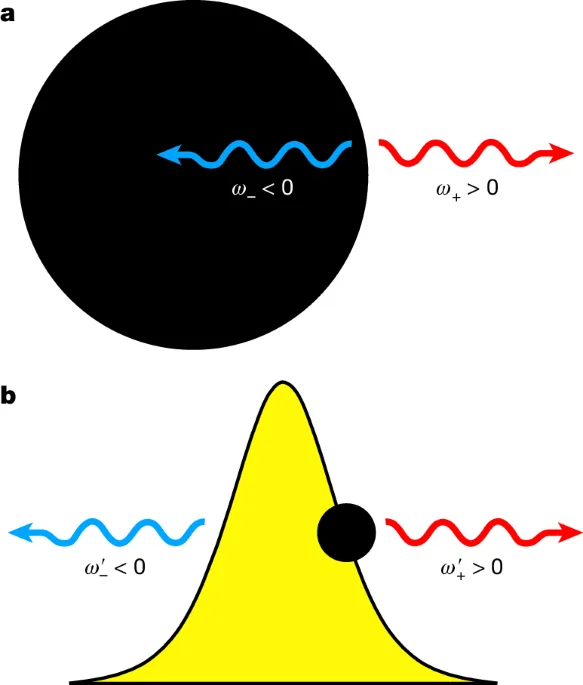
In a groundbreaking development bridging quantum mechanics and gravity, researchers have provided the first experimental and theoretical evidence for the generation and subsequent backreaction of stimulated Hawking radiation within an optical analogue of a black hole's event horizon. While Hawking radiation, theorized to be the emission of quantum particles from black holes, has never been astronomically observed, this laboratory experiment offers a tangible way to study its complex mechanisms.
Hawking radiation, a key prediction linking quantum field theory with general relativity, posits that black holes are not entirely black but emit particles due to quantum effects near their event horizons. The energy for this radiation is understood to originate from the black hole's gravitational field. However, the precise quantum process by which the field generates these outgoing Hawking quanta, and crucially, how this emission process influences the field itself – known as the backreaction – has remained a significant theoretical puzzle and an observational challenge, given the minuscule energies involved and the vast distances to astronomical black holes.
Experimental Breakthrough in Analogue Gravity
The team utilized a fiber-optical system, a well-established analogue for studying black hole phenomena in laboratories, to simulate an event horizon. Previous theoretical models suggested that the generation of Hawking radiation in such analogues involved a complex, cascading series of interactions. However, this new research, published in Nature, identified and experimentally confirmed a simpler, direct process responsible for generating the radiation. More significantly, the study captured the phenomenon of this generation process directly impacting the underlying field, demonstrating the crucial backreaction effect.
"We have identified theoretically a simple, direct process and observed experimentally how this process reacts back onto the field," stated the lead researcher. This experimental validation is critical because it not only confirms a theoretical prediction but also provides a controllable system to probe fundamental physics. The ability to observe the backreaction in a laboratory setting is a significant leap, as it mirrors the complex interplay expected in astrophysical black holes.
The implications of this discovery extend beyond the immediate system. The researchers suggest that the identified direct process and its backreaction may be a universal mechanism applicable to other laboratory analogues of curved spacetime, such as those involving Bose-Einstein condensates or flowing water. Furthermore, it offers a potential pathway to understanding the analogous processes occurring within actual gravitational fields. This finding could pave the way for future experiments designed to probe the quantum nature of gravity and the thermodynamics of black holes in unprecedented detail.
Understanding the backreaction of Hawking radiation is crucial for a complete picture of black hole evaporation. If black holes indeed evaporate through Hawking radiation, their mass and gravitational field must change in response to this particle emission. Observing this feedback loop in a controlled laboratory environment provides invaluable data for refining theoretical models and perhaps one day, understanding the ultimate fate of black holes and the information paradox associated with them.