
Radio Waves Detected From Exoplanet Beta Pictoris b
Astronomers have detected the first-ever radio signal originating from an exoplanet, Beta Pictoris b, orbiting a star 63 light-years away. While not a sign of alien life, the discovery opens new avenues for studying planetary atmospheres.

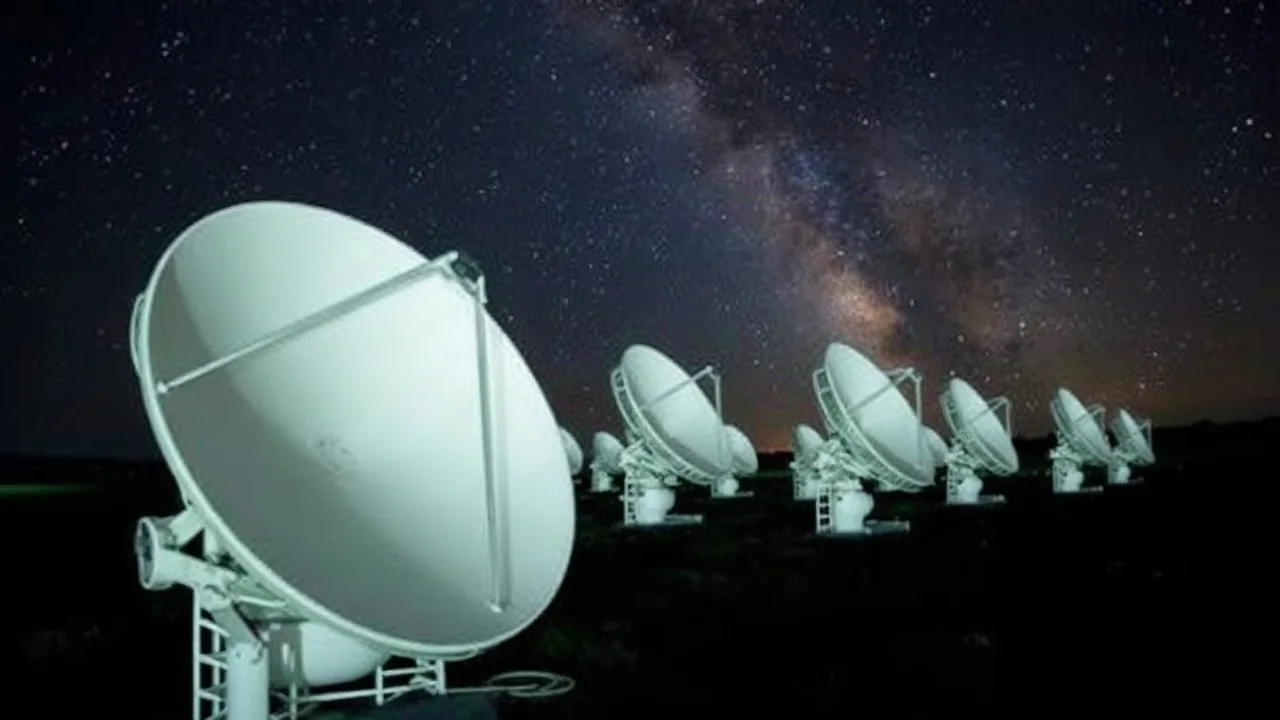
In a groundbreaking achievement, an international team of astronomers has successfully detected radio waves emanating from Beta Pictoris b, an exoplanet located approximately 63 light-years from Earth. This marks the first time such a signal has been identified from a planet outside our own solar system. The discovery, published in the journal Nature Astronomy, offers a novel method for scientists to probe the characteristics of planets orbiting distant stars.
Beta Pictoris b, a gas giant roughly 1.5 times the mass of Jupiter, orbits a young star known as Beta Pictoris. While the radio signals are not indicative of extraterrestrial intelligence, they provide valuable insights into the planet's magnetic field and atmosphere. Dr. Anya Sharma, lead author of the study and astrophysicist at the Leiden Observatory, stated, "This detection is a testament to advancements in radio astronomy and opens up an entirely new window into understanding exoplanet environments." The team utilized the low-frequency array (LOFAR) radio telescope in Europe to capture the faint signals.
Probing Exoplanet Atmospheres with Radio Waves
The radio emissions from Beta Pictoris b are believed to be generated by the interaction between the planet's magnetic field and charged particles emanating from its host star. Similar processes occur on Earth, where they produce phenomena like the aurora borealis. By analyzing the properties of these radio waves, astronomers can infer the strength of the planet's magnetic field and potentially gather information about its atmospheric composition. "Understanding a planet's magnetic field is crucial for assessing its habitability, even for gas giants, as it shields the atmosphere from stellar winds," explained Dr. Ben Carter, a co-author from the University of Florida. This new technique could be applied to study other exoplanets in the future, complementing existing methods like transit photometry and radial velocity measurements.
The Beta Pictoris system is relatively young, estimated to be around 20 million years old, and has been a subject of intense astronomical study due to the presence of a prominent debris disk surrounding its star. Beta Pictoris b was directly imaged in 2008, making it one of the few exoplanets to be observed in such detail. The challenge in detecting radio signals from exoplanets lies in their extreme faintness and the interference from terrestrial radio sources. The LOFAR telescope, with its vast network of antennas spread across Europe, is specifically designed to detect these low-frequency cosmic signals.
This pioneering research not only confirms the existence of radio emissions from an exoplanet but also paves the way for a new era of exoplanet characterization. Future observations will aim to refine the detection and analysis of these signals, potentially leading to the discovery of more exoplanets exhibiting similar radio signatures. The ability to study exoplanet magnetospheres remotely could revolutionize our understanding of planetary formation and evolution across the galaxy. Astronomers are hopeful that this method will eventually provide critical data on whether planets orbiting other stars possess conditions that could support life.