
Severe Northern Lights Alert: 25 States Brace for Geomagnetic Storm
NOAA has issued a severe geomagnetic storm warning for June 4-5, potentially bringing aurora displays to 25 U.S. states. Skywatchers are advised to look north.

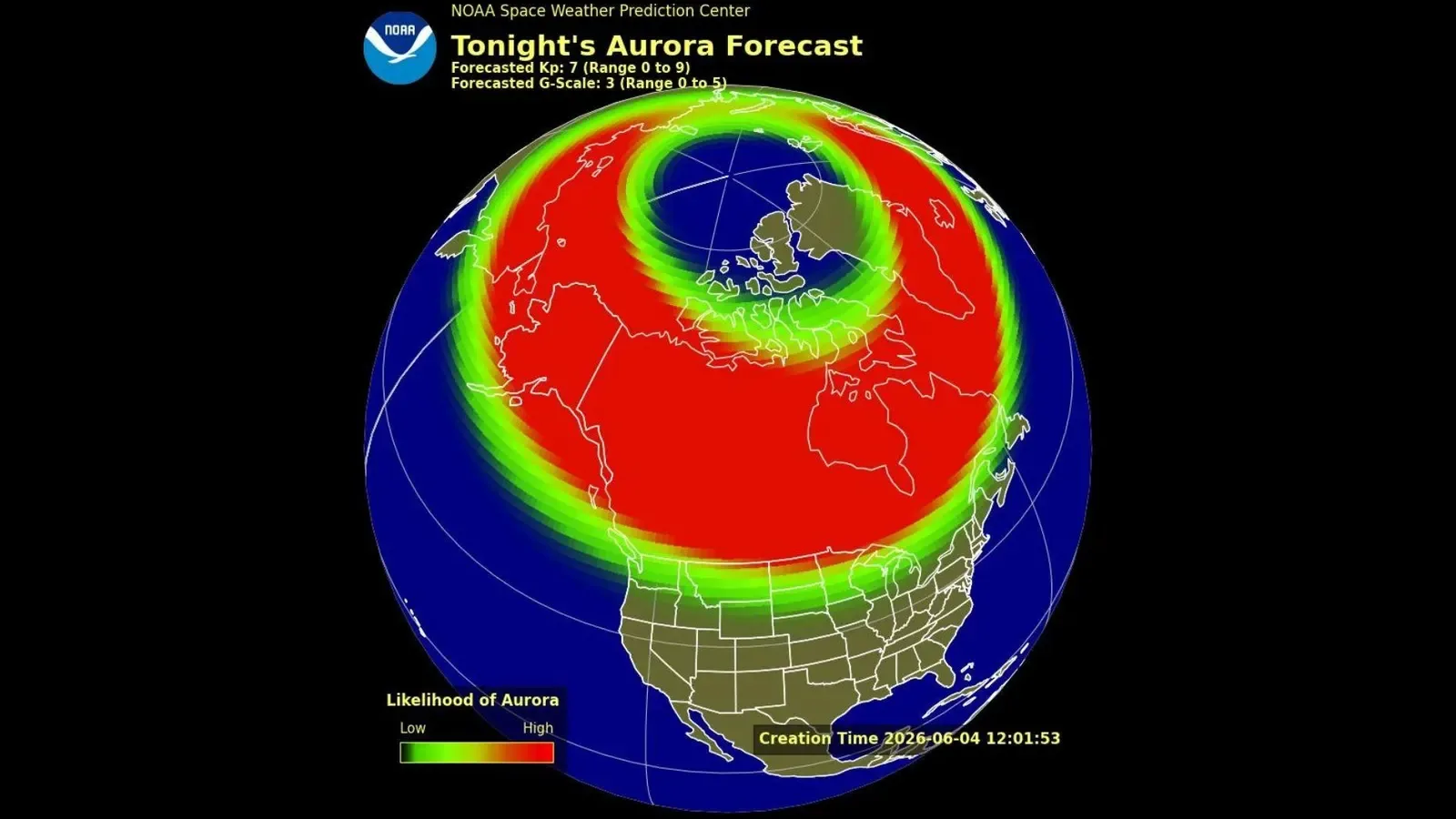
A severe geomagnetic storm warning has been issued by NOAA's Space Weather Prediction Center, anticipating strong to severe conditions on Thursday, June 4, and extending into Friday, June 5. Multiple solar eruptions, known as coronal mass ejections (CMEs), are expected to impact Earth's magnetic field, potentially creating spectacular aurora displays across a wide swath of the United States. Skywatchers in northern states are encouraged to seek clear vantage points looking north after dusk.
The forecast upgrade follows the detection of several Earth-directed CMEs originating from the sun on June 3 and June 4. These CMEs can interact in space, a process sometimes called a "cannibal CME," leading to intensified geomagnetic activity. NOAA's latest prediction indicates Kp values could reach 6.33 (G2) on June 4, potentially rising to 6.67 (G3) later that day. These levels are sufficient to push the aurora visibility well into the northern U.S. A G3 storm could even bring the lights as far south as mid-latitudes under optimal conditions.
The northern lights may be visible in states including Washington, Idaho, Montana, Wyoming, North Dakota, South Dakota, Minnesota, Wisconsin, Michigan, New York, and Maine. Additional opportunities may arise in Oregon, Nebraska, Iowa, Illinois, Indiana, Ohio, Pennsylvania, Massachusetts, Connecticut, Rhode Island, Vermont, and New Hampshire. Historically, similar storms have allowed naked-eye auroras to be seen in over 25 states.
Understanding Geomagnetic Storms and Aurora Viewing
The intensity of an aurora display is influenced by several factors, primarily the orientation of the solar wind's magnetic field. While the Kp index gauges geomagnetic storm strength, the southward orientation of the interplanetary magnetic field (IMF), known as Bz, is crucial for coupling solar wind energy with Earth's magnetosphere. A sustained southward Bz of -5 nT or stronger typically signals an imminent and potentially vibrant aurora. Current forecasts are being closely monitored by aurora enthusiasts and scientists alike.
Despite favorable geomagnetic conditions, viewers in northern regions might face challenges due to the approaching June solstice. The shorter nights and persistent twilight in early June can limit the darkness required to observe fainter auroral displays, even when the geomagnetic storms are strong. Optimal viewing requires clear, dark skies away from light pollution, with many using specialized apps like My Aurora Forecast and Aurora Now for real-time updates.