
Solar System's Instability Threatens Destruction, New Study Reveals
A recent astronomical study suggests our solar system may be far more unstable than previously believed, with potential for complete destruction within billions of years.

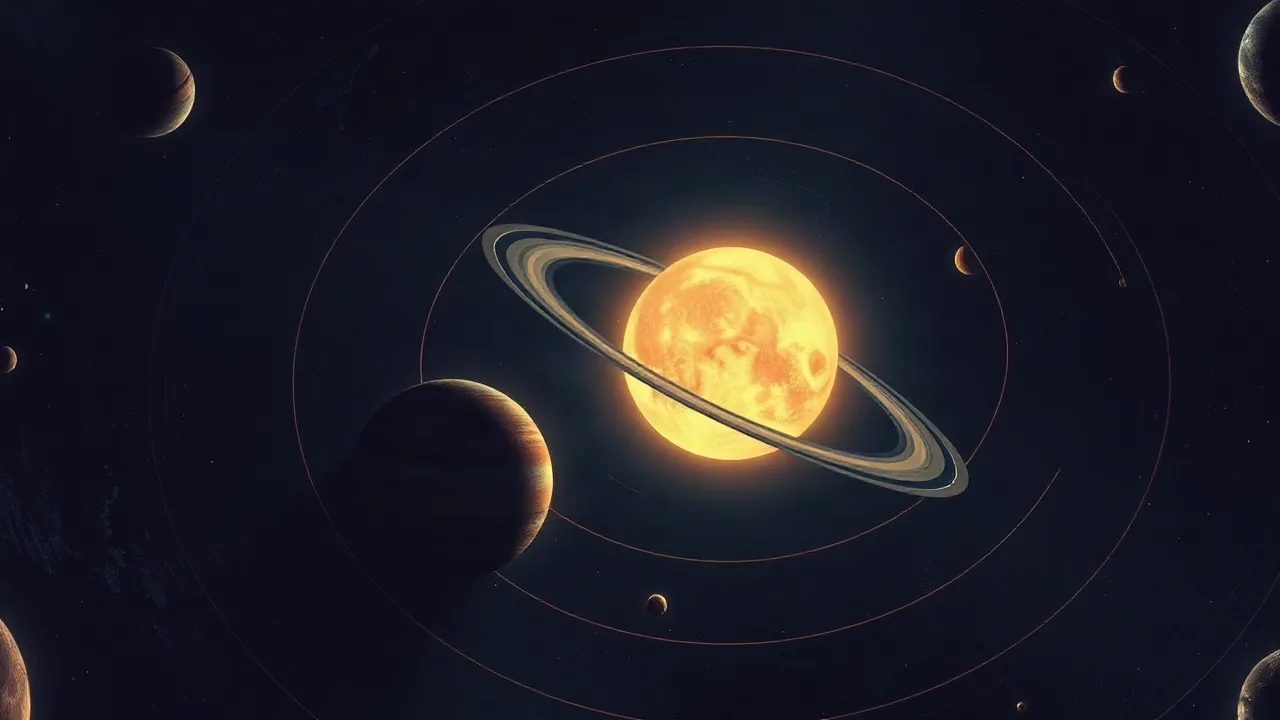
Astronomers have uncovered startling new evidence indicating that our solar system's long-term stability is not guaranteed, suggesting a potential for catastrophic disruption far sooner than anticipated. A groundbreaking study, published in the journal Nature Astronomy, utilized advanced simulations to model the complex gravitational interactions between celestial bodies over vast timescales.
The research, led by Dr. Anya Sharma of the Institute for Advanced Celestial Studies, focused on the long-term evolution of planetary orbits and the influence of the Sun's eventual transition into a red giant. While previous models suggested a relatively stable existence for billions of years, this new analysis incorporates more precise calculations of gravitational perturbations, particularly those influenced by the gas giants Jupiter and Saturn.
"We've always assumed a degree of inherent stability within our solar system, allowing for life to evolve over eons," Dr. Sharma stated in a press conference on October 2, 2026. "However, our simulations reveal a surprisingly high probability of chaotic interactions that could eject planets from their orbits or even send them on collision courses. The implications are profound, extending our understanding of cosmic timelines and planetary fates."
A Shifting Cosmic Landscape
The study's simulations extended over several billion years, a period during which the Sun itself will undergo significant changes, expanding into a red giant and potentially engulfing the inner planets. However, the primary concern identified by the researchers is not solely the Sun's expansion but rather the dynamic interplay of planetary masses. The gravitational tugs between planets, especially the massive Jupiter and Saturn, can subtly alter each other's orbits over immense periods. These small deviations can amplify, leading to unpredictable consequences.
One particularly concerning scenario modeled involves Mercury, the innermost planet. The new simulations indicate a non-negligible chance that Mercury's orbit could become significantly destabilized, potentially leading to a collision with Venus or even Earth, or being flung out of the solar system entirely. Similar, though less probable, instability was observed for Venus and Mars.
This finding revises previous estimates of the solar system's lifespan. While the absolute end of the solar system is tied to the Sun's eventual demise, the *functional* lifespan—the period during which the planets maintain relatively stable orbits conducive to life—could be drastically shorter. The study suggests that the window for such stability might be measured in mere billions of years, rather than tens of billions.
The research team emphasized that this does not suggest an imminent threat. The timescales involved are astronomical, meaning such chaotic events, if they occur, are billions of years in the future. Nonetheless, the findings underscore the dynamic and often unpredictable nature of planetary systems across the universe. Understanding these cosmic processes is crucial for astronomy and our broader search for extraterrestrial life, as it informs the conditions under which planets can remain habitable over long periods.
The work by Dr. Sharma and her colleagues provides a more nuanced view of our place in the cosmos. It highlights that even seemingly stable systems are subject to the relentless forces of gravity and cosmic evolution. The findings will undoubtedly spur further research into orbital mechanics and the long-term fate of planetary configurations, refining our understanding of the universe's grand, unfolding narrative.