
SpaceX Falcon 9 Rocket Creates Ethereal Jellyfish Cloud Over East Coast
A SpaceX Falcon 9 rocket launch on Tuesday morning produced a striking 'jellyfish' cloud formation visible across the East Coast. The unusual atmospheric display followed the ascent of 29 Starlink satellites.

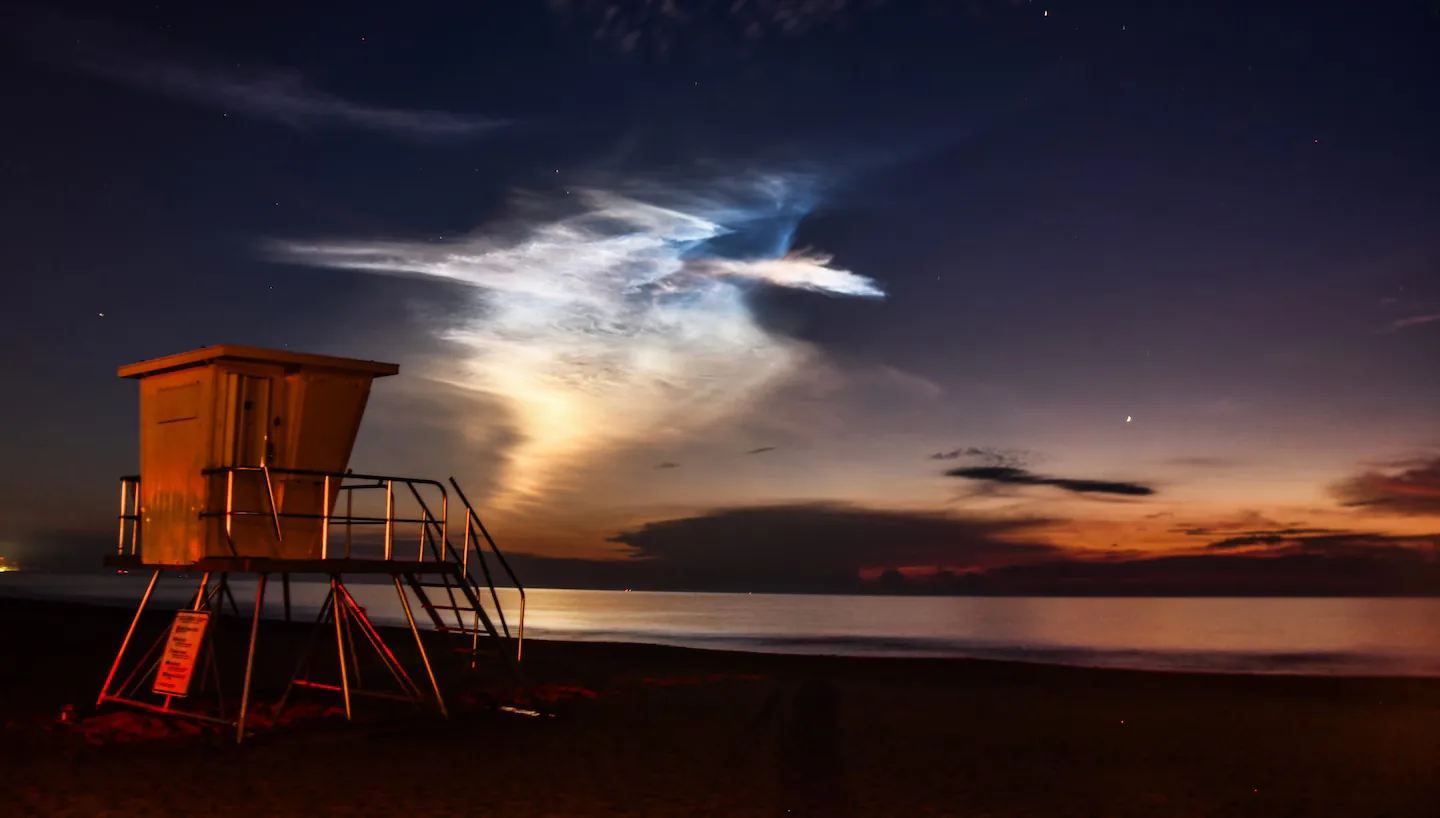
An extraordinary celestial phenomenon greeted early risers across the U.S. East Coast on Tuesday, August 25, 2026, as a rocket launch painted the pre-dawn sky with an unusual, bioluminescent-like cloud formation. The spectacle, which began shortly before sunrise around 5:45 a.m. Eastern Time, resembled a luminous jellyfish drifting through the atmosphere and persisted for approximately 30 minutes.
This ephemeral display was the byproduct of a SpaceX Falcon 9 rocket lifting off from Cape Canaveral Space Force Station in Florida at 5:33 a.m. The powerful rocket was tasked with deploying 29 Starlink internet satellites into low Earth orbit. As the booster ascended, the exhaust plume interacted with atmospheric conditions at high altitudes, creating the distinctive, translucent shape that captivated onlookers.
SpaceX has become a regular feature in the skies above Florida, with its Falcon 9 rockets launching numerous Starlink missions throughout 2026. However, the specific atmospheric conditions on Tuesday morning allowed for this particularly striking visual effect. The phenomenon was widely shared on social media, with residents from Florida to New England posting photos and videos of the alien-like cloud.
Atmospheric Optics and Rocket Exhaust
The 'jellyfish' cloud is a rare instance of atmospheric optics influenced by rocket propulsion. According to Dr. Evelyn Reed, an atmospheric physicist at the National Center for Atmospheric Research, such formations occur when the supercooled water vapor in the upper atmosphere freezes upon contact with the rocket's exhaust gases. "The ice crystals that form then scatter sunlight in a way that can create iridescent or cloud-like structures," Dr. Reed explained. "The specific shape and luminescence depend heavily on the altitude, temperature, humidity, and wind patterns at the time of the launch."
While rocket launches are common, the visual result seen on Tuesday is not. Previous launches have sometimes produced colorful sunsets or extended contrails, but the distinct, bulbous shape mimicking a marine creature is uncommon. The event underscores the complex interactions between human technological endeavors and Earth's natural atmospheric processes. For many, the sight was a beautiful, albeit unusual, reminder of the ongoing advancements in space exploration and satellite technology being spearheaded by companies like SpaceX.
The successful deployment of the 29 Starlink satellites on this mission further bolsters SpaceX's constellation, aiming to provide global broadband internet coverage. This latest launch continues the company's ambitious schedule for 2026, with further missions planned for both Starlink and other commercial and governmental payloads. The visual spectacle, however, served as a unique moment of public engagement with the science and technology driving these orbital endeavors, transforming a routine rocket launch into a memorable natural wonder.