
SpaceX Rocket Debris Imaged on Moon by NASA Orbiter
NASA's Lunar Reconnaissance Orbiter has captured images of the impact site where a SpaceX Falcon 9 upper stage crashed into the Moon. The crater is approximately 60 feet wide.

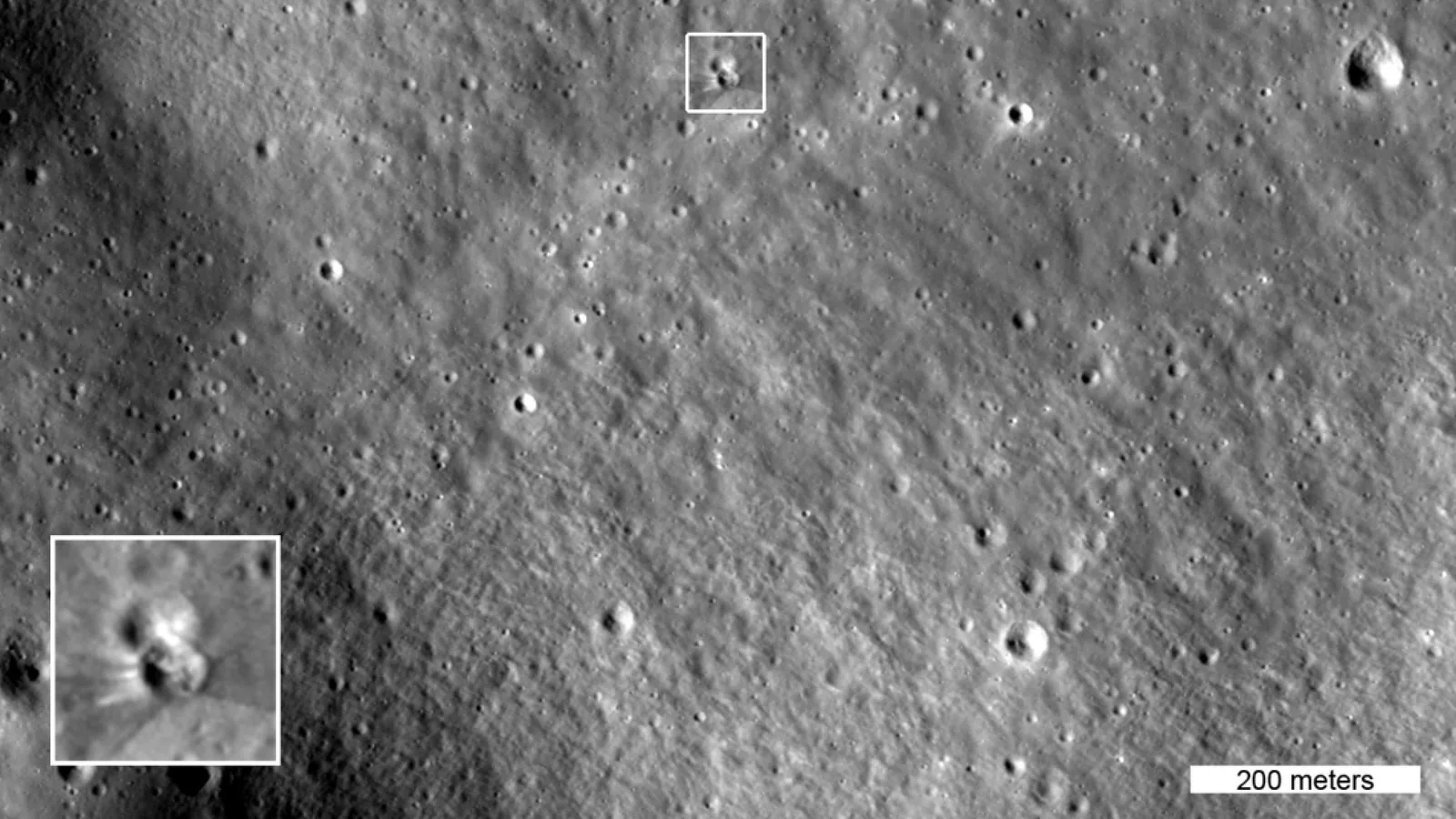
NASA's veteran moon-circling spacecraft, the Lunar Reconnaissance Orbiter (LRO), has captured detailed imagery of the impact site where a SpaceX Falcon 9 rocket upper stage met its end on the lunar surface. The photos, taken on August 11 and August 12, 2026, show the aftermath of the rocket body's collision with the moon near Einstein Crater. The object impacted at a speed of approximately 5,400 mph (8,690 kph).
The LRO's high-resolution camera system, known as LROC, obtained clear views of the crater from multiple angles as the orbiter circled the moon every 117 minutes. According to LROC Principal Investigator Mark Robinson, who is affiliated with the company Intuitive Machines in Houston, the newly formed impact crater measures about 60 feet (18 meters) in diameter and appears to be less than 10 feet (3 meters) deep.
"The distinctive V-shaped ejecta pattern on the south side of the crater is consistent with natural impactors hitting the moon at low angles relative to the surface," Robinson stated. He also noted that the final image in the LROC sequence, acquired with a significant slew angle of 68 degrees, offers a perspective similar to what an astronaut might observe from an Orion spacecraft window during an Artemis mission.
Lunar Surface Features Revealed
To capture these crucial images, LRO operators maneuvered the spacecraft to orient its cameras toward the target region during passes approximately 60 miles (97 km) above the moon. This allowed researchers to study the crater under various lighting conditions, highlighting distinct features. NASA officials explained in an August 18 statement that the LRO imagery reveals bright and dark streaks radiating from the crater. The darker streaks are composed of surface dust and rocks that have been altered over extensive periods by solar wind, cosmic rays, and micrometeorite impacts. This weathered material was excavated by the collision. In contrast, the brighter streaks near the crater rim are formed from fresh material brought up from deeper beneath the lunar surface.
Adding to the observational data, South Korea's lunar orbiter, known as the Korea Pathfinder Lunar Orbiter or Danuri, had also previously imaged the impact zone. The Danuri mission team utilized its high-resolution Lunar Terrain Imager to detect the new crater. After capturing its initial images, the Danuri mission provided updated crater coordinates to the LRO team, aiding in the refinement of NASA's subsequent imaging efforts. This collaborative international observation underscores the ongoing interest in lunar surface dynamics and the unexpected consequences of space debris.
The incident highlights a growing concern in the space community regarding the management of orbital debris, even in the vacuum of space. While this particular object was an intended payload from a SpaceX Falcon 9 rocket, its uncontrolled trajectory and subsequent impact serve as a stark reminder of the challenges associated with space missions. The long-term effects of such impacts on the lunar environment are a subject of ongoing scientific study, with missions like LRO playing a vital role in documenting these events for future analysis and space exploration planning.