
SpaceX Rocket Stage to Crash Into Moon on August 5
An unguided SpaceX Falcon 9 rocket stage is on a collision course with the moon, expected to impact near the Einstein crater on August 5. The event offers scientists a unique opportunity to study lunar impacts.

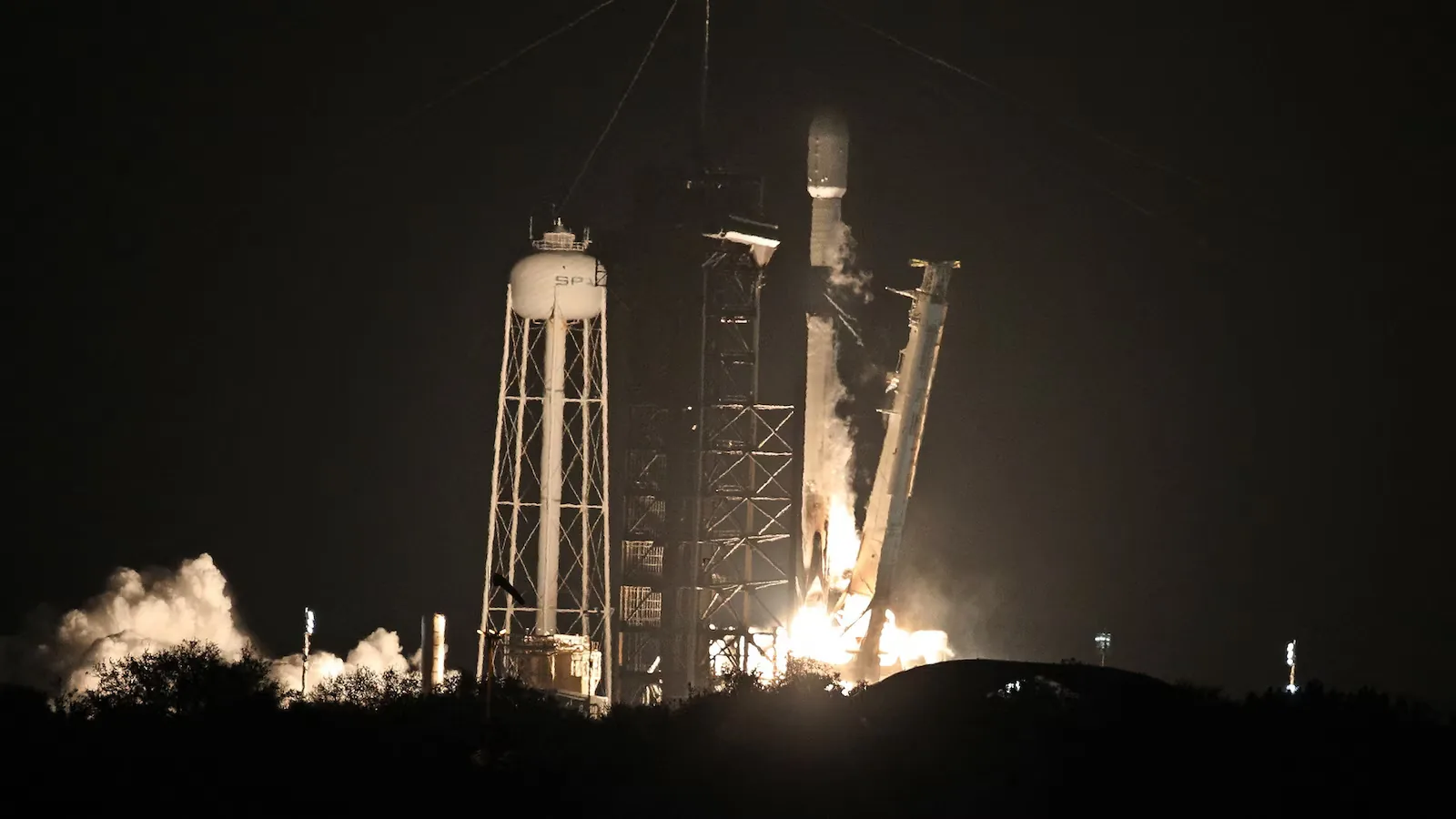
A discarded upper stage of a SpaceX Falcon 9 rocket is set to make an unintentional, high-speed collision with the moon on August 5, 2026. The approximately five-ton piece of space debris will strike the lunar surface near the Einstein crater on the western limb of the moon at approximately 2:34 a.m. ET. The uncontrolled descent was first predicted by astronomer Bill Gray, who has been tracking the object's trajectory. Gray also co-authored a study on the impending impact with an international team of researchers.
The collision is expected to vaporize the rocket stage, generating a significant flash of light and excavating a fresh crater on the moon. "We expect that to vaporize the booster, create a flash of light, probably a plume of ejecta -- dust, regolith, other stuff mixed into it -- and of course excavate a fresh crater on the lunar surface," explained Benjamin Fernando, a postdoctoral researcher at Los Alamos National Laboratory and lead author of the study. The findings were recently made available on the open-access preprint server arXiv, though the paper has not yet undergone peer review.
Unique Scientific Opportunity
Scientists view the impending impact as a rare chance to gather crucial data. Unlike natural meteoroid impacts, for which object mass and speed are often unknown, the characteristics of this SpaceX rocket stage are well-documented. "Because the researchers know those two variables for the upper stage, they can use the impact as a 'calibration event' to test all of the techniques that we use for studying natural impacts, which we don't know are going to happen in advance, unlike this event," Fernando stated. This calibration will help refine methods for studying unpredictable celestial events.
Furthermore, the impact will provide insights into the moon's composition. As the rocket stage disintegrates upon impact, it will eject a plume of lunar material. Researchers hope to measure the composition of this plume to learn more about the makeup of that specific region of the moon. This knowledge is increasingly valuable as organizations like NASA plan for future lunar missions, including a potential return of astronauts by 2028 and the establishment of a permanent lunar base.
Fernando also highlighted the impact's relevance to understanding lunar hazards. "These sorts of things are going to happen more and more often. And as we have more astronauts on the lunar surface, more lunar infrastructure habitats, for example, we need to understand how much of a risk these impact events actually pose," he said. The event will allow scientists to study both the direct risks, such as debris or flashes of light, and indirect risks, like clouds of ejected material interfering with spacecraft functions or lunar orbit. Studying these phenomena is critical for ensuring the safety of future human and robotic presence on the moon.
The rocket stage in question was part of the January 15, 2025, SpaceX launch carrying two lunar landers: Firefly Aerospace's Blue Ghost 1 and ispace's Resilience. While Blue Ghost successfully landed on March 2, 2025, the Resilience lander unfortunately crashed shortly before reaching the surface. The Falcon 9 upper stage was subsequently left in a moon-crossing orbit. "I don't think we know from SpaceX exactly to what degree they were in the know that this was going to happen," Fernando commented, adding that the orbit chosen for the stage likely presented a possibility of such an event. The exact awareness SpaceX had, or if the calculation was simply not performed, remains unclear.
Observing the impact will be challenging. The predicted flash will be too faint for the naked eye and even difficult to spot with small telescopes. While no impact flash has ever been recorded on a sunlit portion of the moon, researchers encourage amateur astronomers to point their telescopes toward the predicted impact site. "It might be that they see a flash of light. It might be that they see the plume of debris. Obviously, the bigger the telescope, the better the conditions, the more likely you are to see something," Fernando advised. The rarity of such events and the lack of precise observational data underscore the importance of widespread observation and reporting from anyone able to witness the phenomenon.