
SpaceX Rocket Crater Captured in First Moon Images by Korean Orbiter
South Korea's Danuri orbiter has captured the first images of a crater left on the Moon by a SpaceX Falcon 9 rocket stage. The impact occurred in January 2026.

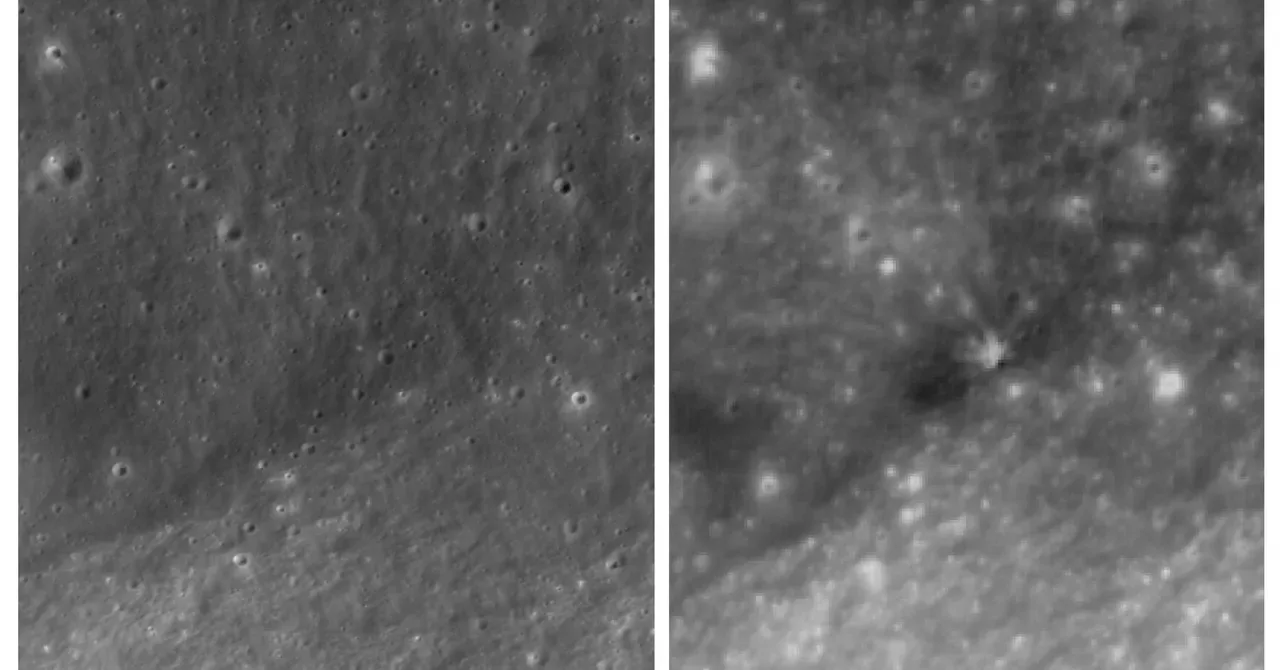
The first photographic evidence of a SpaceX Falcon 9 rocket stage impacting the Moon's surface has surfaced, offering a glimpse of the resulting crater. The Korea Aerospace Research Institute (KARI) released images captured by its Danuri lunar orbiter, which is part of a select group of satellites currently circling the Moon at an altitude of approximately 62 miles (100 kilometers). The Danuri orbiter passed over the impact zone shortly after the event, providing crucial before-and-after imagery. These new photographs reveal clear indications of a recent collision, consistent with astronomical projections that anticipated a crater dozens of feet wide and nearly 12 feet (3.6 meters) deep.
These visual confirmations align with earlier spectroscopic observations from the Very Large Telescope, which detected plumes of sodium and lithium rising from the lunar surface. This elemental release strongly suggested that the errant rocket fragment had indeed struck the Moon. Astronomers had meticulously predicted the timing and location of the SpaceX rocket impact well in advance, noting that the event might be discernible with sufficiently powerful observational tools. However, in the days leading up to the collision, space agencies like NASA cautioned that observing the precise moment of impact would be challenging due to factors such as atmospheric weather conditions and the specific timing of orbital passes.
Space debris and orbital mechanics
Like KARI, NASA operates its own lunar orbiters, and it is possible that higher-resolution images of the impact area will emerge in the coming days following thorough data verification. Nevertheless, even with enhanced resolution, obtaining a highly detailed view of the crater is unlikely given its relatively small scale compared to the vast lunar landscape. The Moon itself measures approximately 2,160 miles in diameter, underscoring the minuteness of the impact site in the broader cosmic context.
The Falcon 9 rocket stage's unintended crash landing followed an unstable orbit that lasted for over a year. Launched in January 2026 to deliver lunar landers, the rocket's trajectory was gradually altered by the gravitational pulls of Earth, the Moon, and the Sun. This extended period in an unstable orbit ultimately led to its collision with the lunar surface.
SpaceX addressed the incident, stating that for most missions, they carefully plan for the controlled deorbiting of the Falcon second stage to ensure a safe re-entry over the ocean. "In higher-energy missions, such as those heading to a lunar transfer orbit, nearly all of the vehicle’s performance is dedicated to successfully placing the payload into the intended orbit, and a controlled deorbiting maneuver is not always possible," the company explained. "We are actively working to be as responsible as possible with the hardware left in space and to ensure space safety, even on more complex missions."
The company further elaborated that in this particular case, the prolonged influence of solar activity and gravitational forces gradually deflected the second stage toward the Moon. "Impacts like this are rare, but they can occur with objects in these types of orbits, and we are collaborating with NASA to find the optimal disposal solution," SpaceX added, highlighting ongoing efforts to manage space debris responsibly.