
SpaceX to Launch Starship V3 on May 19, Featuring New Engines and Launch Pad
SpaceX is targeting May 19 for the maiden flight of its Starship Version 3 rocket. This mission, Flight 12, will be the first launch from the new Launch Pad 2 and will showcase upgraded Raptor 3 engines.

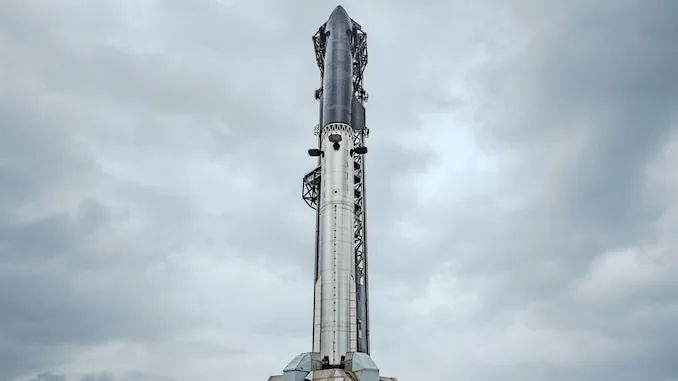
SpaceX is aiming for no earlier than Tuesday, May 19, for the highly anticipated debut of the third major iteration of its Starship-Super Heavy rocket. The announcement followed the successful completion of an integrated tanking test on Monday. This mission, designated Flight 12, marks not only the first launch of the collective Starship V3 but also the inaugural flight from Pad 2, an updated launch facility designed with both launch and catch capabilities.
Starship V3 incorporates a new generation of Raptor engines, referred to as Raptor 3. SpaceX stated on its website, “The flight test’s primary goal will be to demonstrate each of these new pieces in the flight environment for the first time, with each element of the Starship architecture featuring significant redesigns to enable full and rapid reuse that incorporate learnings from years of development and test.” While the flight profile remains suborbital, similar to previous tests, SpaceX will not attempt to catch either the upper stage (Ship 39) or the first stage (Booster 19) due to the numerous new components. Booster 19 is scheduled for a controlled splashdown in the Gulf of Mexico approximately seven minutes after liftoff. Ship 39 will target an aquatic landing in the Indian Ocean, about an hour into the mission.
Key Upgrades and Testing Objectives
This iteration of the Super Heavy booster features an integrated hot staging system, exposing the forward dome of the fuel tank during the stage separation. A non-structural steel layer, working with tank pressure, is designed to shield the liquid methane tank from the intense heat of the upper stage engines. As with previous flights, SpaceX plans to deploy simulated Starlink satellites from the Ship 39 upper stage. This mission will carry 22 satellites, nearly double the previous flights, with two possessing novel functionalities. These two satellites will conduct a unique test: scanning Starship’s heat shield and transmitting imagery to operators. This data aims to refine methods for assessing the heat shield's readiness for return-to-launch-site operations on future missions. To facilitate this test, several tiles on Starship’s heat shield have been painted white, serving as targets to simulate missing tiles.
SpaceX is also testing a more complete heat shield configuration. On previous missions, multiple tiles were intentionally omitted; for Flight 12, only one tile is intended to be missing at liftoff. According to SpaceX, “For Starship entry, a single heat shield tile has been intentionally removed to measure the aerodynamic load differences on adjacent tiles when there is a tile missing.”
The Raptor 3 engines have also seen significant upgrades. Sea-level variants now produce 250 tf (551,000 lbf), up from 230 tf (507,000 lbf), while vacuum engines generate 275 tf (606,000 lbf), an increase from 258 tf (568,000 lbf). Internal integration of sensors and controllers, shielded by engine thermal protection, eliminates the need for individual engine shrouds. A redesigned ignition system is also featured across all engine variants. These simplifications contribute to a mass reduction of approximately 1 ton per engine at the vehicle level.
The development of Starship V3 is crucial for NASA's lunar exploration ambitions, particularly its Human Landing System (HLS) program. Future versions of Starship are expected to demonstrate in-space propellant transfer, a capability vital for supporting lunar missions. Both SpaceX's Starship and Blue Origin's Blue Moon Mk.2 rely on multi-launch architectures that require fuel transfer to their respective landers. This complex maneuver has never been successfully executed in space before.
Tom Percy, NASA’s HLS Systems Engineering and Integration Manager, highlighted the importance of these developments. Speaking prior to the Artemis 2 mission, Percy stated, “That first prop transfer flight is going to be really important to us for SpaceX and we expect to see that and get some real great data from it.” He further elaborated on the broader implications: “I think more importantly for me, just as a long-term vision for space exploration, we know that multi-launch architectures for deep-space exploration are going to have to become a common thing. And so all the things that both providers (both SpaceX and Blue Origin) are doing to manage the development and the understanding of how to coordinate multiple launches to be able to build these bigger exploration systems is going to help us not only for the Moon, but also for Mars and beyond.” This mission represents a significant step towards realizing those ambitious goals in space exploration.