
Sun's Surface Revealed in Unprecedented Detail by Inouye Telescope
Scientists using the Inouye Solar Telescope have captured the sharpest image of the sun's surface ever. The new view reveals Kelvin-Helmholtz instability in action, offering fresh insights into stellar dynamics.

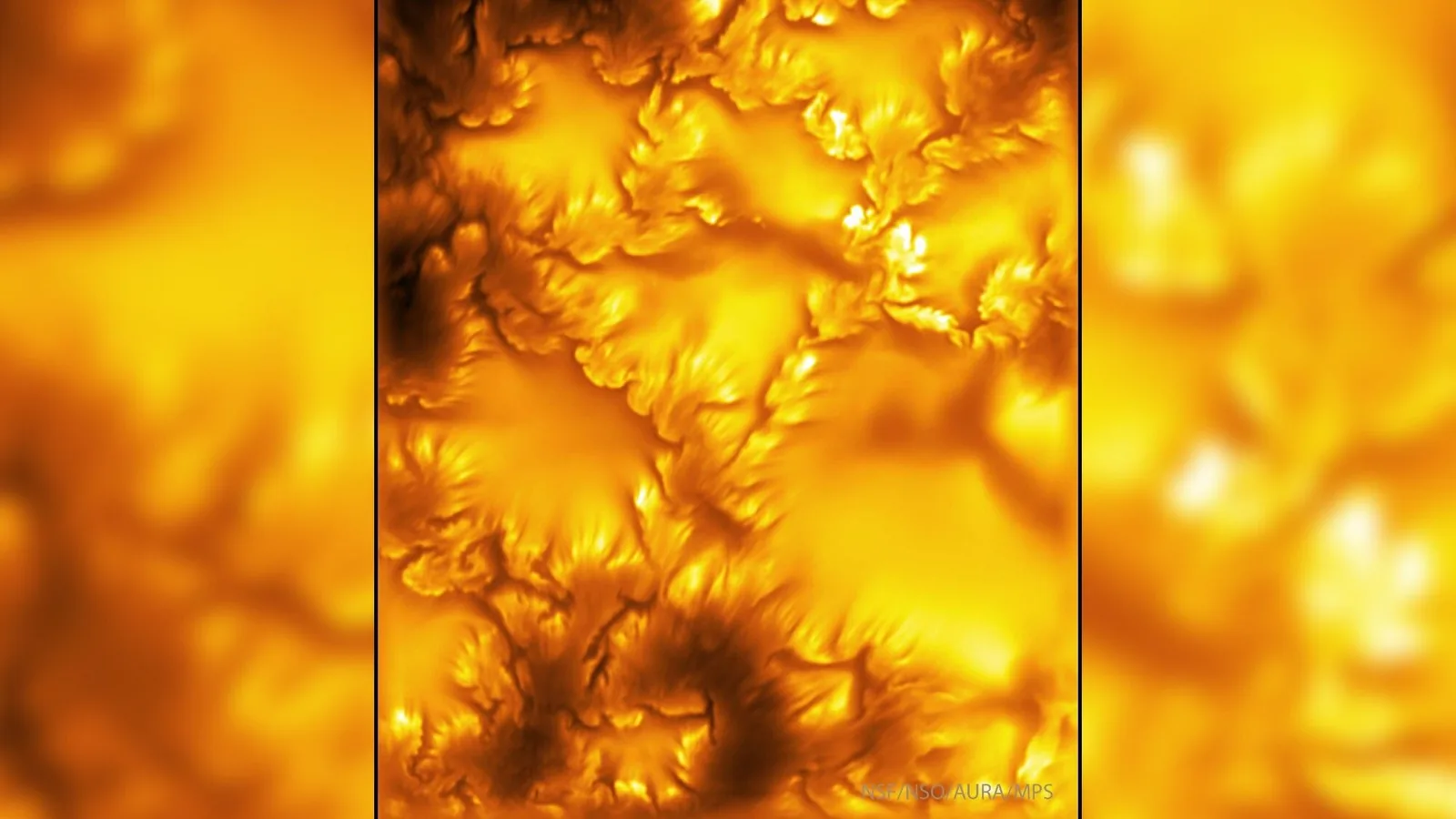
An international team of researchers has captured the most detailed image ever recorded of the sun's surface, revealing intricate patterns that offer new insights into the star's internal processes. The groundbreaking observations were made using the U.S. National Science Foundation's Daniel K. Inouye Solar Telescope in Hawaii.
Analysis of the high-resolution data has identified swirling patterns on the sun's surface at the edges of magnetic regions. These formations are the first direct visual evidence of Kelvin-Helmholtz instability (KHI), a phenomenon occurring when fluids moving at different speeds interact. While long suspected to exist on the sun, this marks the first time KHI has been directly observed and documented.
Understanding Solar Dynamics
The Inouye Solar Telescope, operational since 2020, is designed to observe the sun with unprecedented clarity, studying the solar wind and the sun's magnetic field to better understand the forces that shape our solar system. Its advanced instrumentation allows scientists to capture solar activity at a resolution never before possible.
"We believe that the discovery of Kelvin-Helmholtz Instability in the solar photosphere, backed up by analysis of numerical simulations, is a major step forward in our understanding of the dynamics and evolution of solar and stellar plasma, and will serve as a basis for future discoveries," said David Boboltz, the deputy director at the National Solar Observatory. The observations involved researchers from the National Solar Observatory, the NSF's High Altitude Observatory, and Germany's Max Planck Institute for Solar System Research.
Kelvin-Helmholtz instability is a fundamental concept in fluid dynamics, explaining how waves can form at the interface between two fluids moving at different velocities. On Earth, this can be observed in cloud formations or ocean waves. Applying this to the sun provides a crucial window into how energy and plasma are transported within stars.
The findings, published on August 10, 2026, are expected to enhance models of solar activity, potentially improving our ability to forecast space weather events. These events, such as solar flares and coronal mass ejections, can impact satellite operations, power grids, and communication systems on Earth. This new level of detail from the Inouye Solar Telescope provides critical data for refining these predictive capabilities.
Capturing such fine detail on the sun’s turbulent surface is a significant technological achievement. The sun's plasma is incredibly hot and dynamic, making it a challenging subject for observation. The telescope's ability to resolve these smaller-scale instabilities is key to unlocking deeper secrets about stellar physics. This research advances the field of heliophysics, the study of the sun and its influence on the solar system.