
Antarctic Glacier Drilling Team Reaches Ocean Beneath Thwaites Ice
A South Korean-led scientific mission has successfully drilled through the Thwaites Glacier in Antarctica, reaching the ocean cavity below. The team hopes data from the breakthrough will offer clues about future sea level rise.

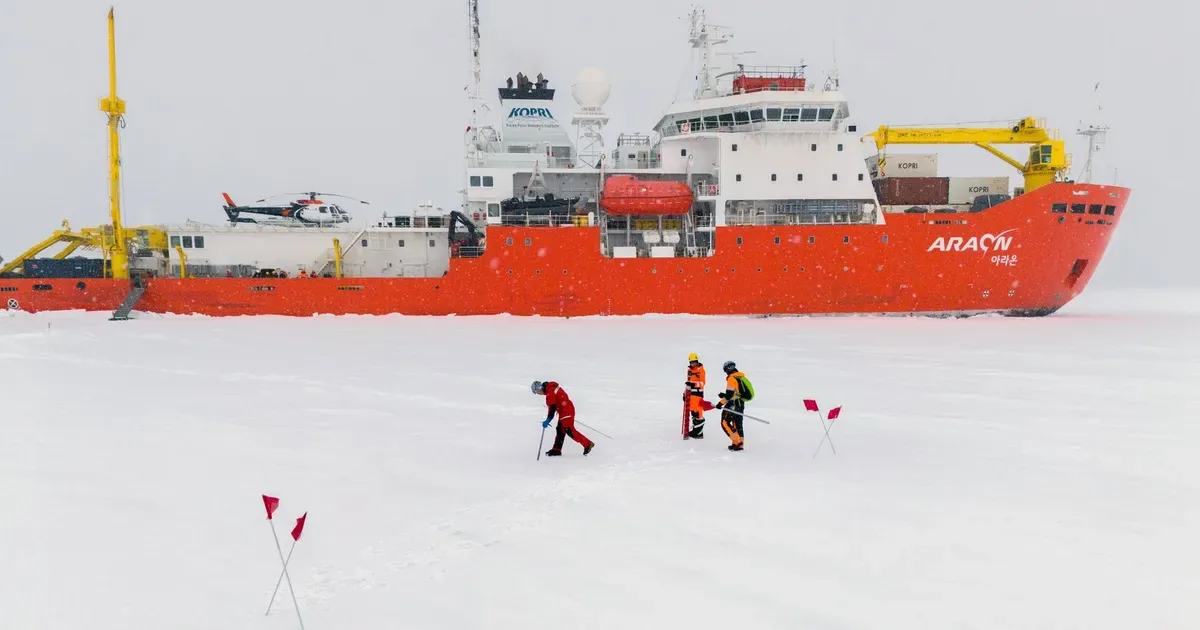
An international team of scientists, led by South Korean polar researcher Won Sang Lee, has successfully drilled through the massive Thwaites Glacier in Antarctica, reaching the ocean cavity that lies beneath. The mission, which involved piercing nearly half a mile of ice, aims to gather crucial data on the glacier's stability and its potential impact on global sea levels. The team faced challenging conditions, including extreme weather and the inherent dangers of working on a shifting ice sheet.
Lee, a geophysicist with the Korea Polar Research Institute, described Thwaites as a glacier that is noticeably melting, potentially within the lifetime of the current or next generation. "Thwaites, you can feel it," Lee stated. "It’s going to be gone, sooner or later. Not on centennial, millennial time scales. It might be within our lifetime, or the next generation." The urgency of understanding Thwaites stems from its potential to significantly raise global sea levels if it collapses entirely, a scenario that could inundate coastal cities worldwide.
The expedition's primary objective was to deploy instruments into the subglacial ocean cavity. After a lengthy journey and multiple delays, including waiting for favorable weather conditions to transport equipment onto the glacier via helicopter, the team commenced drilling operations. Using jets of hot water, they melted a 1-foot-wide hole through the ice. The process required meticulous effort, with engineers working around the clock over two days to achieve the breakthrough.
Challenges and Determination
The path to Thwaites was not without its obstacles. Lee, who has been dreaming of this research for nine years, faced personal tragedy shortly before the expedition when his father passed away. Despite his grief, he was encouraged by his family to continue with the mission, honoring his father's support for his scientific endeavors. The team also contended with logistical hurdles, including delays in reaching the glacier due to sea ice and unfavorable weather that initially grounded their helicopters.
Oceanographer Peter Davis, who was responsible for preparing and installing the instruments, emphasized the importance of perseverance. "With all the best fieldwork, you just sneak through, and then you get it done," Davis remarked, highlighting the resilient spirit of polar exploration. Once the drilling hole was complete and the instruments were successfully lowered, Davis began collecting data. The initial reports indicated a potential issue with the equipment being stuck, adding another layer of tension to the mission's final stages.
The Thwaites Glacier, often referred to as the "Doomsday Glacier," is a subject of intense scientific scrutiny due to its rapid melting and its potential to accelerate global sea level rise. Its complete collapse could contribute more than 15 feet to sea levels over centuries. The data collected by Lee's team is expected to provide invaluable insights into the ocean currents interacting with the glacier's base and the overall rate of its melt. This research is critical for refining climate models and informing strategies to mitigate the impact of rising seas on vulnerable coastal communities around the globe.
The team's success in penetrating the ice marks a significant achievement in polar research. The complex operations required the coordination of scientists and engineers, utilizing specialized equipment and enduring the harsh Antarctic environment. The data gathered from beneath the ice is anticipated to be a vital piece in the global puzzle of understanding and responding to climate change.