
Vera Rubin Observatory Begins 10-Year Universe Survey
Chile's Vera Rubin Observatory has launched a decade-long survey of the southern sky using a car-sized camera. The project aims to map billions of celestial objects and unravel cosmic mysteries.

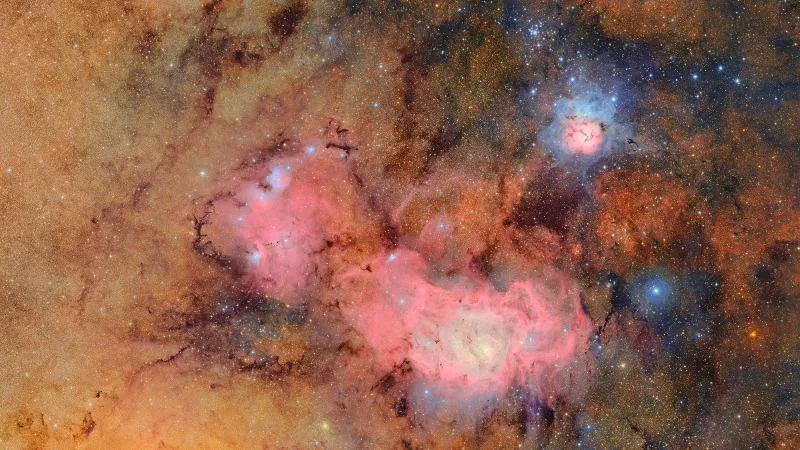
The Vera Rubin Observatory in Chile has officially commenced its historic Legacy Survey of Space and Time (LSST), embarking on a 10-year mission to capture unprecedented images of the southern sky. Starting Tuesday, the state-of-the-art facility will utilize its massive, car-sized digital camera to create a dynamic, time-lapse panorama of the cosmos, potentially unlocking profound secrets about galactic evolution and the universe's most enigmatic phenomena. The observatory, perched atop the 8,800-foot Cerro Pachón mountain, is equipped with the world's largest digital camera, weighing a substantial 6,600 pounds.
Over the next decade, the LSST will systematically scan the night sky, employing a series of colored filters to generate "color-rich" images. This comprehensive survey aims to document the movements and transformations of celestial bodies ranging from near-Earth asteroids to distant supernovae and black holes. The data collected is expected to provide a dynamic, living portrait of the universe, enabling scientists to observe rare and difficult-to-detect cosmic events in unparalleled detail. This ambitious project is jointly funded by the U.S. National Science Foundation and the Department of Energy, representing an $800 million investment in astronomical research.
Brian Stone, acting director of the U.S. National Science Foundation, remarked on the significance of the launch. "Today, we begin filming the greatest cosmic movie ever made," Stone stated in a press release. "This moment reflects decades of vision, innovation and the power of federal investment." The project's scope includes creating a comprehensive new inventory of objects within our solar system and the Milky Way galaxy, as well as contributing to the understanding of dark matter by analyzing the distorted light patterns from remote galaxies.
Mapping the Cosmos and Its Mysteries
The LSST's operational review and system optimization took longer than initially anticipated, with the survey's start date being pushed back from early 2026. "The decision to officially begin the LSST was made after a period of system optimization and a careful operational review of technical readiness, data system performance and scientific validation," explained Željko Ivezić, head of the LSST. "Important factors that played a role in this decision included image quality, effective survey speed, system uptime and reliability, and calibration accuracy."
Each night, the observatory's sophisticated camera will capture thousands of images, completing a full sweep of the southern sky every few days. The telescope's ability to revisit the same celestial patch hundreds of times throughout the survey will allow for the creation of detailed evolutionary timelines for star systems and galaxies. This long-term observation strategy is particularly valuable for studying transient astronomical events. "Rubin is bringing the universe to life, illuminating a treasure trove of discoveries: pulsating stars, supernova explosions, the fossil record of galaxies, clues to the mysteries of dark energy and dark matter, and entirely new phenomena never seen before," a statement from the observatory team highlighted.
Preliminary imaging conducted during system optimization has already yielded significant findings, including the detection of 11,000 new asteroids and numerous other novel objects within our solar system. As the LSST progresses, researchers will leverage artificial intelligence and machine learning algorithms to sift through the vast quantities of data, identifying notable changes and phenomena. Scientists anticipate the system will generate approximately 7 million alerts nightly, flagging interesting movements, explosions, or other significant celestial events. The observatory has also committed to making its data widely accessible. "When the LSST is complete, the final dataset will contain billions of objects with trillions of measurements, all accessible through regular data releases," according to the observatory’s news release. "This is the first time so much astronomical data will be available to so many people, opening the door to new kinds of discoveries by both scientists and the public." This open-data approach is expected to democratize astronomical research, enabling a broader community of scientists and enthusiasts to contribute to our understanding of the universe.