
Webb Telescope's Vast Cosmic Map Reveals Universe's Hidden Structure
The James Webb Space Telescope has produced the largest-ever map of the universe, detailing the cosmic web's structure and galaxy evolution over 13 billion years. This new map enhances our understanding of celestial formation and star life cycles.

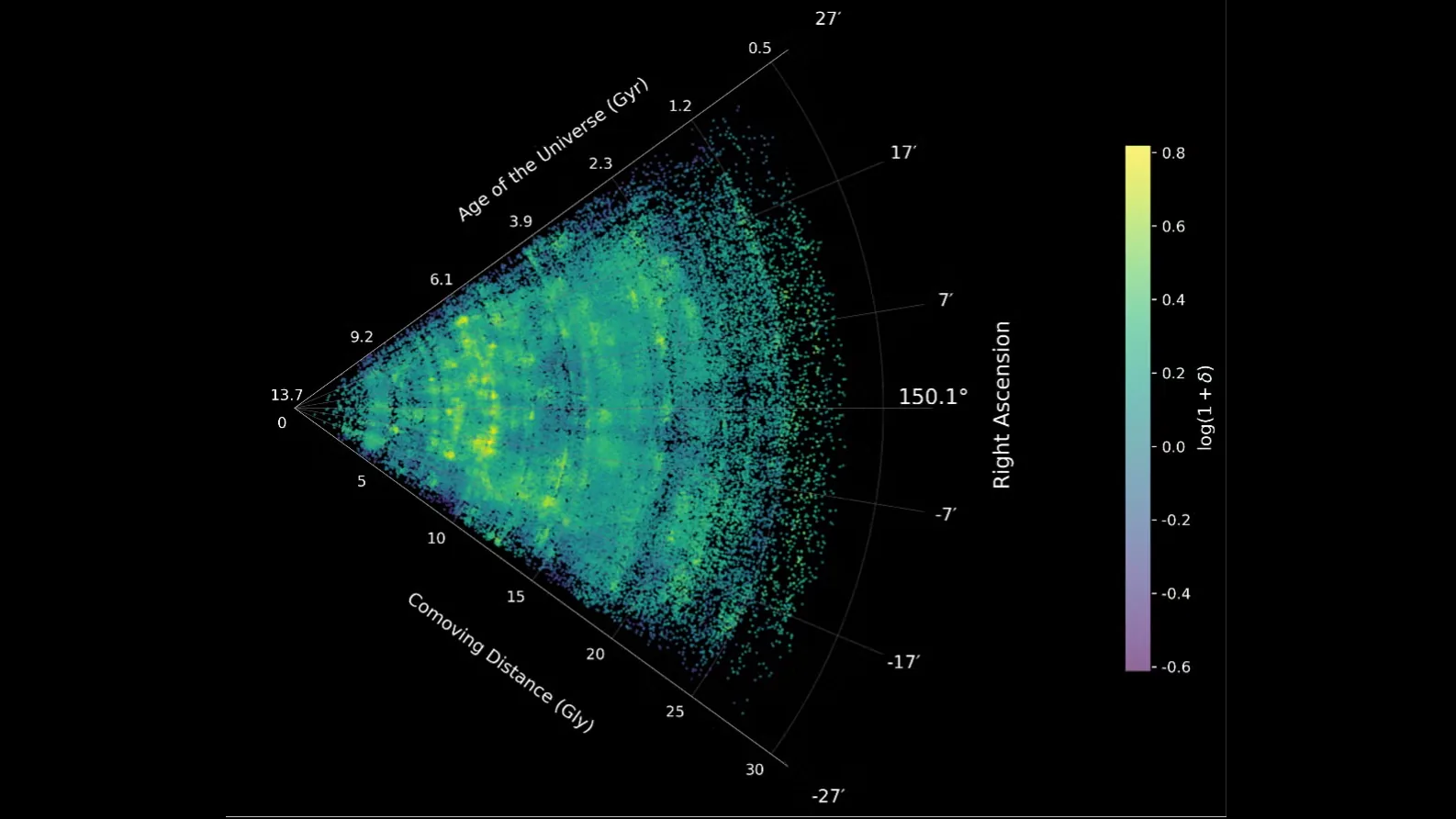
Astronomers have unveiled an unprecedentedly detailed map of the universe's underlying structure, thanks to the most extensive survey yet conducted by the James Webb Space Telescope (JWST). This ambitious project, named COSMOS-Web, allows scientists to trace the evolution of galaxies from the universe's infancy approximately 13 billion years ago to their current arrangements within the vast cosmic web. This immense framework, composed of gas filaments, stars, voids, and dark matter, dictates the large-scale organization of all celestial bodies.
Published on May 6 in The Astrophysical Journal, the research was led by a team from the University of California, Riverside (UCR). By analyzing a wealth of JWST data, they have shed new light on how intrinsic and external forces shape the birth and death of stars, thereby influencing the development of galaxies and galactic clusters across cosmic epochs. A key finding is that the universe has already passed its peak era of star formation, a transition facilitated by the very structure of the cosmic web.
"We show how the cosmic web helped shape galaxy growth before, during, and after that peak era," explained Hossein Hatamnia, a co-author and astronomer at UCR, in an email. "At earlier times, dense regions appear to be sites of rapid galaxy growth, while at later times dense environments are associated with the shutdown of star formation."
Revealing Cosmic Architecture in Unprecedented Detail
The COSMOS-Web survey is the most ambitious JWST program to date, dedicating 255 hours to observe a contiguous region of the sky roughly three times the size of the full moon. Compared to previous surveys like COSMOS2020, which utilized the Hubble Space Telescope and other instruments, COSMOS-Web offers superior redshift precision and captures a greater number of galaxies, including fainter, lower-mass, and more distant objects. Redshift, a measure of cosmic distance and time, is determined by the stretching of light waves as they travel across the universe.
Previous maps, while valuable, were often sparser and less detailed, particularly in dense cosmic regions where galaxies form and grow earlier and larger. The older COSMOS2020 survey, for instance, tended to overestimate the depth in these crowded areas and underestimate it in less dense regions. In contrast, the JWST-derived map from COSMOS-Web maintains relative contrast across different cosmic environments, providing a clearer picture.
This enhanced clarity reveals crucial details about galaxy evolution. The map indicates that massive galaxies within dense environments are more likely to become quiescent, meaning their star-forming potential is shutting down. The researchers theorize that this phenomenon is linked to the sheer mass of these galaxies. Once the dark matter halos anchoring them reach about 1 trillion solar masses, they can energize surrounding gas, preventing new star formation. Furthermore, the intense jets emitted by active supermassive black holes at galactic centers can also quench star formation by heating gas to prohibitive temperatures.
These mass-related star-killing mechanisms were dominant until approximately 7 billion years ago, about half the age of the universe. In more recent cosmic history, the surrounding environment of galaxies plays a more significant role in quenching star formation, potentially by stripping away essential materials or hindering the accumulation of cold gas needed for star birth.
"The jump in depth and resolution is truly significant, and we can now see the cosmic web at a time when the universe was only a few hundred million years old, an era that was essentially out of reach before JWST," stated Bahram Mobasher, a distinguished professor of physics and astronomy at UCR and co-author of the study. This advancement allows astronomers to study the early universe with unparalleled clarity, resolving faint, ancient galaxies previously obscured by the limitations of earlier instruments.
The comprehensive catalog of 164,000 galaxies compiled for the construction of this cosmic web map is now publicly accessible, promising to fuel further research into the universe's grand structure and evolution for years to come. This data is a cornerstone for understanding galactic clustering and the distribution of matter on the largest scales.