
Webb Telescope Spots Galaxy Behind Most Distant Fast Radio Burst
The James Webb Space Telescope has identified the galaxy responsible for the most distant Fast Radio Burst (FRB) ever detected. The signal originated from a galaxy 10 billion light-years away.

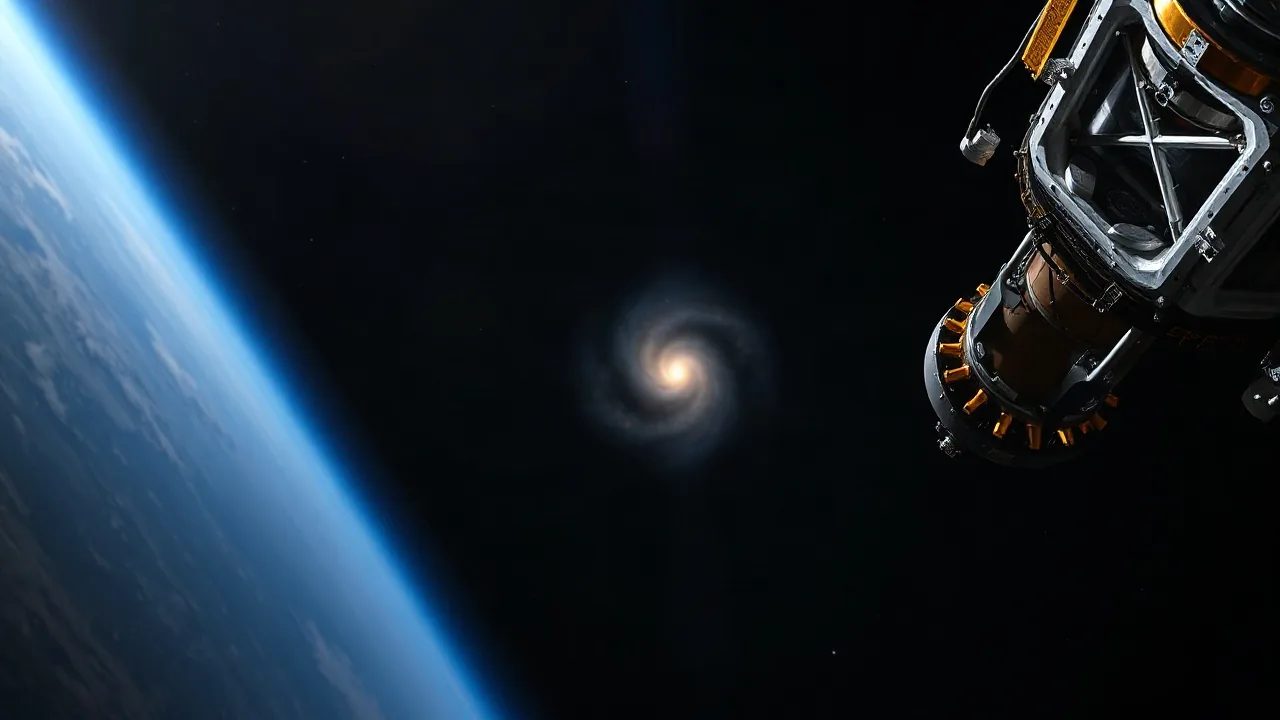
The James Webb Space Telescope (JWST) has achieved a new milestone, pinpointing the precise galaxy that emitted the farthest Fast Radio Burst (FRB) ever observed. This remarkable detection helps astronomers understand the enigmatic origins of these powerful cosmic signals, which are millisecond-long flashes of radio waves originating from deep space.
The FRB, designated FRB 20220610A, was first detected by the Canadian Hydrogen Intensity Mapping Experiment (CHIME) in British Columbia, Canada. However, it was the advanced infrared capabilities of the JWST that allowed scientists to trace the signal back to its source galaxy, located an astonishing 10 billion light-years from Earth. This places the event in the very early universe, when the cosmos was only about 3.8 billion years old.
This discovery is significant because FRBs are notoriously difficult to localize. Their fleeting nature and immense distances make it challenging to identify their parent galaxies. Previously, the most distant FRB was localized to a galaxy about 3 billion light-years away. The new detection by JWST pushes that boundary considerably further into cosmic history.
A Surprising Source Galaxy
What makes this finding particularly intriguing is the nature of the source galaxy itself. Unlike some other localized FRBs that have been found in active star-forming regions, FRB 20220610A appears to originate from a galaxy that is not actively creating new stars at a high rate. This suggests that the mechanisms behind some FRBs might be more diverse than previously assumed.
"We were astonished to find that the host galaxy of this FRB is quite mature, with older stars, and has not formed new stars in a long time," said Dr. Ryan Chiti, a postdoctoral researcher at the University of Toronto and co-author of the study published in Nature. "This tells us that the mechanisms that produce FRBs may not be linked to very young, massive stars, as some theories have suggested."
The detection was made possible by JWST's Near-Infrared Camera (NIRCam) instrument, which can capture highly detailed images of distant celestial objects. By analyzing the light captured by NIRCam, astronomers were able to determine the distance to the host galaxy and study its properties.
Fast Radio Bursts are one of the most puzzling phenomena in astrophysics. While their exact cause remains unknown, leading theories involve highly magnetized neutron stars, known as magnetars. These incredibly dense remnants of collapsed stars can generate intense magnetic fields capable of producing powerful radio emissions. However, the varied environments in which FRBs have been found are prompting scientists to consider alternative or supplementary explanations.
The ability of the Webb Telescope to peer back billions of years in time is revolutionizing our understanding of the early universe. This latest discovery adds another piece to the complex puzzle of FRBs, offering crucial data points to refine theoretical models. Astronomers plan to use JWST to search for more distant FRBs, aiming to build a comprehensive picture of their distribution and evolution across cosmic time. This could unlock deeper insights into the conditions of the universe shortly after the Big Bang and the extreme physics governing these enigmatic signals.