
Webb Telescope Finds Early Black Hole Preceded Galaxy
The James Webb Space Telescope has detected a supermassive black hole in the early universe that appears to have formed before its host galaxy, challenging current models of cosmic evolution.

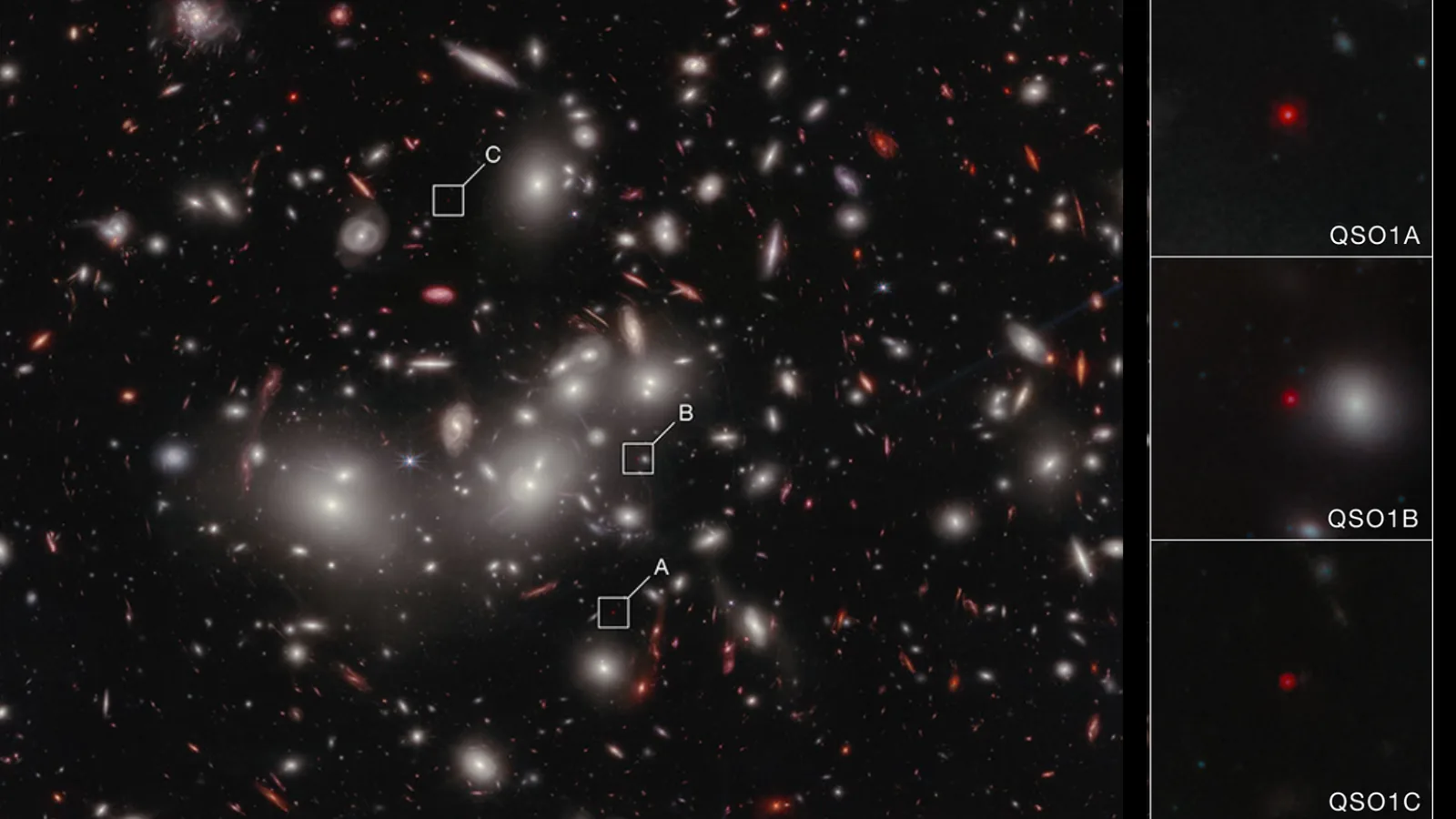
The James Webb Space Telescope (JWST) has made a groundbreaking discovery, revealing a supermassive black hole in the early universe that predates its host galaxy. This finding, observed in a celestial object known as a "Little Red Dot," could fundamentally alter our understanding of how black holes and galaxies form and grow. The object, designated Abell2744-QSO1, existed just 700 million years after the Big Bang.
Little Red Dots first appeared in JWST observations in 2022, puzzling astronomers with their unique characteristics and prevalence in the infant universe. These ancient galaxies seem to vanish around 1.5 billion years after the Big Bang. Alongside these mysterious dots, JWST has identified numerous supermassive black holes with masses millions to billions of times that of our sun existing before the universe was a billion years old. This presents a significant challenge, as it was previously believed that the processes of feeding and merging required for black holes to reach supermassive status would take longer than this timescale.
A Paradigm Shift in Cosmic Understanding
The new study focusing on Abell2744-QSO1 suggests that supermassive black holes might form directly, bypassing the need for a massive star to collapse over millions of years. This implies these early black holes may not have needed to consume vast amounts of gas and dust from their nascent galaxies to achieve their immense size, suggesting they could have formed before their host galaxies coalesced. "This is a remarkable finding," stated team member Roberto Maiolino of the University of Cambridge. "It's a paradigm shift, a total revisiting of the classical scenarios of how black holes form and grow." The research was published on May 27 in the journals Nature and the Monthly Notices of the Royal Astronomical Society.
To reach this conclusion, scientists concentrated on Abell2744-QSO1, an object whose light has traveled for over 13 billion years to reach Earth. The 1,300 light-year-wide galaxy existed when the universe was only about 700 million years old. Studying QSO1 was facilitated by gravitational lensing, a phenomenon predicted by Albert Einstein where the gravity of a massive object between an observer and a distant light source bends and magnifies the light from the background object. In this case, the galaxy cluster Abell 2744, also known as Pandora's Cluster, acted as the lens.
Initial assumptions suggested QSO1 was a supermassive black hole weighing 40 million solar masses, enveloped by gas. However, precisely measuring its mass in the early universe was problematic. "Before now, all of the mass measurements of black holes in the early universe have been indirect, based on assumptions from what we know about them in the local universe," explained team member Francesco D'Eugenio, also from the University of Cambridge. "We didn't know if those assumptions really apply to the distant universe."
The research team hypothesized that if the central black hole was indeed as massive as presumed, its mass should influence the motion of surrounding gas. Using the JWST's Near Infrared Spectrograph (NIRSpec), they mapped the gas's orbital patterns. They observed a clear Keplerian motion—gas orbiting a central point like planets around a sun—indicating that the mass was concentrated at the center. "This is important because it tells us that most of the mass of QSO1 is concentrated in the black hole at the center," said team co-leader Ignas Juodžbalis of Cambridge University. "If the mass were more distributed, as it would be if there were a lot of stars, the gas would not have this perfect Keplerian rotation."
This direct measurement confirmed QSO1's central black hole possesses a mass of 50 million solar masses. Astonishingly, this black hole accounts for 66% of the total mass of the Little Red Dot. This ratio is thousands of times greater than what is observed in local universe galaxies, where black holes typically constitute a much smaller fraction of the total mass. This finding strongly suggests that the black hole could not have formed from a collapsing star and grown through gradual accretion within its host galaxy. Instead, it implies the black hole was born "big" and the galaxy is now forming around it. The precise formation mechanism remains a subject of investigation, with theories ranging from the collapse of a "heavy seed" gas cloud to direct formation during the Big Bang itself.
The team is now examining other Little Red Dots to ascertain if they also harbor similarly massive, precocious black holes with galaxies in development. This ongoing research promises to further refine our understanding of the complex interplay between black holes and their galactic environments in the earliest epochs of the cosmos.