
AI and Construction Careers: Jensen Huang's 2026 Workforce Forecast
NVIDIA CEO Jensen Huang predicts AI will reshape construction jobs by 2026, eliminating routine tasks but creating demand for tech-savvy workers. Learn what skills matter most.

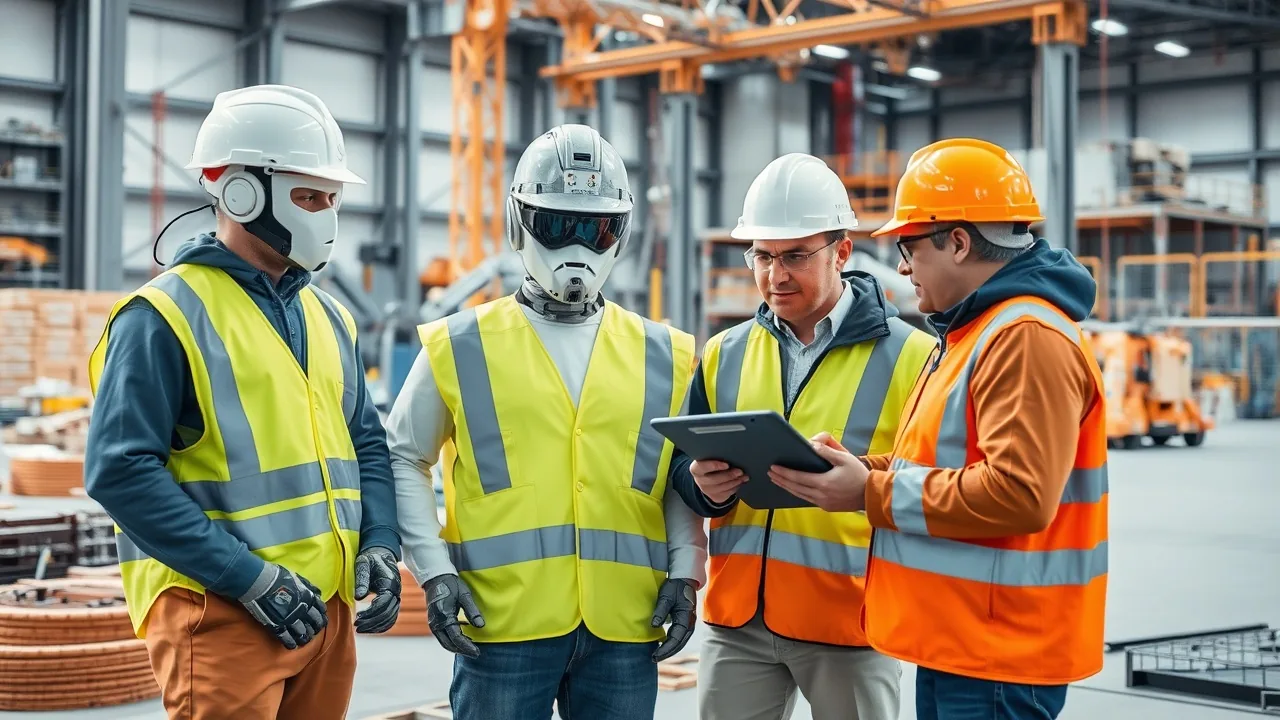
Jensen Huang, chief executive of NVIDIA, told an audience at the Construction Industry Round Table in June 2026 that artificial intelligence will not destroy construction careers but will fundamentally alter what the job entails. The shift, he argued, is already underway across project management, safety monitoring, and equipment operation.
"We are not replacing construction workers," Huang said during his keynote address. "We are replacing the parts of construction work that are repetitive and dangerous. The human element, the creativity, the decision-making under uncertainty—those remain irreplaceable." His remarks reflect a broader consensus among technology leaders that the construction industry, one of the slowest to adopt digital tools, stands at an inflection point in 2026.
Construction careers have historically relied on manual labor, site experience, and apprenticeships. That foundation has not changed, but the skill set demanded of workers has accelerated. Crane operators now manage semi-autonomous equipment. Project managers interpret real-time data feeds from hundreds of sensors. Safety officers review drone footage and AI-generated hazard assessments before boots hit the ground.
The Shift from Manual to Data-Driven Work
The construction sector employed 11.8 million workers in the United States as of July 2026, according to the Bureau of Labor Statistics. Of that workforce, roughly 30 percent work in roles that involve routine decision-making—tasks that machine learning can now handle. Site superintendents spend less time walking jobsites with clipboards; instead, they review thermal imaging and structural monitoring data on tablets. Estimators no longer rely solely on past projects; AI models trained on thousands of builds predict material costs with 95 percent accuracy.
This does not mean those jobs disappear. Rather, the cognitive load shifts. A superintendent in 2026 must interpret AI recommendations, override them when field conditions demand it, and coordinate teams across distributed worksites. These roles require both domain expertise and technological fluency.
AI in construction is not limited to prediction and monitoring. Robotic systems now handle formwork, concrete finishing, and bricklaying on major commercial projects. Companies like Dusty Robotics and Sarcos Robotics have deployed units on hundreds of sites. Yet each robot requires a technician with dual competency: understanding the machine's algorithms and knowing how to troubleshoot when it encounters an unforeseen condition.
Skills and Credentials for 2026 and Beyond
Industry bodies and education providers are racing to define the new credential stack. In March 2026, the Construction Industry Institute published a skills framework identifying five core competencies for construction professionals:
- Data literacy and interpretation of analytics dashboards
- Equipment and robotics operation, including AI-assisted systems
- Cybersecurity awareness for jobsite networks
- Change management and adaptive problem-solving
- Stakeholder communication across remote and on-site teams
Community colleges across the country have launched new certificate programs. Arizona State University, in partnership with Turner Construction and Bechtel, introduced a Construction Technology specialization in January 2026. The curriculum blends traditional construction management with Python programming, machine vision, and IoT sensor deployment. Enrollment jumped 45 percent in the first semester.
Existing workers are not left behind. Trade unions, particularly the International Union of Operating Engineers (IUOE), have partnered with technology vendors to retrain members. The IUOE launched a "Heavy Equipment Technology" apprenticeship track in 2025 that integrates AI safety systems and autonomous vehicle operation. As of August 2026, over 2,800 journey-level operators have completed the program.
Automation in construction is not uniform across the industry. Megaprojects—infrastructure bonds, data center builds, and urban renewal efforts—adopt advanced robotics and AI first. Smaller residential and commercial contractors remain reliant on skilled labor. This creates a bifurcation in the job market. Workers who upskill in technology command higher wages; those who do not face declining demand for purely manual roles.
Economic and Social Implications of the Transition
Huang's forecast carries implications beyond individual career paths. The construction industry has historically been a gateway to middle-class stability for workers without four-year degrees. Wage earners in skilled trades earn median salaries of $65,000 to $85,000 annually, often without student debt. If future of work requirements push workers toward continuous education and technology certifications, the barrier to entry may shift.
Labor economists at the Urban Institute published a report in May 2026 projecting that construction jobs requiring AI literacy will grow by 18 percent through 2030, while purely manual positions contract by 8 percent. The aggregate effect is net job growth, but the composition changes. Workers aged 55 and older face the steepest adjustment.
Employers are responding with incentives. Salary premiums for workers certified in AI-assisted equipment operation now range from 12 to 20 percent above baseline pay. Several major contractors—Skanska, Kiewit, and Boral—offer tuition reimbursement for employees pursuing technology credentials. These programs are not universal, however, and depend on company size and capital availability.
Huang's comments also underscore a philosophical point: technology forecast accuracy depends on how organizations deploy tools, not on the tools themselves. A company that purchases autonomous equipment but retains hierarchical, silo-based management will not realize productivity gains. A firm that integrates AI insights into collaborative decision-making, invests in workforce development, and treats technology as a complement to human judgment will outperform peers.
The construction sector in August 2026 stands at a crossroads. The imperative to adopt AI and automation is no longer aspirational; it is competitive necessity. Simultaneously, the human skills—site judgment, risk management, client relations—that AI cannot replicate have become more valuable. Workers and employers who recognize this duality and act accordingly will shape the industry's next decade.