
OpenAI Unveils GPT-Live Voice Models for Natural Chatbots
OpenAI has launched new conversational voice models, GPT-Live-1 and GPT-Live-1 mini, designed to offer more natural, real-time interactions in ChatGPT. The models enable seamless interruptions and full-duplex communication, aiming to enhance user engagement.

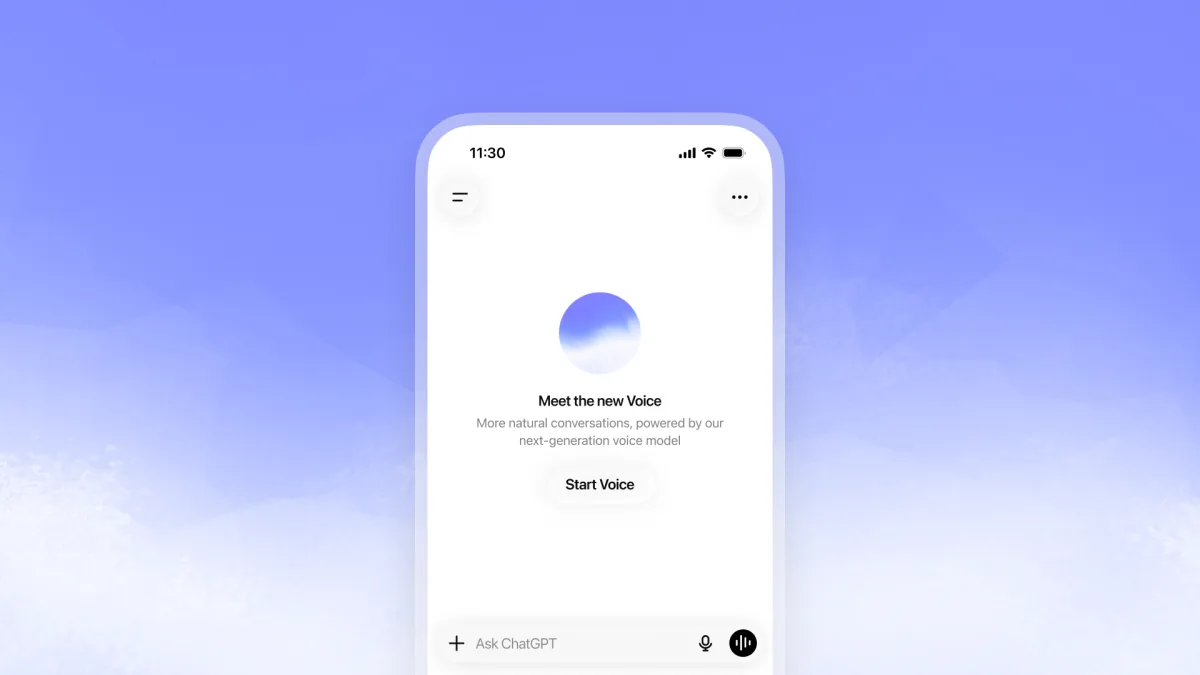
OpenAI announced on July 8, 2026, the release of its advanced conversational voice models, dubbed GPT-Live-1 and GPT-Live-1 mini, which aim to significantly improve the naturalness and responsiveness of interactions with AI assistants. These new models are engineered for full-duplex communication, meaning they can listen and speak simultaneously. This capability allows users to interrupt the AI naturally and opens the door for features such as real-time language translation during conversations. The company is replacing its current advanced voice mode in ChatGPT with the GPT-Live-1 mini model as the default for all users, while subscribers to paid tiers will gain access to the more powerful GPT-Live-1 version.
Previously, voice interactions in ChatGPT relied on a pipeline of separate models: one for speech-to-text transcription, a large language model for generating responses, and a text-to-speech model for output. OpenAI stated during a press briefing that the new integrated models address shortcomings of the older system, such as the AI interrupting users or lacking the intelligence to handle complex queries effectively. The updated system will now leverage OpenAI's latest text models, like GPT-5.5, to handle search, reasoning, and agentic tasks, allowing the conversation to flow uninterrupted.
Enhancing Long-Term Conversations and Contextual Awareness
A key improvement highlighted by OpenAI is the models' ability to remain silent and absorb conversational context over extended periods before responding when prompted. This enhanced contextual awareness is crucial for enabling longer, more complex dialogues. During the briefing, Atty Eleti, ChatGPT Voice's product lead, shared that he has engaged in 30- to 40-minute conversations with the voice feature, suggesting its potential for intricate tasks. OpenAI envisions voice as a primary interface for computing, particularly for complex work. Eleti elaborated, "Over time, we think this will also unlock the ability to use voice as a kind of primary interface to computing, and to manage increasingly complex long-running agentic work. The kind of amazing use cases that we see people using Codex and ChatGPT to accomplish, we think voice can be the future interface to all kinds of work."
The company also demonstrated that the new voice mode can present information visually, a feature also being explored by other startups like Monogram, which secured $40 million in seed funding from DST and Lux Capital for its interactive assistant technology. OpenAI's focus on voice features follows years of development aimed at making ChatGPT's voice mode more natural and engaging. Currently, over 150 million users interact with ChatGPT through features like Voice and Dictation.
Competitors are also enhancing their voice assistants. Apple and Amazon have introduced updates to make their respective assistants more conversational and better at handling context. Startups such as Sesame, co-founded by Oculus co-founder Brendan Iribe and Ankit Kumar, are also developing AI assistants capable of natural conversation and background task completion. OpenAI's advancements align with this trend, striving to provide a more seamless, hands-free experience for extended use.
Despite the drive for natural interaction, OpenAI emphasized that the new models are not intended to be AI companions. Built-in safeguards are designed to ensure age-appropriate responses for teenagers and to provide resources if sensitive topics like self-harm arise. However, the new voice mode is not without its challenges. A demonstration of the live translation feature into Hindi revealed an assistant with a noticeable American accent and slightly unnatural, bookish Hindi pronunciation. OpenAI stated that the mode is optimized for "most spoken languages" but did not specify which ones.