
SpaceX Launches Falcon 9 With 81 Satellites, Including Fire Detectors, 3D Printers
SpaceX launched its Falcon 9 rocket carrying 81 customer satellites into orbit from California early Tuesday. The payload includes advanced fire detection satellites, military technology demonstrators, and a 3D printer for use in space.

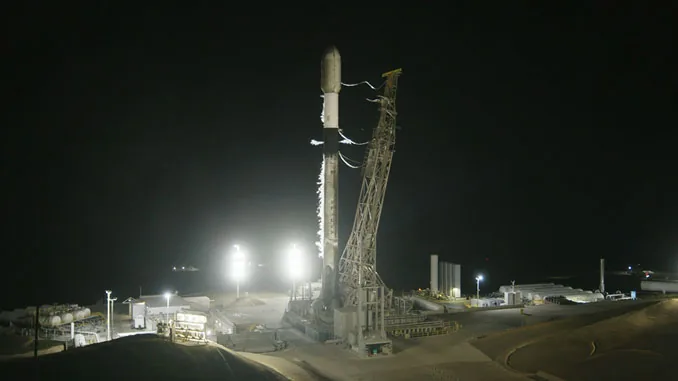
A SpaceX Falcon 9 rocket blasted off from Vandenberg Space Force Station in California early Tuesday, carrying 81 customer satellites into a Sun-synchronous Earth orbit. The mission, designated Transporter-17, is part of SpaceX's ongoing Smallsat Rideshare Program, a cost-effective service for deploying numerous smaller satellites from various clients.
Liftoff occurred at 12:12 a.m. PDT (3:12 a.m. EDT) from Space Launch Complex 4 East. The reusable Falcon 9 booster, designated B1097 for its 11th flight, is expected to land on the drone ship 'Of Course I Still Love You' approximately 8.5 minutes after launch, marking another milestone in SpaceX's reusable rocket technology.
The diverse payload highlights the growing demand for small satellite deployment. Among the 81 payloads are three FireSat satellites from the nonprofit Earth Fire Alliance. These satellites are designed to aid in detecting wildfires from orbit, building upon a prototype launched in March 2025. The alliance aims to establish a constellation of over 20 satellites by 2029 to achieve near real-time wildfire monitoring, with the ultimate goal of deploying more than 50 satellites.
Advanced Technologies and Military Demonstrators
Beyond wildfire detection, the Transporter-17 mission is ferrying a variety of cutting-edge technologies. Exolaunch, a major satellite aggregator for the mission, is responsible for 49 of the 81 satellites from 20 international customers. This includes four synthetic aperture radar satellites from Iceye and the first of Unseenlabs' second-generation satellites for space-based radio detection.
Another significant payload is the UAE's first low Earth orbit PNT (position, navigation, and timing) satellite, Leonav-1. Maverick Space Systems is also a key player, manifestingsatellites including SCION-X, which will study the ionosphere and upper atmosphere, and KOYO, a technology demonstrator for a fiber optic gyroscope from Taiwan's National Central University.
The mission also features SPEAR-1, a satellite developed by NearSpace Launch under a contract from the Naval Research Laboratory and the Department of Defense. This spacecraft is part of a three-satellite constellation designed for rapid and cost-effective testing of new technologies in orbit. "By raising the Technology Readiness Level of critical systems, missions like SPEAR help ensure promising innovations can move more quickly from research into operational use," a spokesperson for Seops Space stated regarding the technology demonstrator.
Perhaps one of the most novel payloads is the Replicator-2 satellite from Polish-German company Orbital Matter. This satellite is designed to test the capabilities of 3D printing materials in the vacuum of space. It carries four Printer Assisted Deployment Systems (P.A.D.S.), two of which will deploy custom foldable solar arrays, while the other two will function as standalone printers, including one designed to deploy a secret antenna payload. "The goal for this mission is to not only show that 3D printing is possible directly in the harsh space environment but also to show that it can be used for deployment right now!" Orbital Matter CEO Robert Ihnatisin said on LinkedIn. This mission represents the latest step in advancing orbital manufacturing technologies.
SpaceX's Smallsat Rideshare Program, initiated in 2020, has democratized access to space for a wide range of organizations, from research institutions and startups to established aerospace companies and government entities. By consolidating multiple payloads onto a single Falcon 9 launch, SpaceX significantly reduces the cost per kilogram for satellite deployment, enabling a new wave of innovation in areas like Earth observation, telecommunications, and scientific research. The success of missions like Transporter-17 underscores the critical role of reliable and frequent launch services in advancing these technological frontiers.