
99 Million-Year-Old Feather in Amber Sheds Light on Flight Evolution
A 99-million-year-old pennaceous feather discovered in Burmese amber provides new clues about the stepwise evolution of prehistoric flight capabilities.

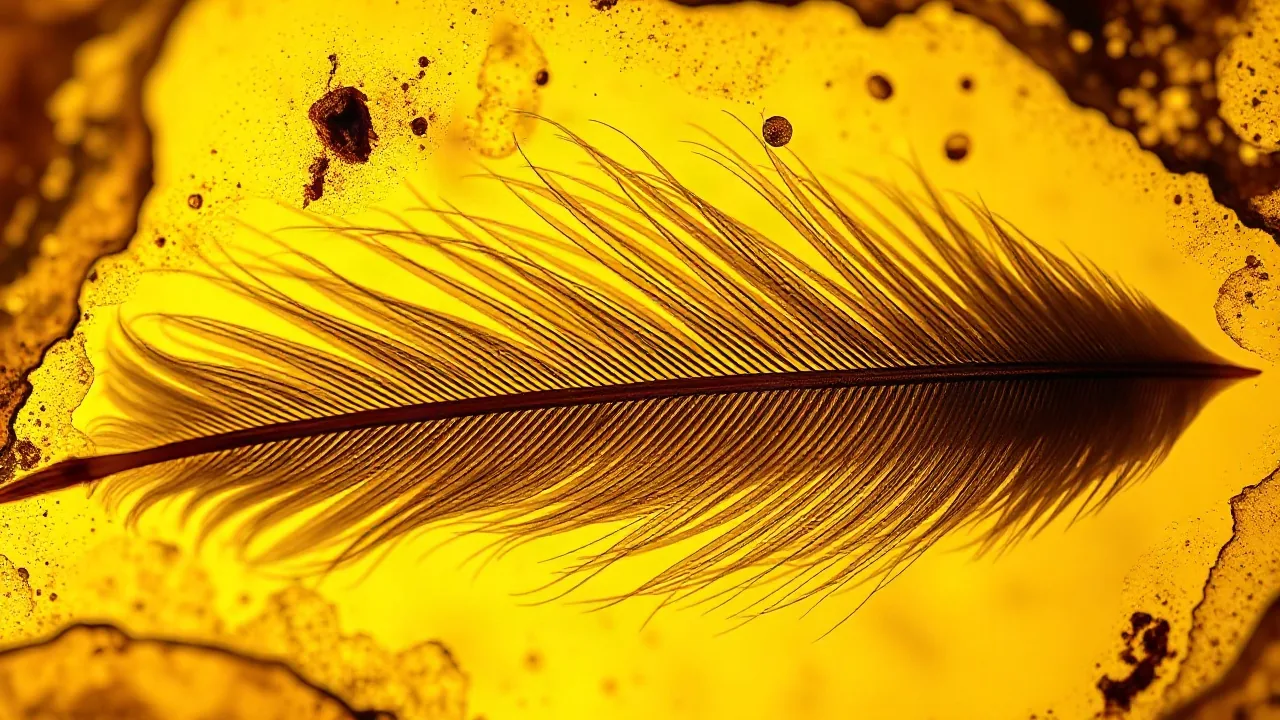
A rare pennaceous feather trapped inside Burmese amber dating back about 99 million years is offering scientists a fresh look at the developmental timeline of avian flight. Encased during the Cenomanian age of the Cretaceous period, the specimen represents the longest three-dimensionally preserved example of its kind documented to date. Catalogued as ECNU A0033, the artifact was originally donated in 2016 to the Biology Museum of East China Normal University by an anonymous amateur collector.
Researchers examined the morphology of the fossilized plumage to understand how ancient theropod dinosaurs and early birds developed aerodynamic traits. “Feathers, the primary integumentary structures of non-avialan dinosaurs and birds, are highly diverse in morphology and function, with form strongly constraining functional performance,” said East China Normal University’s Professor Shuo Wang and colleagues. The team published their findings in the journal Gondwana Research.
The preserved portion of the amber-locked specimen spans approximately 105 mm, with symmetric vanes reaching a maximum width of about 40 mm. Based on overall proportions, researchers estimate that the missing proximal segment accounts for roughly one-quarter of the original length, indicating the complete structure likely exceeded 140 mm. While the external appearance mimics modern flight-related feathers through densely packed barbs and symmetric vanes, closer inspection reveals critical structural departures.
Unraveling Prehistoric Aerodynamics
Microscopic analysis showed that the tiny structures typically connecting neighboring barbs, known as barbules, lack hooklets. This absence prevents the interlocking arrangement found in modern feathers that maintains a continuous aerodynamic surface. Furthermore, the central shaft or rachis features an open underside rather than a fully enclosed, hollow tube, lacking the internal tissue differentiation seen in modern equivalents.
Computer simulations conducted by the team indicated that this open construction made the feather far more flexible under airflow compared to a solid cylinder. Consequently, the findings challenge the assumption that an elaborate, symmetrical feather automatically signals an adaptation for flight. The authors noted that “ECNU A0033 provides direct fossil evidence that pennaceous feather evolution proceeded in a stepwise and modular manner.”
The researchers also investigated preserved pigment-bearing structures called melanosomes. According to the study, “The dark pigmentation of ECNU A0033 is consistent with previous reports of feather coloration in non-avian theropods and early birds, suggesting that dark or otherwise muted hues were widespread among feathered dinosaurs, including early birds.” Because no skeletal remains were preserved alongside the plumage, the exact animal carrying the feather remains unidentified, though researchers point out that its type aligns most closely with non-avialan pennaraptoran theropods.