
Brain-Controlled Hearing Aid Aims to Conquer "Cocktail Party Problem"
Scientists have developed a "brain-controlled hearing aid" system that decodes neural signals to amplify specific voices in noisy environments, potentially revolutionizing assistive listening devices.

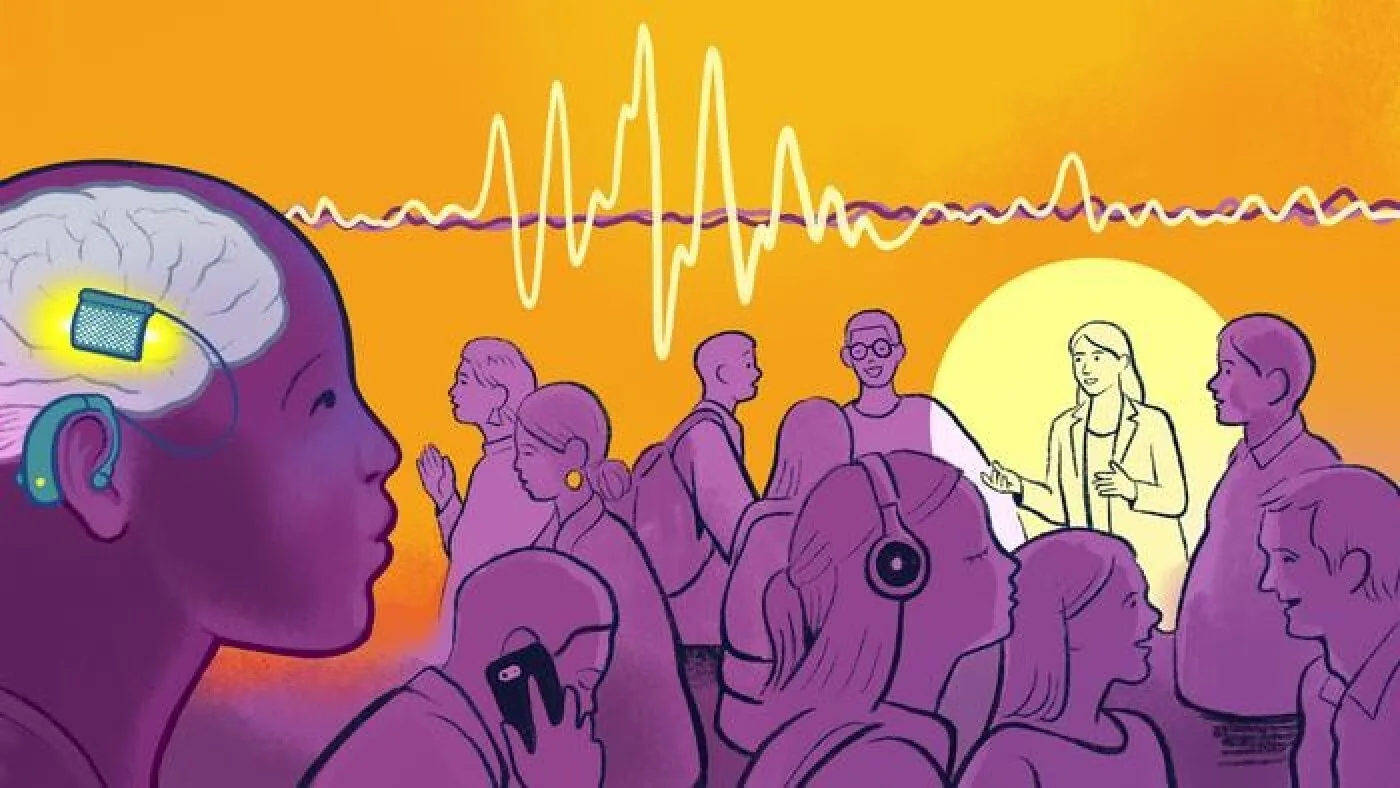
Scientists have developed a groundbreaking system that decodes a person's brain waves to direct hearing devices, effectively offering a "brain-controlled hearing aid." This innovation aims to tackle the persistent "cocktail party problem," where individuals struggle to isolate a single voice amidst background noise. The research, published in the journal Nature Neuroscience, could significantly enhance future hearing technologies, including hearing aids, assistive listening devices, and cochlear implants.
The new approach is rooted in a discovery from 2012 by Nima Mesgarani, an associate professor at Columbia University and head of the school's Neural Acoustic Processing Lab, and Dr. Eddie Chang, a neurosurgeon at the University of California, San Francisco. They identified a specific pattern of brain waves in the auditory cortex, the brain's sound processing center, that tracks the sound a listener is focusing on. "When you look at the brain of a listener at the cocktail party," Mesgarani explained, "what you see is that these brain waves are tracking only the sound that [the listener] is focusing on, and not the other sources." This neural signature allows researchers to identify the desired sound source.
Decoding Brain Waves for Clearer Sound
Building on this discovery, a team led by Vishal Choudhari, formerly a graduate student in Mesgarani's lab and now a research scientist at a startup focused on next-generation hearing technologies, designed an experiment to leverage this neural signal. The study involved four participants undergoing epilepsy treatment who already had electrodes implanted in their brains, allowing for direct monitoring of signals from their auditory cortex. Researchers simulated a "cocktail party" scenario by using two loudspeakers emitting different conversations at the same volume, posing a challenge for participants' comprehension.
The system was then activated, automatically adjusting the volume based on the participants' brain waves. If a participant intended to focus on "conversation one," the system amplified that sound while reducing the volume of other sounds. The results showed the system correctly identified the desired conversation up to 90% of the time. Crucially, when the system was active, participants reported improved comprehension and reduced listening effort. "If the person wants to hear 'conversation one,' we make that louder and we make everything else softer," Mesgarani stated, highlighting the system's direct responsiveness to user intent.
While promising, the technology's effectiveness on individuals with hearing loss remains an open question. Josh McDermott, who directs the Laboratory for Computational Audition at MIT and was not involved in the study, noted that the brain wave signals might be weaker in those with hearing impairments. "Whether the system will work as well for people with hearing loss remains an 'open question,'" McDermott commented. Nevertheless, he acknowledged the significant potential, as even current advanced hearing aids struggle to isolate specific voices from competing sounds, focusing primarily on reducing general background noise rather than selecting between distinct sound sources.
The demand for sophisticated hearing solutions is growing, with over half of individuals aged 75 and older experiencing disabling hearing loss. This brain-controlled approach offers a novel path forward. McDermott suggested that alternative strategies, such as using artificial intelligence to learn user behavior and predict listening targets, could also address the cocktail party problem. However, a system directly harnessing neural activity presents a unique and potentially more intuitive solution for enhancing the auditory experience for millions.