
Transparent material transparency limit revealed by quantum study
US physicists have discovered through a theoretical study that no material can ever be 100 percent transparent due to an unavoidable quantum process.

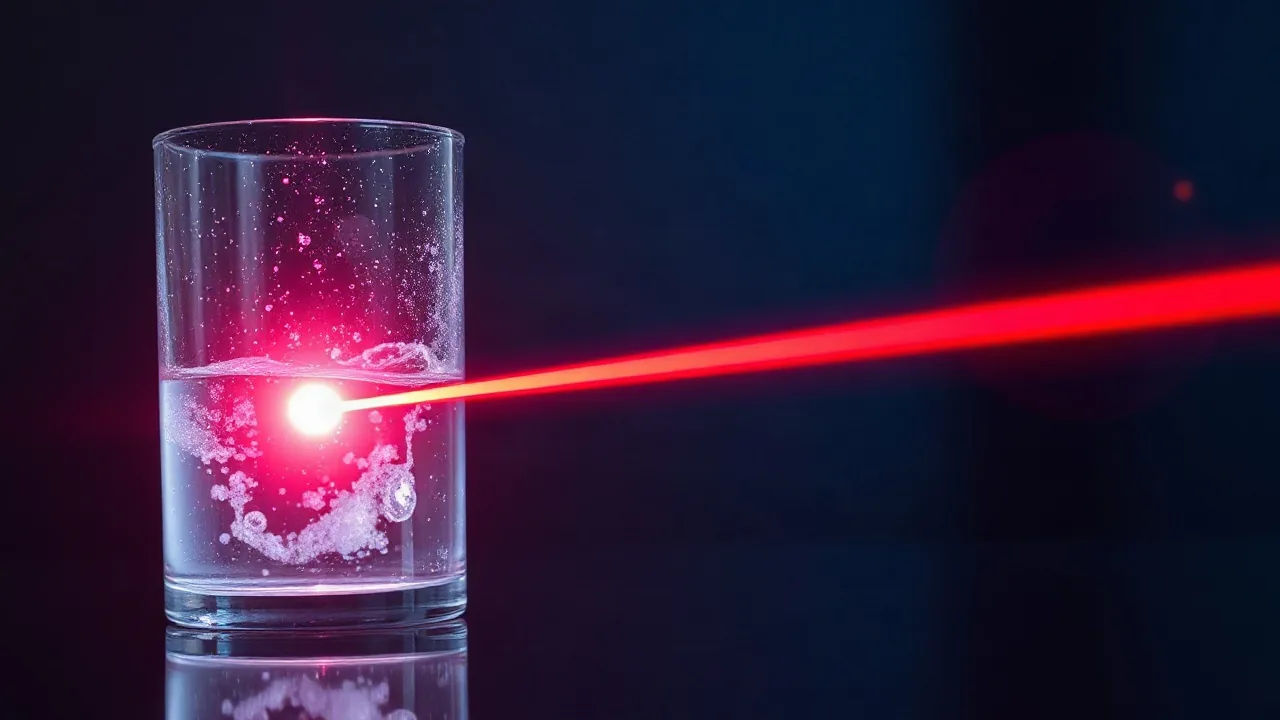
A recent theoretical study reveals that no physical substance can ever achieve complete transparency, according to physicists who analyzed the fundamental rules governing light and matter. While engineers continue developing advanced materials designed to maximize clarity, an unavoidable quantum process ensures that a fraction of light passing through any medium is inevitably lost. The study centers on quantum mechanical interactions where waves of light transform into sound waves, establishing a hard limit set by nature for how clearly any substance can transmit light.
Researchers investigating extreme states of matter previously observed that superfluid helium cooled close to absolute zero displays striking clarity, with visible light passing through without measurable attenuation. Seeking to understand the absolute boundaries of transparency, theoretical physicists Alberto Nicolis and Federico Piazza calculated the theoretical limits for a material completely free of chemical reactions and thermal interference. They were later joined by Angelo Esposito, whose prior research involving dark matter detectors and atomic nuclei contributed to calculating how photons transfer energy.
Quantum Interactions and Light Loss
The calculations demonstrate that as photons travel through a medium, they continuously impart microscopic forces to atomic nuclei, causing energy to bleed into passing sound waves until the light eventually dissipates. Even in an idealized, mathematically perfect superfluid, a light beam would travel a distance equivalent to the diameter of Earth before experiencing noticeable fading, confirming that total transparency is physically impossible. Experts reviewing the findings have highlighted the significance of uncovering such universal constraints.
“I find this work super interesting. In theoretical physics, we look for fundamental limitations set by nature. This paper precisely gives one!” said Borna Salehian, a physicist at the Swiss Federal Institute of Technology Zurich, according to Scientific American. The research team anticipates that these quantum mechanics principles govern the transparency limits across all materials.
Practical applications face similar physical hurdles, as seen in University of Colorado Boulder researcher Ivan Smalyukh holding the Guinness World Record for creating some of the most transparent insulating window gels available. While those substances closely match the refractive index of air, thicker implementations quickly lose clarity. Similarly, fiber-optic communication lines require regular signal amplifiers to counteract gradual attenuation over long distances. The complete theoretical findings were published as a preprint on arXiv.org.