
Green Hydrogen Production Surges With Steel Industry Innovation
Steel manufacturers are adopting breakthrough technologies to produce green hydrogen at scale in 2026, cutting industrial carbon emissions while fueling a clean energy economy.

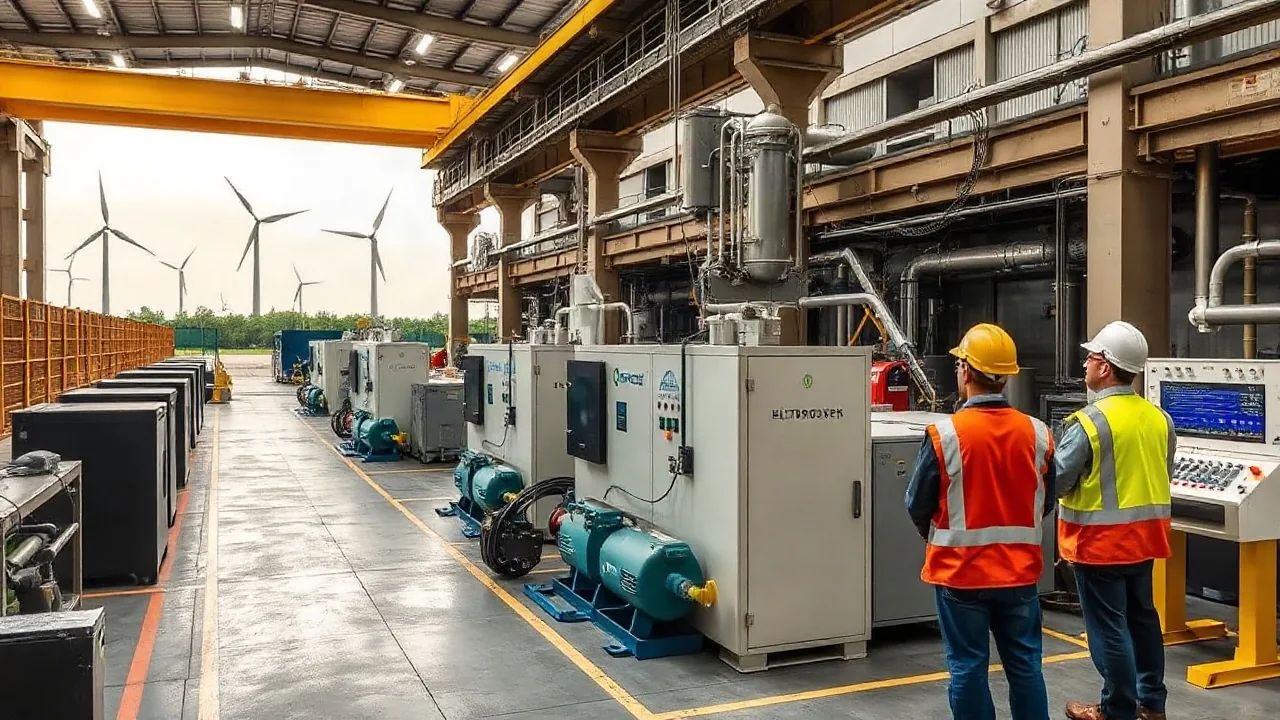
ArcelorMittal announced in July 2026 that its Luxembourg facility would integrate hydrogen-based reduction technology into three blast furnaces by 2028, marking the first major European steelmaker committing to direct green hydrogen replacement in core production. This shift signals an industry-wide pivot toward decarbonization through hydrogen rather than coal, reshaping both green hydrogen production capacity and steel manufacturing economics.
The steel industry consumes roughly 6% of global energy and generates 9% of worldwide carbon dioxide emissions. Traditional blast furnaces rely on coal coke to reduce iron ore. Green hydrogen offers an alternative: when powered by renewable electricity, hydrogen can replace coal in the reduction process, eliminating carbon emissions at the source. "We're not waiting for perfect infrastructure," said Pieter Claes, head of decarbonization at ArcelorMittal, in a September 2026 industry briefing. "Our mills are becoming hydrogen production hubs as much as steel mills."
Germany's ThyssenKrupp reported 48 megawatts of electrolyzer capacity installed across its five largest plants as of August 2026, up from 12 megawatts in 2024. India's Tata Steel began operating a 15-megawatt demonstration unit in Odisha in June 2026, targeting full commercial scaling by 2029. These deployments show that steel industry players are moving from pilot projects to production-scale hydrogen systems.
How Steel Mills Are Becoming Hydrogen Factories
Steel plants themselves generate surplus electricity and steam during production. Integrating on-site electrolyzers allows mills to convert that energy into hydrogen fuel, which can be used immediately in furnaces or exported to regional markets. This dual-use model reduces infrastructure costs and creates new revenue streams.
Major installations follow three primary configurations:
- Alkaline electrolyzers, the most mature technology, operating at 10-50 megawatts per unit with 64-80% electrical efficiency.
- Proton exchange membrane (PEM) systems, offering faster response to variable renewable power and 60-70% efficiency at smaller scales (5-20 megawatts).
- Solid oxide electrolyzers, still in demonstration phase but potentially reaching 90% efficiency by coupling waste heat recovery from furnaces.
Sweden's SSAB and Finland's Outotec jointly launched a 20-megawatt PEM facility in Vasteras in April 2026, specifically designed to support direct reduction iron (DRI) production without coal. The partnership reduced commissioning time to eight months, 40% faster than previous steel-hydrogen projects, by pre-fabricating modular electrolyzer stacks.
Capital costs remain the primary barrier. A 50-megawatt alkaline electrolyzer installation runs 60-80 million dollars, while renewable power contracts in Europe and North America average 40-60 dollars per megawatt-hour. Most mills secure long-term power purchase agreements (PPAs) at fixed rates to ensure hydrogen production economics remain predictable over five to ten year timelines.
Scaling Green Hydrogen Across the Supply Chain
The success of clean energy transitions in steel depends not only on mill-level hydrogen but also on broader market development. Steel demand for hydrogen is projected to reach 45 million metric tons annually by 2035 globally, versus 8 million metric tons produced through zero-carbon methods today. That gap will be filled through a combination of on-site production, regional hydrogen hubs, and cross-border pipeline networks.
The United States announced 3.2 billion dollars in federal grants in March 2026 through the Infrastructure Investment and Jobs Act to support hydrogen hubs in Appalachia, the Midwest, and California. Four projects directly target steel and heavy industry transition. Arcelor's Cleveland mill received 400 million dollars for a 100-megawatt electrolyzer complex paired with a 300-megawatt wind facility, expected operational in late 2027.
Europe's H2Global initiative and the EU Hydrogen Bank created procurement auctions that guarantee fixed hydrogen prices, stabilizing long-term investment returns for steelmakers. Japan's New Energy and Industrial Technology Development Organization (NEDO) announced 180 million dollars in hydrogen infrastructure grants targeting mills in Nippon Steel's portfolio by 2030.
Supply chain integration extends beyond production. Sustainability certification bodies, including ISO Technical Committee 197, developed standards for green hydrogen labeling in September 2026. Steel mills can now market certified "green steel" to automotive, construction, and appliance manufacturers demanding proof of low-carbon sourcing.
Buyers are moving fast. Volvo and BMW committed to purchasing 500,000 metric tons of green steel annually by 2030. Google and Meta signed multi-year procurement agreements with mills producing hydrogen-based DRI. These offtake commitments de-risk steel mills' hydrogen investments and accelerate technology adoption.
Economic and Competitive Implications
The shift toward industrial innovation in hydrogen is reshaping competitive dynamics. Mills with access to cheap renewable power, particularly in Scandinavia, North Africa, and parts of the American South, gain cost advantages. The levelized cost of green steel is projected to fall from 900 dollars per metric ton in 2025 to 650 dollars by 2030 as electrolyzer costs decline and hydrogen production scales.
Chinese steelmakers, which control 55% of global capacity, remain slower to adopt hydrogen. Most rely on coal-dominant grids and lack carbon pricing pressure. However, pilot projects launched by Baowu Steel and Angang Group in 2026 suggest momentum is building, particularly for export-oriented mills facing European carbon border adjustment tariffs beginning 2027.
The hydrogen economy increasingly depends on industrial applications like steel. If steelmakers succeed at achieving cost parity with coal-based production by 2028-2030, hydrogen demand will accelerate across chemicals, refining, and construction. Current forecasts show the global hydrogen market growing at 18% annually through 2035.
The transition is neither complete nor inevitable. Grid capacity, renewable energy availability, and regulatory support remain critical. But the steel industry's move toward green hydrogen production in 2026 demonstrates that decarbonization of heavy industry is moving from laboratory to commercial reality.