
Canon EOS R6 V Camera: Pro Video Features for Mirrorless Users
Canon's new EOS R6 V mirrorless camera targets creators with advanced video capabilities like 7K RAW, active cooling, and robust autofocus. However, the lack of an electronic viewfinder may deter some photographers.

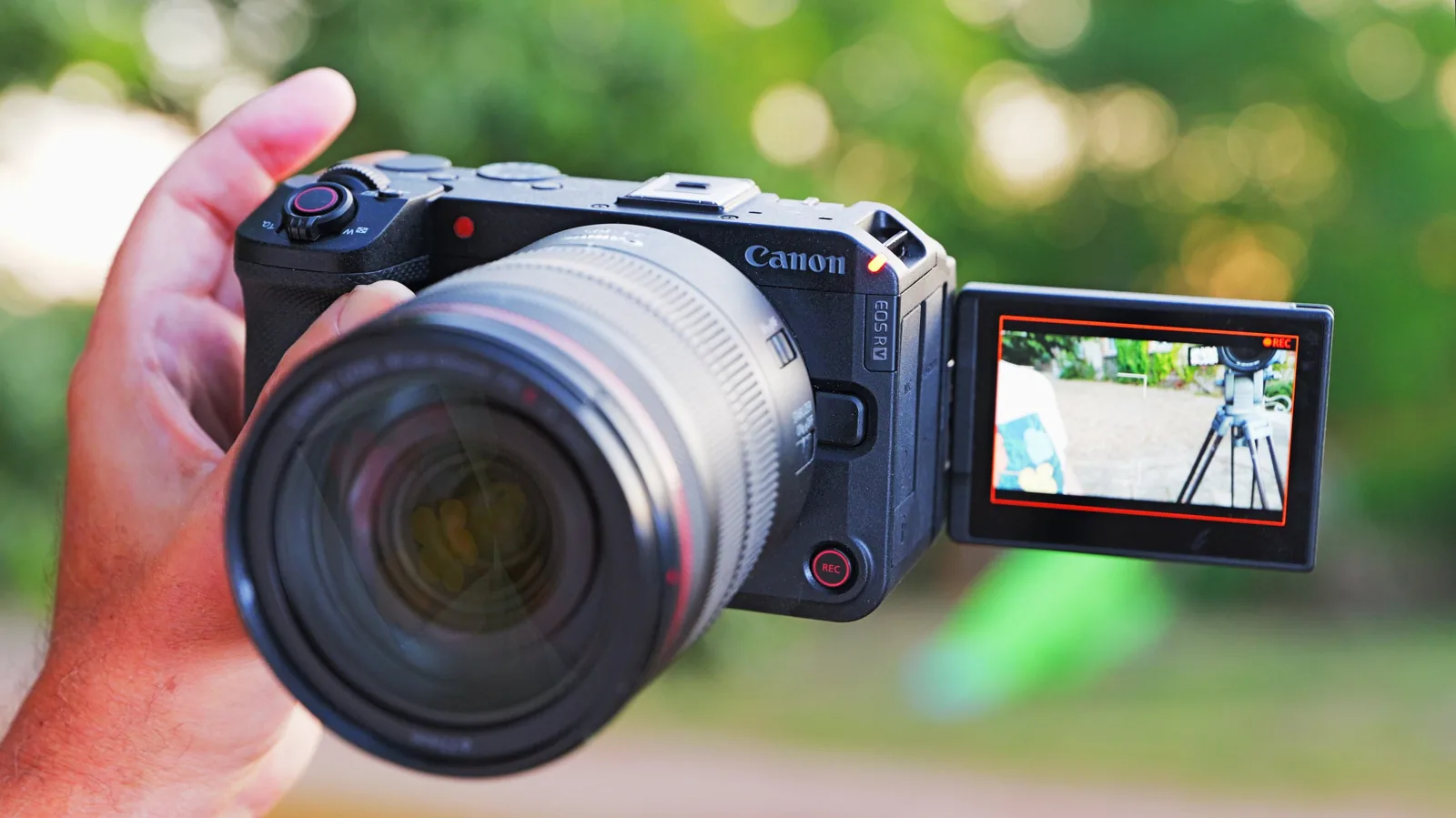
Canon has officially entered the creator-focused vlogging camera market with the unveiling of its new full-frame EOS R6 V. This powerful 33-megapixel mirrorless camera boasts professional-grade video features, including RAW and open-gate recording, designed to compete directly with offerings from Sony. The EOS R6 V sits between Canon's mainstream EOS R6 III and its professional Cinema Line cameras, incorporating the former's stabilization while adding the latter's active cooling system.
Priced at $2,500, the camera offers a compelling package for videographers, though it does come with some notable compromises, chief among them the absence of an electronic viewfinder. During testing in Paris and the French countryside, the EOS R6 V proved impressive for video production, offering a substantial upgrade over previous Canon models in this segment.
The camera's design is noticeably chunkier than the R6 III, a direct result of the integrated active cooling fan and its dust- and water-resistant construction. Despite its increased thickness, the magnesium and polycarbonate body remains relatively light at 688 grams. The EOS R6 V provides a generous array of manual controls, including dual top dials, a joystick, a rear control wheel, and a dedicated photo/video switch, making full manual operation intuitive and minimizing the need to navigate complex menus. Canon's innovative button numbering scheme highlights the seven programmable buttons available.
In contrast, competitors like the Sony ZV-E1 offer a more streamlined control set. The separation of photo and video settings ensures that switching between modes does not alter user-defined preferences, a feature appreciated during dynamic shooting scenarios. While Canon's menu system retains its classic, albeit somewhat clunky, interface compared to Sony's more modern approach, experienced users will find their way.
Advanced Video Capabilities and Performance
The EOS R6 V features a rear three-inch, flip-out display with a resolution of 1.62 million dots, suitable for multi-angle shooting and vlogging. However, its limited brightness can be a challenge in direct sunlight, exacerbated by the lack of an EVF. For professional workflows, the camera supports 7K RAW and C-RAW recording up to 2,600 Mbps. It offers flexible shooting options, including 3:2 open-gate mode (6,960 x 4,640 at 30 fps) and 17:9 (6,960 x 3,672 at up to 60 fps), both supporting RAW or lighter RAW codecs.
Users can also opt for 4K DCI RAW with a 1.5x crop. For those seeking more manageable file sizes, Canon's XF-HEVC S or XF-AVC S 10-bit formats are available in open-gate 3:2 or 4K DCI at up to 120 fps. A dual-card slot setup allows simultaneous recording of RAW files onto a CFexpress Type B card and HD proxies onto an SDXC UHS-II card, enhancing editing efficiency.
The active cooling system is highly effective, preventing overheating even during extended recording sessions in demanding conditions. During testing at 85 degrees Fahrenheit, filming 7K light RAW at 60 fps for over 80 minutes, the camera performed flawlessly until the battery depleted. The Dual Pixel CMOS AF II system delivers excellent video autofocus, comparable to Sony's latest offerings. It accurately tracks subjects like people, animals, and vehicles, with a dedicated mode for close-up product demonstrations, mirroring Sony's popular 'Product Showcase' feature.
Canon's color science is notably strong, producing warm skin tones and accurate colors, particularly evident in challenging lighting conditions where RAW footage allowed for extensive post-production adjustments without compromising image quality. Low-light performance is also commendable, with clean images up to ISO 6,400 and usable results at ISO 12,800.
Stabilization is another strong suit, offering 7.5 stops of shake reduction, enhanced further by digital IS for smooth panning and walking shots. While the 33MP sensor isn't stacked, leading to potential rolling shutter distortion, its fast readout speeds minimize the issue. For hybrid shooters prioritizing stills, the EOS R6 III or other models might be preferable due to the R6 V's lack of an EVF and mechanical shutter. However, the R6 V performs adequately for photography in a pinch, offering 40 fps RAW bursts and pre-shooting capabilities. Its autofocus for photography is also excellent, though Sony's A7 V AF system may offer slightly fewer out-of-focus shots.
While the 33MP sensor delivers sharp images, the dynamic range in stills is not on par with the R6 III, primarily because the R6 V captures 12-bit RAW electronically, unlike the R6 III's 14-bit RAW via mechanical shutter. This results in more noise in shadow areas compared to the A7 V, which offers 14-bit RAW for both electronic and mechanical shutters. Despite this, the RAW mode allows for significant detail recovery in high-contrast scenes, and low-light photos remain clean up to ISO 6,400.