
Ex-Apple, Amazon Engineer Launches AI Chip Firm at 55
A seasoned engineer with decades of experience at tech giants like Apple and Amazon has founded Tranxform AI, a startup aiming to develop power-efficient AI processors for edge computing.

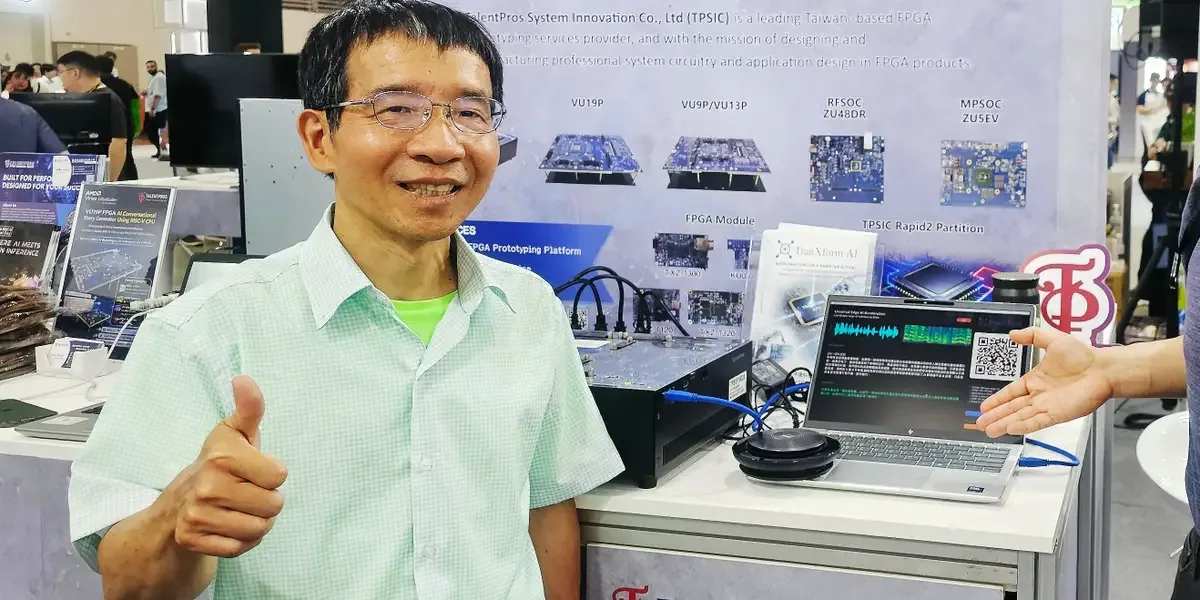
After a distinguished career spanning decades in Silicon Valley's competitive chip design industry, Stephen Huang has embarked on a new entrepreneurial journey, founding Tranxform AI at the age of 55. Huang, who previously contributed to significant projects including MediaTek's GPUs, Apple's Face ID technology, and an Amazon AI chip team, was inspired by the transformative impact of ChatGPT's late 2022 debut. This pivotal moment convinced him the market was ripe for the specialized AI chip company he had long envisioned. Tranxform AI, established in 2024 and based in Taiwan, is focused on creating processors engineered for superior power efficiency, enabling artificial intelligence applications to run effectively outside of traditional large data centers.
The startup, now comprising approximately 40 employees, is actively preparing its inaugural chip, which Huang anticipates will be ready for deployment next year. Huang joins a growing cadre of entrepreneurs capitalizing on the immense opportunities presented by the current artificial intelligence boom. Unlike many founders who build businesses around large language models, Huang brings a wealth of chip design expertise cultivated over decades before launching his own venture. He views his age not as a limitation but as an asset, drawing a parallel to Morris Chang, the founder of Taiwan Semiconductor Manufacturing Company (TSMC), who established the global semiconductor giant at the same age. Huang posits that hardware startups, particularly those in semiconductor design, often place a higher premium on experience, recognizing it as a long-term endeavor requiring nuanced understanding.
The Nuances of Semiconductor Design
Developing a sophisticated system-on-a-chip (SoC) demands an intricate balancing act across numerous hardware and software considerations—a skill set refined over years of practice. "To build a good SoC, you need experience," Huang stated. "Otherwise, you would not know how to balance different operations." His entrepreneurial leap was not without considerable personal risk. Prior to founding Tranxform, Huang enjoyed a stable career and substantial income in the United States. Establishing the company necessitated embracing significant financial and personal risks, including dedicating much of his time to operations in Taiwan, a decision that initially presented challenges for his family. As Tranxform progressed and achieved key developmental milestones, his family’s perspective evolved. "Today, they are proud of what we have accomplished," he shared. Fortuitously, his sons were adults when he launched the company, easing the transition. One son works within the technology sector, while the other had recently completed his university education. "Having them become independent has made it easier for me to dedicate the time and energy needed to build Tranxform," Huang explained.
Huang's conviction that the risk was justified stems from his belief in the escalating demand for specialized AI hardware. As organizations increasingly seek faster and more energy-efficient solutions for running complex AI models, the market for innovative processors is poised for substantial growth. This optimism aligns with current investment trends, as venture capital continues to pour into AI hardware innovation. PitchBook data reveals that venture funding for AI and machine-learning chip startups surged by over 70% in 2025, reaching $16.2 billion from the previous year. However, the number of investment deals saw a slight decrease, falling from 266 to 232, indicating a trend toward larger investments in a more select group of promising companies. As of June 22, 2026, funding for the year totaled $9.9 billion across 87 deals.
While the allure of artificial intelligence propelled Huang toward entrepreneurship, the intense competition for engineering talent in Silicon Valley prompted a strategic reconsideration of his company’s base. His extensive tenure in the region highlighted the formidable challenge startups face in attracting and retaining engineers amidst fierce competition from tech titans like Google, Apple, and Nvidia. "We kept training people, and they got poached," Huang recalled. Consequently, Huang established his company in the prominent Taiwan chip manufacturing hub of Hsinchu, believing it offered a more stable environment for assembling a dedicated engineering team. Among his key hires is Way-Shing Lee, a college acquaintance who joined Tranxform as Chief Technology Officer last year following his retirement from the U.S. chip giant Qualcomm. The startup environment has replaced the predictability of Huang's former career with the demands of fundraising, recruitment, client engagement, and continuous technical problem-solving. "Starting a company is very hard," Huang acknowledged. "You have to find business partners. You have to sell your story. You have to find funding." Tranxform is currently preparing for its subsequent fundraising round, though Huang declined to provide specific details. The company remains in the nascent stages of licensing and currently generates minimal revenue. Nevertheless, Huang remains steadfast in his belief that the most significant opportunities in the AI industry are yet to unfold. "The AI industry is 'probably just getting started'," he asserted.