
First Adult T Rex Footprints Found in North Dakota Preserve
Scientists have discovered the first known series of adult Tyrannosaurus rex footprints in North Dakota's Hell Creek Formation. The 23-foot trackway offers a rare glimpse into the dinosaur's movement.

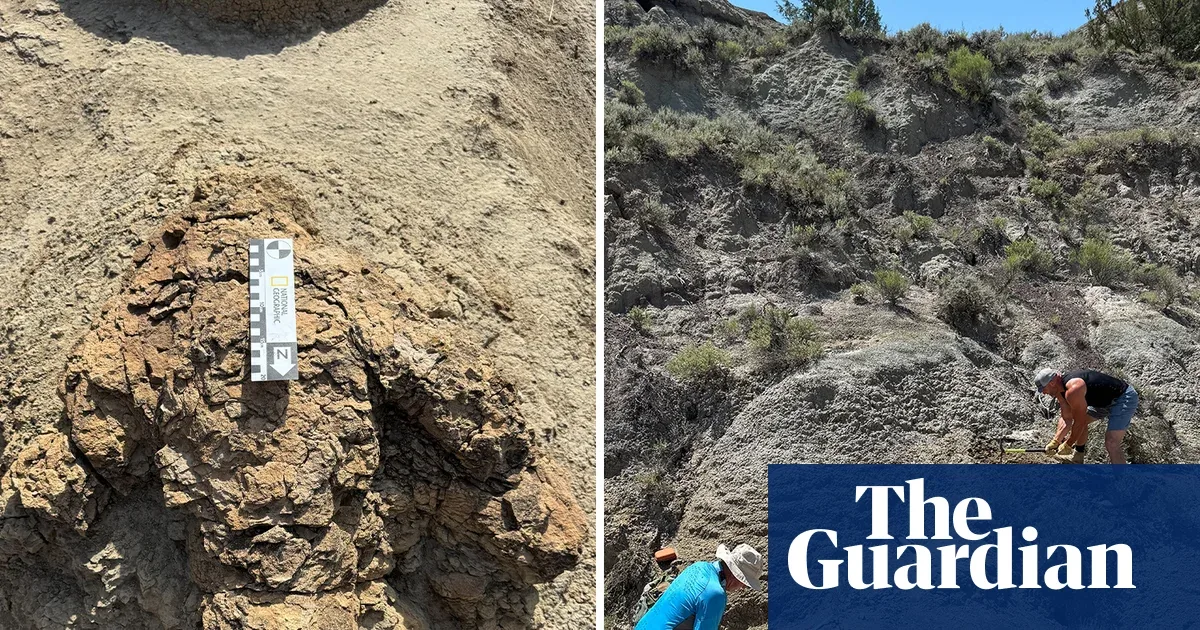
A groundbreaking discovery in North Dakota has yielded the first known series of footprints from an adult Tyrannosaurus rex, offering paleontologists an unprecedented look at the behavior of the iconic predator. The 23-foot-long trackway, comprising four distinct three-toed prints—two left and two right—was identified last year in the famed Hell Creek Formation by researchers from the Denver Museum of Nature and Science and Liverpool John Moores University. These remarkable fossils, dating back approximately 66.5 million years, provide a rare snapshot of a T. rex in motion.
While isolated T. rex footprints and tracks from juveniles or related species have been documented previously, this find marks the first instance of a complete trackway left by a fully grown, wandering Tyrannosaurus rex. "Bones tell us an enormous amount about these animals, but footprints capture a moment of behavior," stated Tyler Lyson, senior curator of vertebrate paleontology at the Denver museum. "With a trackway, we can actually follow an animal as it moved across the landscape. That is incredibly rare for T. rex." The size of the individual prints, each measuring about 3 feet long, combined with a stride of approximately 13 feet, suggests the dinosaur was moving at a pace comparable to a brisk human walk, estimated between 3.5 to 4.5 miles per hour.
A Glimpse into Cretaceous Movement
The T. rex, one of the most recognizable dinosaurs, roamed the Earth during the late Cretaceous period, roughly 66 to 68 million years ago. These formidable creatures, standing an estimated 12 to 13 feet tall, were among the last non-avian dinosaurs to inhabit the planet before the mass extinction event that reshaped life on Earth. The discovery in North Dakota is particularly significant because trackways provide dynamic behavioral data that skeletal remains cannot. The research team employed high-resolution 3D surface scanning to meticulously document each footprint, creating detailed digital and physical reproductions. This advanced methodology allowed for precise measurements and analysis of the dinosaur's gait and estimated speed.
The fossils were found in a region known for its rich dinosaur fossil record, including numerous T. rex bone discoveries. However, capturing evidence of their locomotion has remained elusive until now. The ability to trace the path of this ancient predator offers invaluable insights into its daily activities, such as hunting patterns, territorial range, or migration routes. Understanding how these massive animals moved is crucial for reconstructing their ecological role and their interactions with other species during the final millennia of the age of dinosaurs. This discovery fuels further research into dinosaur biomechanics and the environments they inhabited.
The significance of the find extends beyond its scientific implications. Kent Hups, a Colorado schoolteacher and longtime museum volunteer who co-authored the scientific paper, expressed his astonishment. "As a teacher, I’m always telling my students that science starts with curiosity, passion and careful observation," Hups said. "I never imagined that could lead me to a discovery like this." Three of the discovered footprints are slated for recovery by helicopter later in 2026 and will be transported to the Denver museum for further study and potential public display. This paleontology breakthrough underscores the enduring mysteries of prehistoric life and the thrill of uncovering new evidence about Earth's ancient inhabitants.