
Physicist Explains Ubiquitous Neutrinos, Nobel Prize Work
Neutrinos, elusive subatomic particles, are far more common than previously understood. A leading physicist unpacks the Nobel Prize-winning research that revealed their abundance.

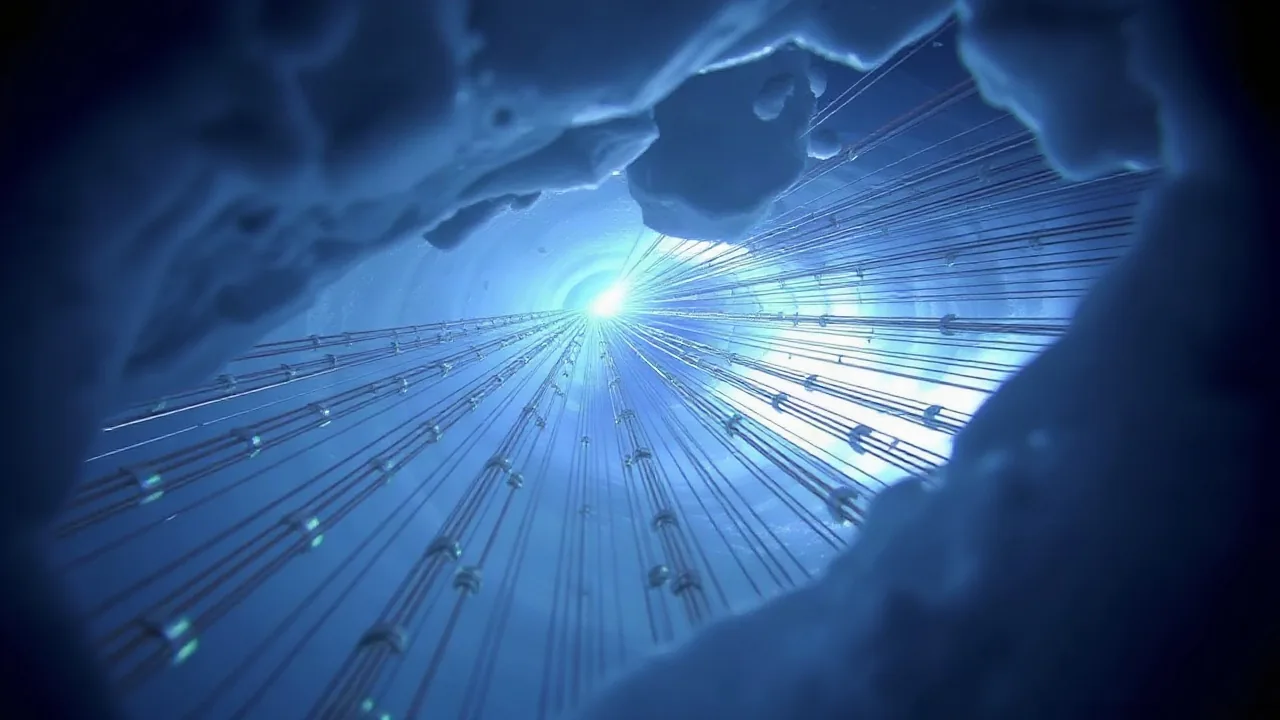
Neutrinos, often called "ghost particles" due to their elusive nature, are far more abundant in the universe than scientists previously believed. This profound realization, stemming from groundbreaking research involving detectors deep within Antarctic ice, has reshaped our understanding of fundamental physics and earned this year's Nobel Prize in Physics. Dr. Francis Halzen, a key figure in the research and a professor at the University of Wisconsin-Madison, explained the significance of these omnipresent particles, which interact so rarely that trillions pass through us every second unnoticed.
The discoveries were made possible by the IceCube Neutrino Observatory, a massive detector situated at the South Pole. This facility, essentially a cubic kilometer of ice embedded with thousands of sensors, is designed to catch the faint blue light (Cherenkov radiation) emitted when a neutrino occasionally interacts with an atom in the ice. For years, scientists like Dr. Halzen and his collaborators have painstakingly analyzed the data from IceCube, searching for high-energy neutrinos originating from cosmic sources far beyond our solar system.
Unraveling Cosmic Mysteries
The Nobel Prize specifically recognized the work that demonstrated neutrinos possess mass, a discovery that challenged the Standard Model of particle physics, which initially posited them as massless. The research at IceCube provided crucial evidence for neutrino oscillations—the process by which neutrinos change from one "flavor" to another as they travel. This oscillation phenomenon can only occur if neutrinos have mass. The ability to detect these high-energy cosmic neutrinos also opened a new window into studying the most energetic phenomena in the universe, such as exploding stars and active galactic nuclei, providing insights previously unobtainable.
Dr. Halzen, in a series of interviews, emphasized that the universe is awash with neutrinos from various sources. "These particles are everywhere, produced by the sun, by cosmic ray interactions in the atmosphere, and by the most violent and energetic processes in the cosmos," he stated. The IceCube experiment has been instrumental in identifying neutrinos from beyond our galaxy, allowing researchers to pinpoint sources of high-energy cosmic rays and study the extreme environments where they are accelerated. This has been a long-sought goal in astrophysics.
The implications of this research extend beyond fundamental physics. Understanding the origin and behavior of neutrinos could have future applications in fields such as medical imaging and materials science, though these are still speculative. For now, the focus remains on refining our understanding of the universe at its most fundamental level. The development and operation of detectors like IceCube Neutrino Observatory represent a triumph of international collaboration and engineering, pushing the boundaries of what is possible in scientific observation.
The journey to this Nobel Prize began decades ago, with theoretical predictions and the persistent pursuit of understanding. The successful operation of Antarctic ice-based detectors has validated these early theories and opened up an entirely new field of astronomy: neutrino astronomy. This field promises to unlock secrets about the universe that have remained hidden, observed only through the faint whispers of these ghost particles.