
August 2026 Sturgeon Moon: Full Moon & Lunar Eclipse Viewing Guide
The August 2026 full moon, known as the Sturgeon Moon, arrives late on August 27th and will be accompanied by a spectacular lunar eclipse visible across the Americas.

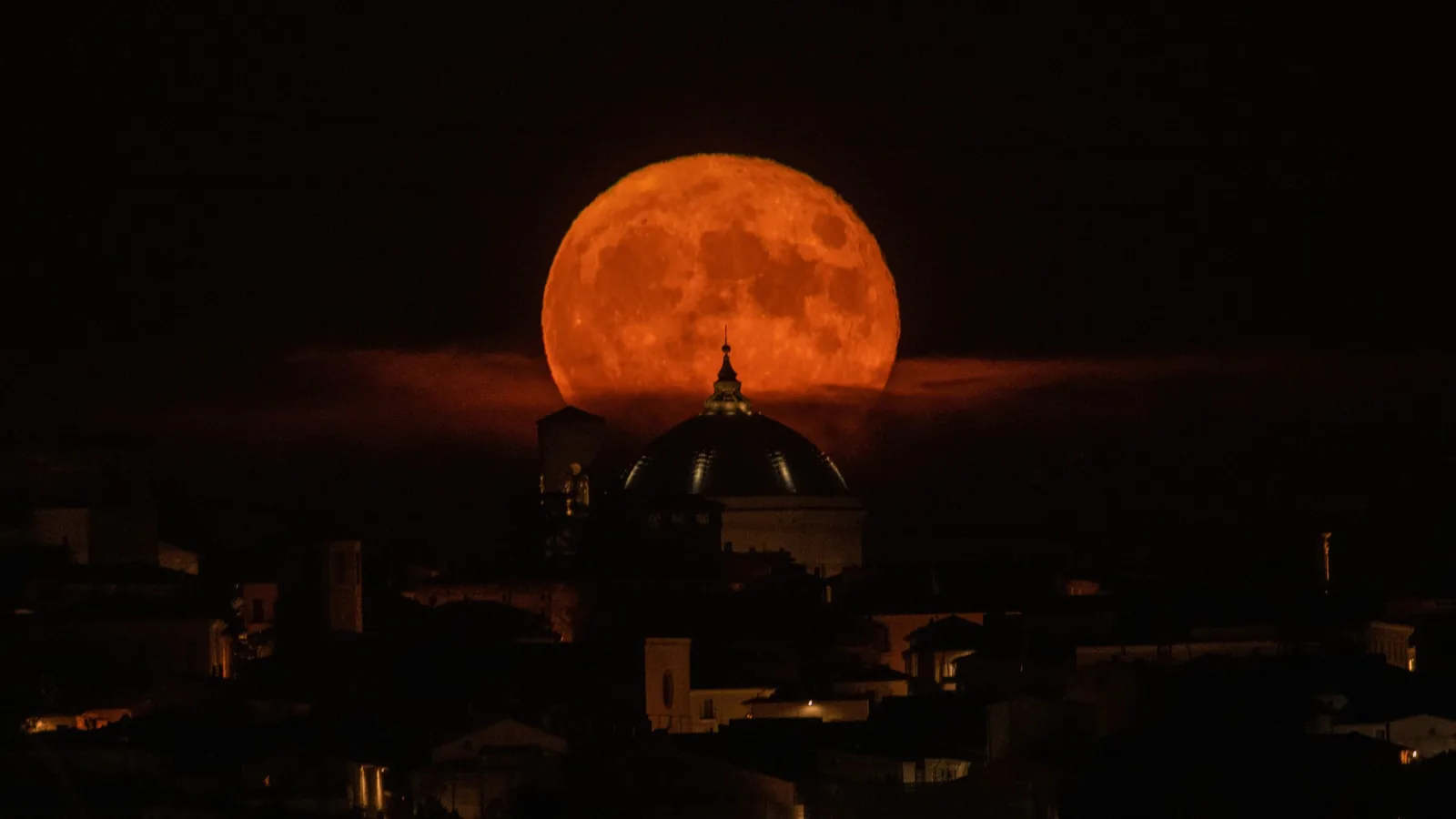
The August 2026 full moon, often called the Sturgeon Moon, is set to illuminate the night sky at 12:18 a.m. on August 28th. This celestial event occurs when the moon reaches its opposition to the sun, appearing directly opposite our star in Earth's sky. Adding to the spectacle, a breathtaking lunar eclipse will unfold late in the month, offering a stunning display visible across North and South America, as well as parts of Africa and Europe. This occurs as Earth passes directly between the sun and moon, casting its shadow upon the lunar disk.
Native American cultures traditionally named this August full moon the Sturgeon Moon, referencing the abundance of large sturgeon fish that were historically easy to catch in the waters of the Great Lakes and Lake Champlain during this time of year. Other indigenous groups referred to it as the Flying Up Moon, symbolizing young birds taking flight, or as the Corn Moon, Harvest Moon, and Ricing Moon, marking various crop gathering seasons. European observers sometimes called it the Lightening Moon, acknowledging the frequent late-summer thunderstorms.
Celestial neighbors and viewing tips
Stargazers in the United States can anticipate the Sturgeon Moon rising above the eastern horizon around sunset on August 27th. In the hour following its ascent, the moon may appear with a distinct yellow-orange hue due to Earth's atmosphere scattering blue light, a phenomenon known as Rayleigh scattering. The widely observed "Moon Illusion" may also make the lunar disk appear larger when close to the horizon, an optical trick of perception.
For those on the West Coast of the U.S., such as in Los Angeles, Earth's shadow will already be subtly darkening the moon by the time it rises. East Coast viewers in cities like New York will witness the eclipse's progression a few hours after sunset. European and African audiences will observe the orbital dance in the early morning hours of August 28th. At the eclipse's peak, approximately 96% of the moon may be engulfed by Earth's inner shadow, bathing it in a deep, blood-red color as filtered sunlight illuminates its surface, with a sliver of bright, silvery light remaining on the outer edge.
Beyond the moon, the night sky will offer other celestial wonders. Look upward to find the prominent Summer Triangle asterism, composed of the bright stars Altair, Deneb, and Vega. Altair and Deneb mark the tails of the great eagle (Aquila) and swan (Cygnus), respectively, while Vega shines brightly in the constellation Lyra. This triangle serves as a navigational aid for both seasoned and novice astronomers. Additionally, Venus will be visible low in the western sky shortly after sunset, and the binary star Spica, the brightest star in Virgo, will be nearby. As the evening progresses, Saturn will rise to the lower left of the moon, its prominent rings now more visible to Earthbound observers following their recent ring plane crossing. Early risers on August 28th can also spot Jupiter and Mars low in the eastern sky before dawn, nestled amongst the stars of Gemini.
This August 28th full moon also coincides with the Hindu festival of Raksha Bandhan, a celebration of the bond between siblings. The event underscores the moon's cultural significance across diverse traditions, connecting different communities through shared celestial observations and ancient customs.